

I have been working on the trends of the Nepalese Foreign Policy as the existing global order gets gradually altered in 21st century world ...
In the annals of Nepal’s democratic journey, few moments have carried the weight of generational hope as profoundly as the March 2026 general elections. The Rastriya Swatantra Party (RSP), led by 35-year-old Balendra Shah — affectionately known as Balen — swept to power on an unprecedented wave of youthful idealism.
Two-thirds of newly registered voters belonged to Generation Z, and 915,119 first-time voters cast their ballots not merely for a party, but for a promise: that the blood spilled during the September 2025 protests, when at least 17 young lives were extinguished by state violence at Maitighar Mandala, and dozons across the country, would not be in vain. These were not ordinary elections; they were a referendum on whether Nepal’s youth could finally wrest control of their destiny from a political establishment they viewed as corrupt, nepotistic, and fundamentally indifferent to their suffering.
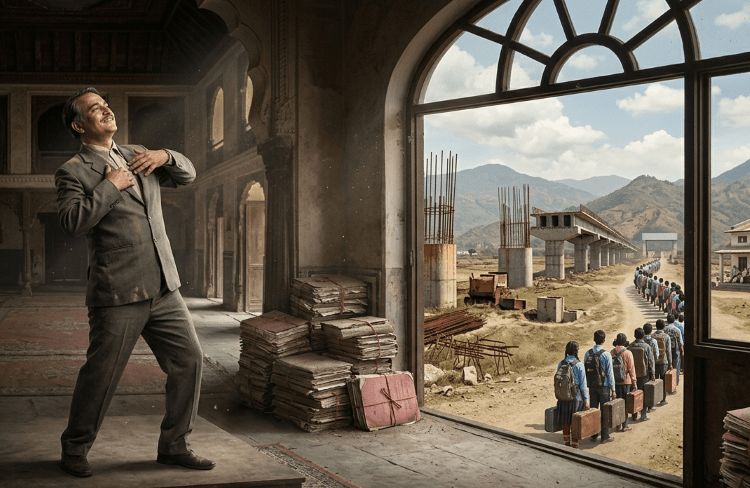
The Gen-Z movement did not merely topple Prime Minister KP Sharma Oli’s government — it redefined the very architecture of political legitimacy in Nepal. And yet, barely three months into the RSP’s tenure, the unveiling of the 2026-27 national budget on May 29, 2026, has exposed the widening chasm between the audacity of campaign promises and the timidity of governance.
The fiscal blueprint presented by Finance Minister Swarnim Wagle allocates a record Rs 2.124 trillion — a staggering 25.2 percent expansion over the previous year — yet the composition of this budget reads like a document drafted by the very establishment it was meant to replace. Recurrent expenditure consumes Rs 1.27 trillion, nearly 60 percent of the total outlay, while capital expenditure — the engine of job creation, infrastructure development, and long-term economic transformation — receives a mere Rs 431 billion, roughly 20 percent. This is not a budget of renewal; it is a budget of maintenance.
For a generation that poured onto the streets demanding structural reform, the prioritization of salaries, subsidies, and administrative costs over productive investment represents nothing less than a continuation of the status quo they so courageously rejected. The budget targets 7 percent economic growth and 6 percent inflation containment, yet these figures appear aspirational rather than anchored in a credible strategy for youth employment, which remains the single most pressing concern of the Gen-Z electorate.
When one examines the financing structure — a deficit of Rs 657 billion to be bridged through Rs 247 billion in foreign loans and Rs 410 billion in domestic borrowing — the specter of debt accumulation without corresponding productive capacity looms large. Nepal’s public debt is already competing with development priorities, and this trajectory risks ensnaring the very youth who voted for change in a fiscal trap they did not create.
Perhaps nowhere is the betrayal more elegantly disguised than in the budget’s tax measures, which have been marketed as revolutionary relief for the middle class. The doubling of the personal income tax exemption threshold to Rs 1 million and the reduction of the top marginal rate by 10 percentage points certainly resonate with urban professionals and salaried employees.
Yet from a developmental economics perspective, these measures reveal a troubling miscalculation. In a country where informal employment dominates and tax compliance remains weak, narrowing the direct tax base at a time of expanding expenditure is fiscally precarious.
The Laffer curve argument — that lower rates will stimulate formalization and ultimately broaden the tax net — is theoretically sound but practically naive in Nepal’s context. Without robust digital tracking, enforcement mechanisms, and a credible path to formalizing the informal economy, these tax cuts risk becoming a revenue hemorrhage that the government will attempt to staunch through indirect taxation or further borrowing — both of which disproportionately burden the poor and the young.
The customs simplification from 11 tiers to 7, the elimination of excise duties on 360 product categories, and the introduction of a consolidated “green levy” are commendable steps toward reducing compliance costs, but they do not address the fundamental question: where are the jobs?
For a generation facing unemployment rates that have driven hundreds of thousands to seek livelihoods abroad — with remittances accounting for 25 percent of GDP — tax relief for the existing middle class is a palliative, not a cure.
The budget allocates Rs 286.48 billion to transport and urban infrastructure — the largest single-sector share — including ambitious projects such as expanding the East-West Highway into a four-lane corridor and completing the Kathmandu-Tarai Fast Track. On the energy front, Rs 85.54 billion is earmarked for adding 1,040 megawatts of generation capacity, alongside a ring-fenced Rs 70 billion for high-voltage transmission corridors.
The unbundling of the Nepal Electricity Authority into separate generation, transmission, and distribution entities, and the permission for private enterprises to export electricity internationally, represent genuine structural reforms. Yet herein lies the paradox: Nepal has a documented history of allocating substantial budgets for capital expenditure while failing to spend them.
Over the past decade, actual capital spending has averaged only 64.1 percent of allocated amounts, with delays in project implementation, bureaucratic hurdles, and poor prioritization eroding the very multiplier effects that infrastructure investment is supposed to generate.
Economist Dilli Raj Khanal has noted that Nepal’s capital stock is actually declining, indicating a shrinkage in the economy’s productive capacity. For Gen-Z voters who were promised not just projects but outcomes, the gap between budgetary allocation and on-ground execution is not an abstract economic concern — it is the difference between staying in Nepal and leaving it.
When public investment declines, private sector confidence falters, and the cycle of low growth, low employment, and high emigration perpetuates itself. The budget’s infrastructure promises, however well-intentioned, do not break this cycle; they merely extend it.
Among the budget’s more headline-grabbing provisions is the establishment of Nepal’s first “Sovereign AI Computing Center” in Kathmandu, utilizing domestic hydropower to provide concessional GPU access for tech startups, alongside fellowships for 15 internationally recognized Nepali AI researchers and a 50 percent income tax exemption for IT service companies exporting digital products.
These measures signal an awareness that Nepal’s future lies in the knowledge economy, not merely in remittance-dependent consumption. Yet the irony is inescapable: the same government that has criminalized dissent, bulldozed the homes of 15,000 landless squatters without adequate rehabilitation, and ruled through ordinances bypassing Parliament — the very democratic institution that Gen-Z fought to strengthen — now speaks of building a digital utopia.
The cognitive dissonance is staggering. How can a government that evades parliamentary accountability, whose Prime Minister has neither addressed the nation nor held a press conference since taking office, credibly claim to be fostering an innovation ecosystem?
Tech ecosystems thrive on trust, transparency, and the rule of law — qualities that this administration has systematically undermined. The AI center and IT tax exemptions are not meaningless, but they are insufficient. They address the supply side of the digital economy without addressing the demand side: the hundreds of thousands of young Nepalis who lack basic digital literacy, reliable electricity, or access to quality education.
The budget’s technology provisions are a veneer of modernity over a governance structure that remains fundamentally opaque and unaccountable.
The most devastating aspect of the RSP government’s trajectory is not any single budgetary allocation, but the systemic erosion of the democratic values that Gen-Z fought and died for.
The government has prorogued Parliament to push through eight ordinances, including measures to dissolve civil service trade unions and student organizations. The President returned the Constitutional Council ordinance for reconsideration, noting that it failed to internalize the spirit of the constitution — yet the government resubmitted it unchanged.
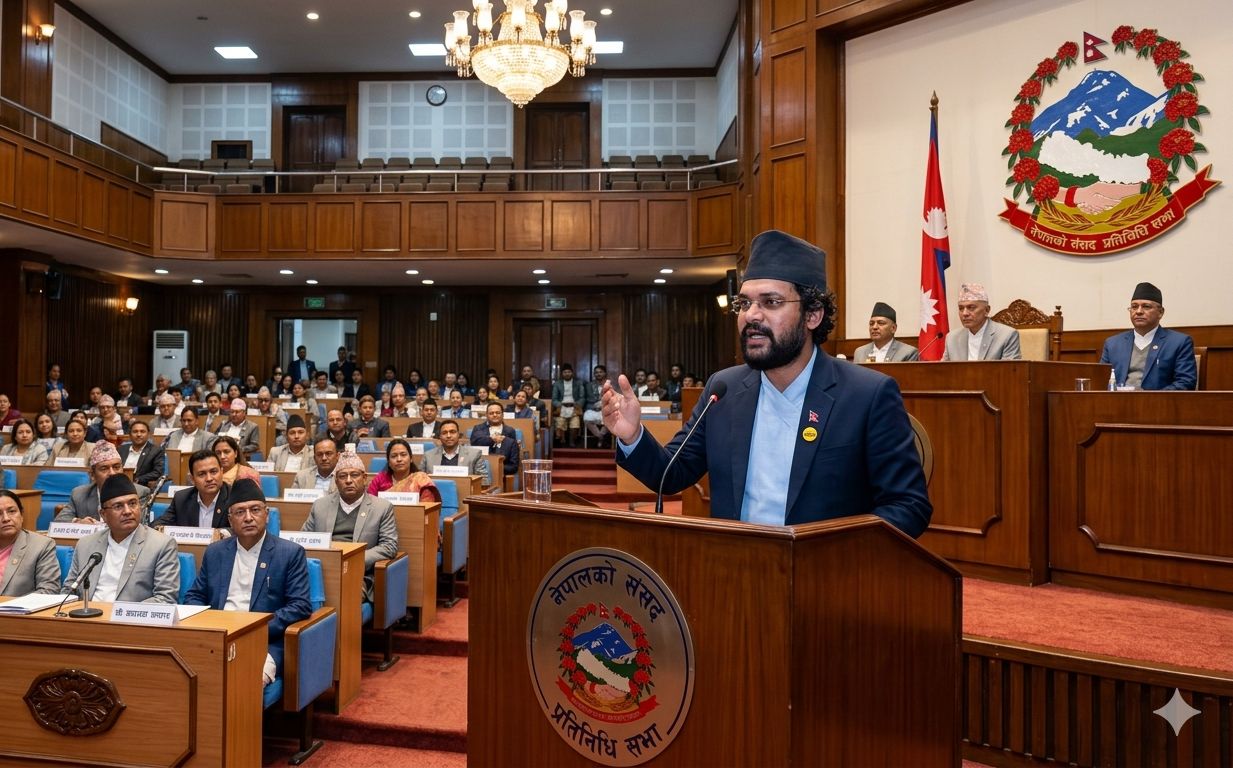
Prime Minister Shah has not addressed Parliament since taking office, walked out midway during the President’s address on government policies, and has been conspicuously absent from his own party’s parliamentary meetings. His cabinet saw two ministerial exits within 30 days — one over nepotism allegations, the other over links to a businessman under investigation.
The very #NepoBaby movement that galvanized youth against the entrenched political families now finds itself governed by a regime that, while not dynastic in the traditional sense, is increasingly authoritarian in its methods. Gen-Z activist Rakshya Bam, who risked her safety during the protests, has publicly stated that the government is “turning away from the people’s issues” and “trying to walk the same wrong path against whose anomalies we revolted.”
When the revolution’s own foot soldiers begin to question its leadership, the moral foundation of the government crumbles — and no amount of budgetary expansion can rebuild it.
The budget does contain provisions for the families of those who died during the Gen-Z protests — financial assistance for martyrs’ families, free treatment and monthly allowances for the injured.
These are not insignificant gestures, and Gen-Z leaders have welcomed them while stressing the need for urgent implementation. Yet there is something profoundly hollow about a government that compensates for lives lost while perpetuating the very conditions that made those lives expendable.
The 17 young people who died on September 8, 2025, were not protesting for compensation; they were protesting for a Nepal where young people would not have to choose between dignity and survival, where merit would triumph over nepotism, and where the state would be accountable to its citizens rather than the other way around.
The budget’s social protection allocations — Rs 120 billion, including doubled child nutrition stipends for vulnerable Dalit families — are commendable but insufficiently transformative. They represent incremental welfare in a country that requires structural transformation.
The 10 percent salary increase for civil servants, military, police, and teachers, alongside a new performance allowance, raises total take-home pay by roughly 21 percent — a generous provision for the state apparatus, but one that does little for the vast majority of Gen-Z Nepalis who are not employed by the government.
The budget, in essence, rewards the existing state structure while offering only symbolic gestures to those who sought to reform it.
The government’s decision to voluntarily delay Nepal’s graduation from Least Developed Country (LDC) status by two years is, from a purely pragmatic standpoint, defensible. It preserves critical international trade preferences and export quotas at a time of economic vulnerability.
Yet for a generation that was promised a “New Nepal” — a nation that would stand tall among its peers, unencumbered by the legacies of underdevelopment — this delay is symbolic of a larger retreat from ambition. The LDC graduation delay is not merely a technical adjustment; it is an admission that Nepal is not yet ready to compete in the global economy on equal terms.
For Gen-Z voters who believed that electing a young, dynamic leader would accelerate Nepal’s development trajectory, this admission is disheartening. It suggests that the RSP government, despite its revolutionary rhetoric, is ultimately constrained by the same fiscal and structural realities that bedeviled its predecessors.
The budget’s reliance on foreign borrowing — Rs 247 billion in external loans — further underscores this dependency. Nepal’s external debt servicing already competes with development priorities, and fresh inflows heighten exposure to currency fluctuations and global interest rate shifts.
The parallels with Sri Lanka’s pre-2022 fiscal expansion, financed through external commercial borrowing and domestic monetization, are not exact but are sufficiently instructive to warrant concern.
A generation that dreamed of sovereignty is finding itself more indebted, more dependent, and more vulnerable than before.
Finally, the 2026-27 national budget of the Balen-led government is not a document of betrayal in the crude sense of deliberate malice. It is something more insidious: a document of incrementalism masquerading as transformation, of continuity disguised as change, of a political class that has learned to speak the language of revolution while governing in the grammar of the status quo.
The Gen-Z movement was unprecedented not merely in its scale but in its moral clarity. It was a movement against corruption, nepotism, unemployment, and political stagnation — and for accountability, transparency, and structural reform.
The RSP government, riding on this wave, had an opportunity to craft a budget that would have been remembered as a turning point: one that prioritized productive investment over recurrent consumption, youth employment over bureaucratic comfort, and democratic accountability over executive convenience. Instead, it has produced a budget that, while ambitious in size, is timid in vision.
The youth of Nepal did not sacrifice their blood and dreams so that a new set of leaders could replicate the patterns of the old. They did not march to Maitighar Mandala, face police bullets, and bury their friends so that a Prime Minister could govern through Facebook posts and ordinances.
The budget is not merely an economic instrument; it is a moral statement about who matters in a society. And in this budget, the Generation Z that placed its faith in Balen and the RSP finds itself, once again, on the margins — remembered in token gestures, but absent in substance. The dream has not been destroyed; it has been deferred.
And as the poet wrote, a dream deferred does not simply fade — it festers, it sags, it explodes. The Balen government would do well to remember that the same energy that brought it to power can, and will, turn against it if the covenant with Nepal’s youth remains unfulfilled.
The blood of the martyrs demands not compensation, but transformation. And transformation, like democracy, cannot be ordained — it must be earned, every single day, through accountability, through inclusion, and through the unwavering courage to choose the path not taken.
I have been working on the trends of the Nepalese Foreign Policy as the existing global order gets gradually altered in 21st century world ..
I have been working on the trends of the Nepalese Foreign Policy as the existing global order gets gradually altered in 21st century world. I am an MA in English and MPhil in International Relations a...
@ Copyright matrikapoudyal.com All Rights Reserved
Designed by Fortune Info Tech