


I have been working on the trends of the Nepalese Foreign Policy as the existing global order gets gradually altered in 21st century world ...
Nepal stands at one of the most sensitive geostrategic crossroads in Asia. Sandwiched between two rising giants, India and China, and watched closely by Western powers, the Himalayan republic has survived for centuries by preserving its territorial integrity through careful diplomacy and historical wisdom.
Today, however, this delicate balance faces a serious test. The recent statements by Prime Minister Balendra Shah in Parliament have exposed a worrying gap between the gravity of Nepal’s geopolitical reality and the maturity of its current leadership. A landlocked nation with asymmetric power relations on every side cannot afford the luxury of impulsive diplomacy.
The ancestors of modern Nepal understood this truth better than most. Through the Sugauli Treaty of 1816 and subsequent diplomatic engagements, they managed to retain the core of Nepal’s sovereignty even after facing the military might of the British East India Company.
The territorial claims over Limpiyadhura, Lipulekh, and Kalapani were later reinforced by Nepal’s own constitutional and cartographic assertions in 2020, when the previous government amended the national emblem to include these areas. These were not acts of aggression but measured steps to protect inherited rights.
For decades, Nepali leaders from across the political spectrum have defended this position with a united voice, knowing that any crack in that consensus would weaken the republic’s bargaining power.
The power asymmetry Nepal faces is stark and multidimensional. India, with its overwhelming economic, military, and cultural influence, remains Nepal’s largest trading partner and the gateway to the sea.
China, with its growing investments and strategic interests in Tibet, offers an alternative but comes with its own expectations. Western powers, including the United Kingdom and the United States, maintain historical interests and development partnerships that shape Nepal’s international standing.
None of these actors treats Nepal as an equal in raw power terms. Yet Nepal has survived not by matching their strength but by leveraging its strategic location and maintaining a non-aligned, balanced foreign policy that keeps all sides engaged without surrendering to any.
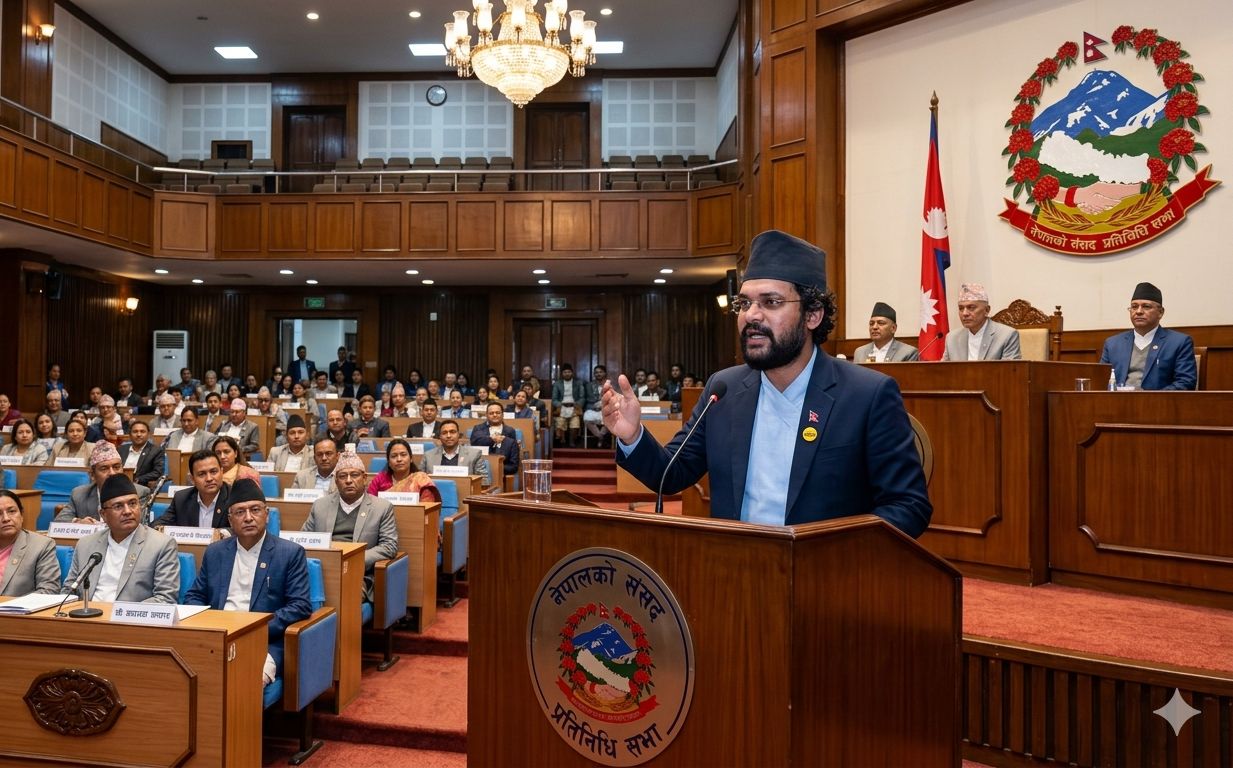
It is against this backdrop that Prime Minister Shah’s remarks in Parliament on May 31, 2026, must be judged. While responding to questions about the Kalapani dispute, he stated that Nepal too has encroached upon Indian territories in multiple places, adding that he learned this only after becoming Prime Minister.
This statement, unprecedented from a Nepali head of government, triggered an immediate uproar in the House.
Opposition lawmakers from the Nepali Congress and the Nepal Communist Party demanded clarification and expunction of the remarks from parliamentary records, warning that such words could damage national integrity.
The Prime Minister’s attempt to appear balanced by suggesting mutual fault revealed a fundamental misunderstanding of how sovereignty is defended in international relations.
The damage control that followed only confirmed the seriousness of the misstep. The Ministry of Foreign Affairs was forced to issue a clarification late that same day, explaining that the Prime Minister’s words referred only to technical issues of cross-border occupation in the Dasgaja area and river-border demarcation, where citizens of one country may cultivate land that technically falls on the other side.
Border experts have since noted that the claim of Nepali encroachment into India is not supported by historical facts or treaty records. A leader’s off-the-cuff remark should not require an entire ministry to reinterpret it within hours. This episode illustrates the difference between the careful language of statecraft and the casual tone of political rhetoric.
What makes this approach particularly puerile is the context in which it was delivered. The Lipulekh, Limpiyadhura, and Kalapani dispute is not a domestic debating point; it is a live international issue involving India and China, with the United Kingdom holding historical responsibility as the successor to British India.
Prime Minister Shah’s suggestion that the UK should be involved because the dispute dates back to the colonial era, while imaginative, ignores the reality that Nepal must first consolidate its own position before inviting external actors. Diplomatic notes have been sent to India and China, and the response from New Delhi proposes expert-level talks.
This is precisely the moment when Nepal needs a unified, firm, and historically grounded position, not a leader who publicly doubts his own country’s claims.
The Prime Minister’s broader diplomatic conduct raises similar concerns. Since taking office in March 2026, he has adopted an assertive posture toward foreign officials, refusing meetings with India’s Foreign Secretary Vikram Misri and with senior American diplomats below the rank of Foreign Minister.
While protocol matters, diplomacy in a small state requires flexibility and tactical wisdom, not rigid posturing that isolates the country from its most important partners. Assertiveness without strategic depth is merely vanity. Nepal cannot resolve its border disputes, secure its trade routes, or protect its sovereignty by alienating the very governments it needs to negotiate with.
A rational and cohesive boundary diplomacy would begin with internal consensus. The Prime Minister should consult border experts, historians, and the full spectrum of political parties to forge a unified national position before speaking in Parliament.
He should treat the 1816 Sugauli Treaty, the 2020 constitutional map, and subsequent diplomatic correspondence as sacred tools of statecraft, not as optional talking points. Engagement with India and China should be continuous, professional, and based on documented historical claims rather than improvised observations. The goal is not to win headlines but to secure territory.
Nepal’s sovereignty has survived because past leaders understood that geostrategic vulnerability demands geostrategic patience. The current Prime Minister would do well to study that legacy.
Territorial integrity is not defended by rhetorical equivalence or diplomatic theater; it is defended by clarity, preparation, and the quiet courage to stand by one’s own historical truth. Nepal deserves leadership that matches the gravity of its geography.
I have been working on the trends of the Nepalese Foreign Policy as the existing global order gets gradually altered in 21st century world ..
I have been working on the trends of the Nepalese Foreign Policy as the existing global order gets gradually altered in 21st century world. I am an MA in English and MPhil in International Relations a...
@ Copyright matrikapoudyal.com All Rights Reserved
Designed by Fortune Info Tech