

I have been working on the trends of the Nepalese Foreign Policy as the existing global order gets gradually altered in 21st century world ...
Civility costs nothing, yet it buys the peace of nations. A gentle word at the doorway, a patient ear at the table, a respectful nod in the street—these small acts are the bricks of a decent society.
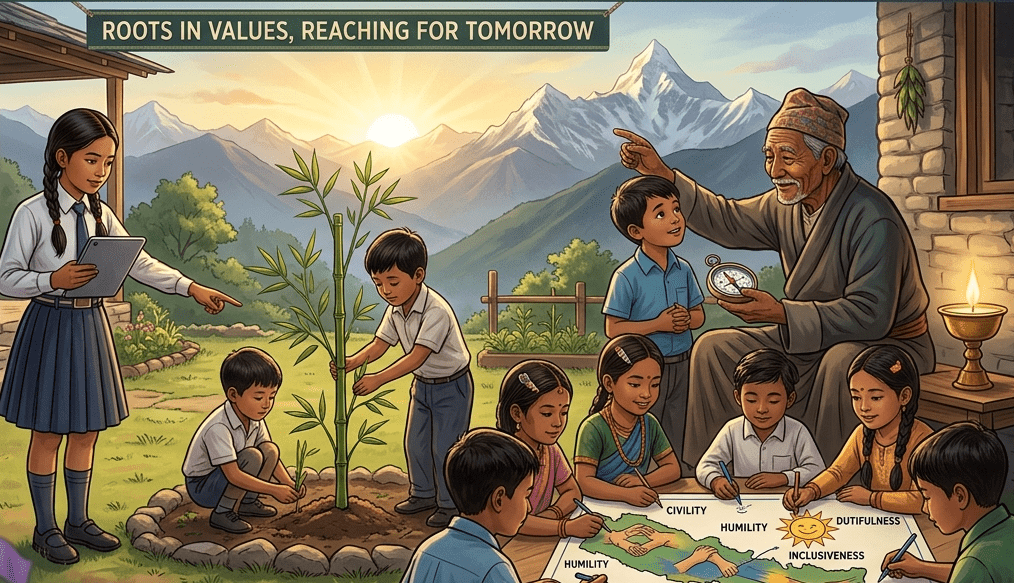
The dawn breaks over the Himalayas, and with it rises a generation born of bytes and bandwidth. Nepal’s Gen Z and Gen Alpha stand at the threshold of tomorrow, bright-eyed, swift-fingered, and globally connected.
Yet brightness alone does not warm a home, and speed alone does not steady a nation. There is an urgency in the air—a quiet alarm—that calls for a new apolitical pedagogy, one that plants enduring values in young hearts before the winds of time scatter them beyond reach.
We stand at a crossroads where screens often speak louder than elders, and where opinions travel faster than wisdom. It is not the fault of youth that they inherit a world of noise; it is our collective duty to offer them a compass.
Without guidance, the finest minds may drift, and the strongest hands may forget how to build. The question before us is not whether our children are capable, but whether we are courageous enough to teach them what truly matters.
Education must be a sanctuary of principles, not a battlefield of politics. An apolitical pedagogy does not mean silence on truth; it means clarity above conflict, unity above division.
When classrooms become mirrors of partisan strife, young souls learn to argue before they learn to understand. Let the school be a garden where ideas grow in sunlight, not under the shadow of flags. Let us teach our children to think, not merely to take sides.
Civility costs nothing, yet it buys the peace of nations. A gentle word at the doorway, a patient ear at the table, a respectful nod in the street—these small acts are the bricks of a decent society.
Decency is not old-fashioned; it is timeless. When we teach our youth that character is their truest currency, we prepare them not just for careers, but for life itself. For what is success without the grace to share it?
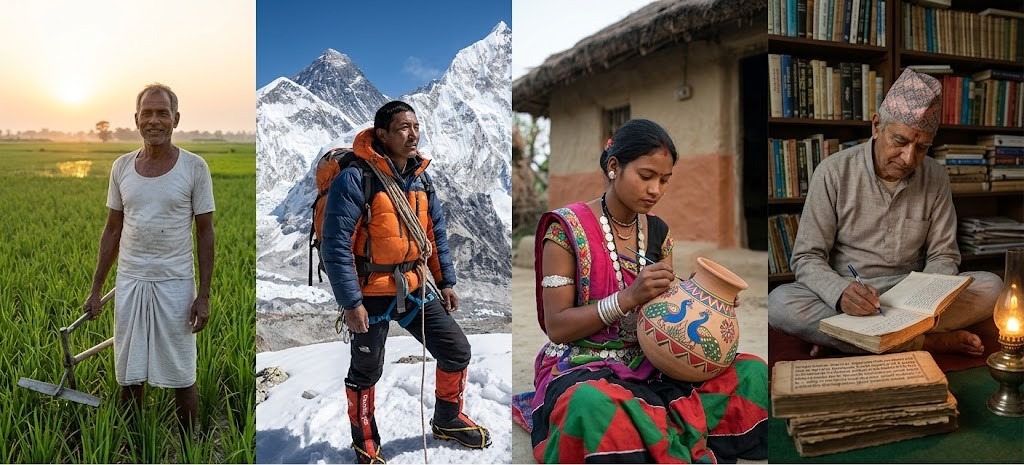
Gratefulness turns what we have into enough, and humility reminds us that the mountain is greater than the climber. In the valleys of Nepal, where generations have tilled the soil with prayer and perseverance, there lies a lesson too precious to lose.
Let our children know that every comfort carries a debt to those who came before. Let them learn that the tallest bamboo bends in the wind, and that strength without humility is merely pride waiting to fall.
Inclusiveness is not a gift we give to others; it is a wisdom we gain for ourselves. Nepal is a mosaic of languages, faiths, and faces—a living proof that beauty thrives in difference. To be accommodative is not to surrender one’s truth, but to make room for another’s.
When a Newar smile meets a Tharu greeting, when a mountain song joins a Terai rhythm, the nation breathes as one. Let our pedagogy teach that bridges are stronger than walls.
Dutifulness is the quiet engine of every great civilization. Duty to parents is not bondage; it is the repayment of a love that asked for no receipt. Duty to the nation is not burden; it is the honor of inheriting a legacy.
Let our youth understand that rights shine brightest when responsibilities stand beside them. A generation that knows its duties does not ask what the country can give, but what it can grow.
To forget one’s past is to walk forward with eyes closed. The geography of Nepal is not merely lines on a map; it is the pulse of the earth beneath our feet. Its history is not dates in a book; it is the breath of ancestors in our rituals.
The civilizations that flourished here were built on reverence—for elders, for soil, for sacred memory. Let Gen Z and Gen Alpha learn that respect for seniors is not obedience to age, but recognition of the road already traveled.
The best time to plant a tree was twenty years ago; the second-best time is now. We cannot delay this calling. A new apolitical pedagogy is not a dream for tomorrow—it is a necessity for today.
Let every classroom become a temple of values, every lesson a step toward nobility, and every child a guardian of Nepal’s soul.
The Himalayas have stood because their roots run deep. So too will our nation stand, when our youth stand rooted in civility, humility, and an unshakable love for all that Nepal is, was, and shall forever be.
I have been working on the trends of the Nepalese Foreign Policy as the existing global order gets gradually altered in 21st century world ..
I have been working on the trends of the Nepalese Foreign Policy as the existing global order gets gradually altered in 21st century world. I am an MA in English and MPhil in International Relations a...
@ Copyright matrikapoudyal.com All Rights Reserved
Designed by Fortune Info Tech