

I have been working on the trends of the Nepalese Foreign Policy as the existing global order gets gradually altered in 21st century world ...
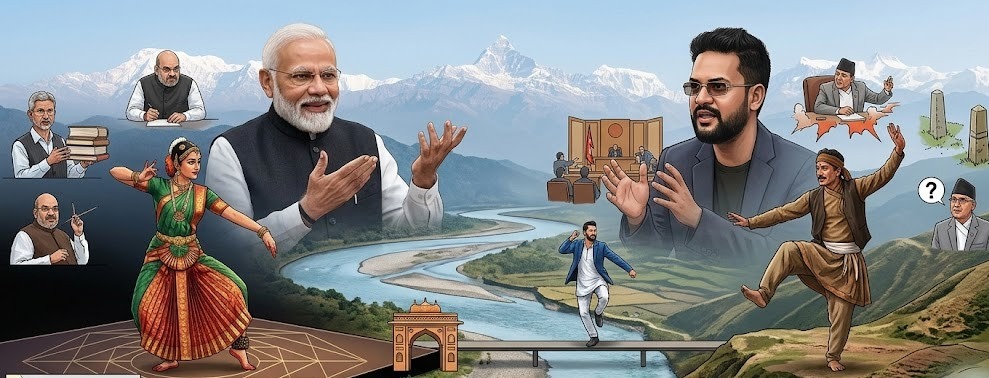
India and Nepal are bound in a dance of necessity. But too often it feels like Bharatnatyam on one side and Maruni on the other. One is graceful, ceremonial, and heavy with old steps. The other is earthy, improvisational, and stubbornly its own. They share a stage, but the tempo is unequal. The rhythm is off. And the political mistrust sits in the wings like a prop no one knows how to remove.
Diplomacy towards neighboring countries has an odd kind of geometry to it. Not just a border, they share. You share a history woven from rivers with shifting beds. They have treaties made in the dusk years of empires. They detail the everyday passages of common people: those who cross with vegetables, prayers and complaints over an invisible line.
India has, for decades, danced a diplomatic Bharatnatyam — the classical vocabulary of South Asian statecraft. It is precise. It is codified. Generations of meaning are stored in every gesture. Eyes are very communication while the lips keep quiet.
The footwork maps out territory with mathematical certainty. Nepal, in this same theatre, has lately begun to dance a different step. It is something closer to the Maruni. This is a folk tradition born in the hills. It is improvisational.
It is earthy. It is sometimes levitous. Yet it is capable of sudden, startling gravity. The recent choreography between these two nations reveals both the beauty and the peril of this difficult complicity. It played out across the early days of June 2026.
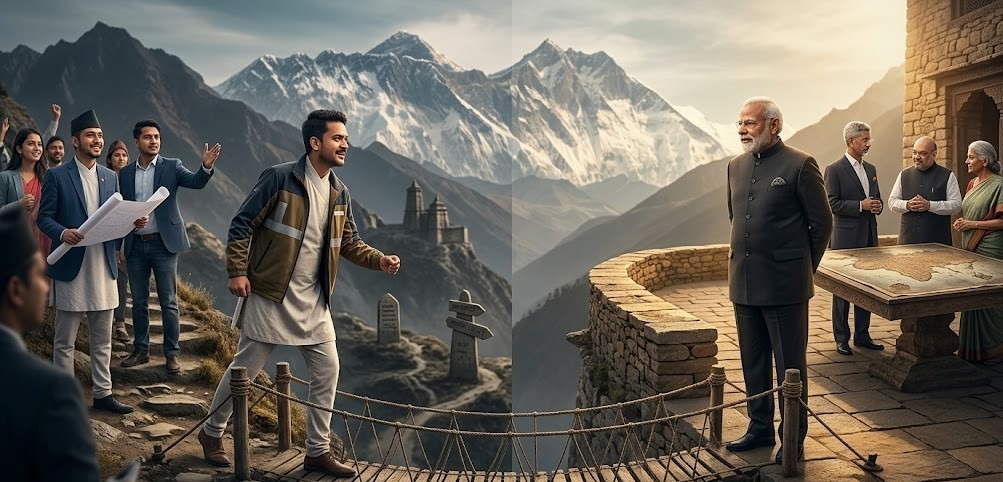
Rabi Lamichhane is president of Nepal’s ruling Rastriya Swatantra Party. His political biography reads like a screenplay written in adrenaline. He arrived in New Delhi on the first of June. The invitation came from BJP president Nitin Nabin. He carried with him the weight of a five-day mission. His own party described it as an agenda of prosperity. He moved through the capital with the energy of a performer. He understood that every handshake is a stanza, every bilateral meeting is a verse in a longer poem.
He sat with Prime Minister Narendra Modi. Modi’s own diplomatic Bharatnatyam is by now a masterclass in controlled gesture. His warmth is measured in millimetres. His smiles are calibrated to convey exactly the right degree of neighbourly regard. Lamichhane then turned to External Affairs Minister S. Jaishankar. Jaishankar is a scholar-diplomat. His sentences land like weighted arguments in a law review.
Lamichhane also met Home Minister Amit Shah. Shah’s political instincts are as sharp as the Himalayan air. The RSP president spoke of development diplomacy. He spoke of connectivity and religious tourism. He spoke of making the Nepali embassy in New Delhi more responsive.
Thousands of his countrymen live and labour in India’s vastness. He extended invitations to Modi and Nabin to visit Kathmandu. He returned home declaring that the border dispute would be addressed diplomatically. It would be addressed gradually. Efforts were already progressing. It was a performance of reasonableness. It landed with the kind of impact that makes seasoned observers lean forward in their chairs.
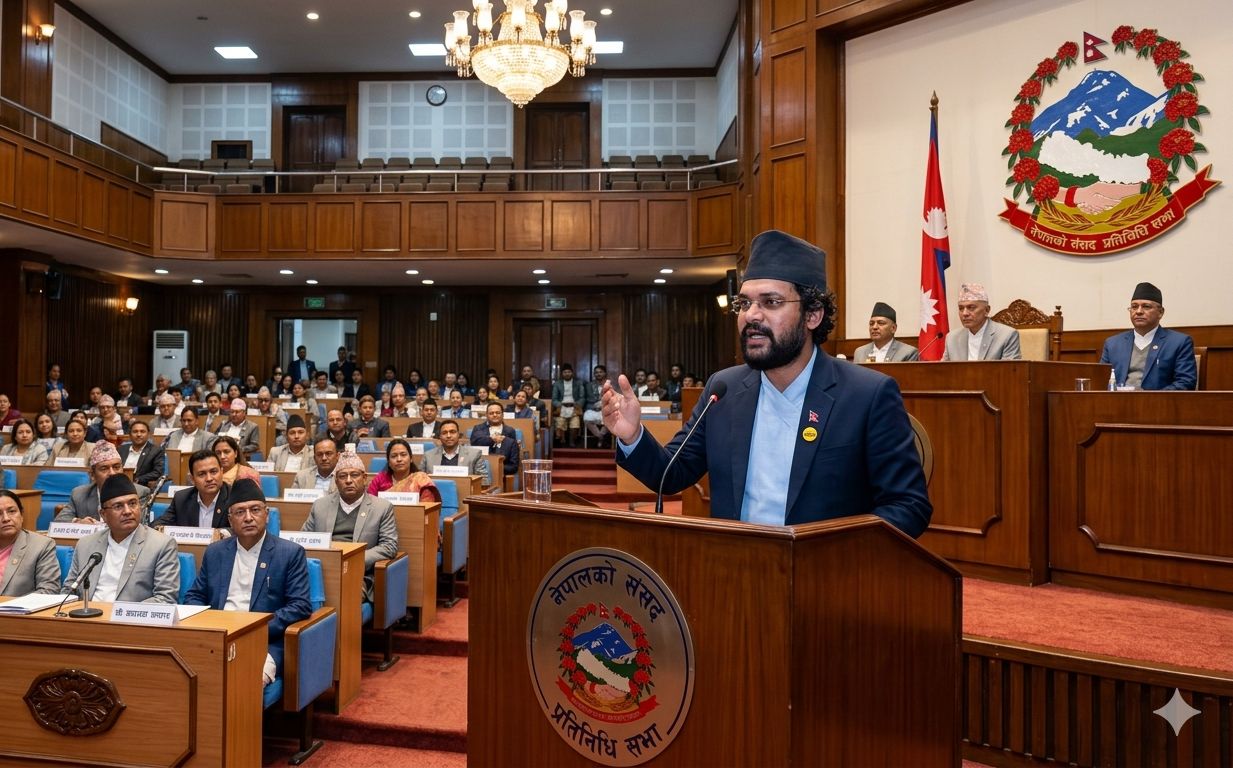
Yet no dance is performed in a vacuum. The stage upon which Lamichhane moved had been set only days earlier. It had been set by remarks that shook the rafters of Nepal’s Parliament. Prime Minister Balendra Shah is thirty-six years old.
He is a former rapper, and Kathmandu mayor. He now occupies Singha Durbar. He does so with the restless energy of a man who has never learned to whisper. He had stood before lawmakers on the thirty-first of May.
He uttered words that no Nepali head of government had ever spoken aloud. He confessed that after becoming Prime Minister he had learned something that surprised him. Not only had India encroached upon Nepali territory. Nepal had also encroached upon Indian land in multiple places. He spoke with the disarming candour of someone who has not yet been fully house-trained by the protocols of statecraft.
The chamber erupted. Opposition lawmakers demanded that the remarks be expunged from the record. Former ambassadors declared that Nepal had never encroached upon Indian territory. The Foreign Ministry scrambled to clarify.
The Prime Minister had been referring to technical realities of cross-border occupation in no-man’s land. He had been referring to boundary pillars that had vanished. He had been referring to river courses that had wandered like confused pilgrims. But the words had already flown. In diplomacy, as in dance, a misstep cannot be unperformed.
The Indian response came with swift precision. This is what characterises New Delhi’s diplomatic Bharatnatyam at its most disciplined. Ministry of External Affairs spokesperson Randhir Jaiswal stepped before the press. He delivered a statement that was at once a reassurance and a rebuke. He noted that nearly ninety-eight percent of the India-Nepal boundary had already been demarcated.
He noted that unresolved segments remained. He noted that the shifting course of the Gandak River had complicated matters. He noted that cross-border occupations of no-man’s land were being jointly mapped. Then came the pivot. It was delivered with the gentle firmness of a guru correcting a disciple’s posture.
There is no role for any third parties in a bilateral matter between India and Nepal. The message was unmistakable. Shah had suggested that the United Kingdom and China might also have a stake. This stake would be in resolving a dispute rooted in the colonial era.
From New Delhi’s perspective, this was a deviation from the choreography. It was an improvisation. It threatened to introduce discordant notes into a carefully composed raga. The MEA’s response coincided precisely with Lamichhane’s arrival in Delhi. This created a tableau. Nepal’s ruling party president was warmly welcomed. His Prime Minister’s words were being quietly but firmly set aside.
Into this delicate atmosphere stepped Shishir Khanal. He is Nepal’s Foreign Minister. He arrived in New Delhi on the fifth of June. This was an official visit. It would overlap with the final hours of Lamichhane’s mission. It would extend into the seventh. Khanal is a man who carries the intellectual bearing of someone who has read widely and thought deeply.
He addressed a press conference at the Nepali Embassy. He did so with the composure of a performer who knows that the show must go on. The previous act had left the audience restless. He clarified that Nepal was not asking for mediation from third parties. He clarified that the government’s focus was on establishing Nepal’s claim over Kalapani, Lipulekh, and Limpiyadhura.
This would be done through diplomatic processes. He clarified that the reference to Britain had been about accessing historical documents. These documents were in libraries and museums. This was not about inviting external arbitration. He spoke of a completely new political reality in Nepal. He spoke of a generation that refused to look at India through a distorted, hyper-sensitive lens.
This was the lens of twentieth-century geopolitics. He spoke of a determination to shift the entire vocabulary of Nepal-India relations. He called this Development Diplomacy. With Jaishankar, he announced the operationalisation of peer-to-peer cross-border digital payment transactions.
This was a small step. It was symbolically potent. It wove the two economies more tightly together. He said talks were possible with an open heart. In that phrase one heard the echo of the Maruni’s invitation to join the dance. It was an invitation to set aside hierarchy. It was an invitation to move together in shared rhythm.
What makes this pas de deux so fascinating? What makes it so fraught? It is the fundamental asymmetry of the two dancers. India’s diplomatic Bharatnatyam is performed from a position of overwhelming material and strategic advantage. Its economy is the fifth largest in the world. Its military is among the most formidable in the region. Its cultural soft power extends across the globe.
Nepal’s diplomatic Maruni, by contrast, is danced from a position of geographical vulnerability and economic dependence. Yet it carries within its steps a stubborn pride. It carries a refusal to be merely the junior partner.
It carries a determination to assert sovereignty even when the assertion seems quixotic. Shah’s remarks about mutual encroachment were clumsily delivered. They were, in this sense, an authentic expression of the Maruni spirit.
They were unfiltered. They were direct. They were unwilling to accept the narrative that Nepal is always and only the victim. They were also, from the perspective of classical statecraft, a blunder of the first order.
They gave India’s diplomatic establishment precisely the opening it needed. It could reassert bilateralism as the only legitimate frame. It could remind Kathmandu that there are rules to this dance.
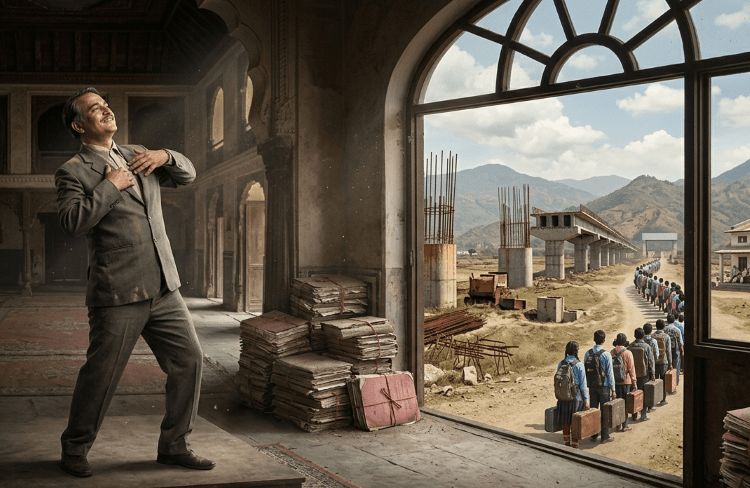
It could remind Kathmandu that improvisations have consequences. For the ordinary people who live along the open border, these high-altitude diplomatic manoeuvres translate into concrete and immediate struggles. They translate into struggles for survival. The farmer in the Terai wakes before dawn. He tills land that may or may not be on the right side of an invisible line. He does not parse the nuances of the Sugauli Treaty.
He does not follow the shifting jurisprudence of the Uttarakhand High Court regarding the 1950 Treaty of Peace and Friendship. The woman who crosses into India to sell her vegetables at a border market does not care what the payment system is called. She does not care whether it is peer-to-peer cross-border connectivity or Development Diplomacy. She cares whether the transaction goes through. She cares whether the customs officer will demand a bribe.
She cares whether she will make it home before nightfall. The Nepali labourer works in a construction site in Gurgaon. Or he works in a restaurant in Mumbai. He does not follow the parliamentary debates in Kathmandu. He does not follow debates about whether Nepal has encroached upon Indian territory. He follows the fluctuating exchange rate. He follows the availability of remittance channels. He follows the rumors about visa policy changes.
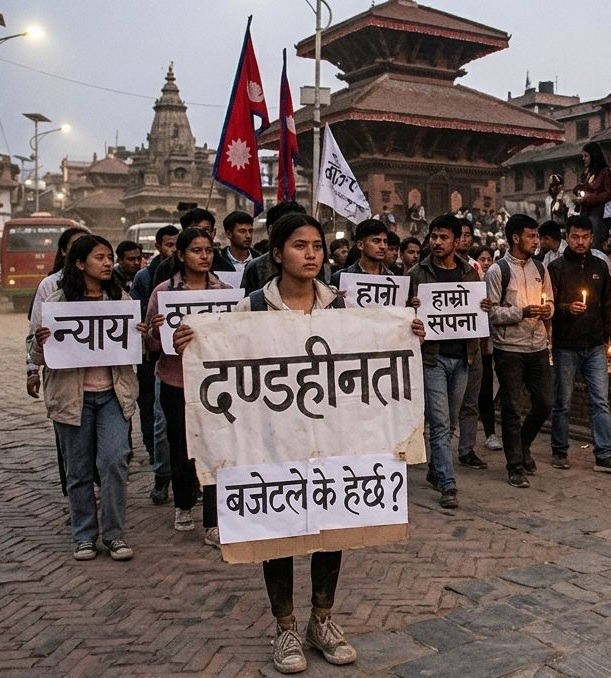
These might determine whether he can see his children again this year. These are the audiences for whom the diplomatic dance is performed. They never purchase a ticket to the theatre. Their patience is not infinite. When border disputes disrupt trade, the consequences are real.
When customs enforcement becomes arbitrary, the consequences are real. When the open border that has been the lifeline of millions begins to feel like a noose, the consequences are real. The abstract choreography of statecraft acquires flesh-and-blood consequences.
And yet, there is something in the very difficulty of this complicity. It suggests the possibility of a deeper resolution. This resolution transcends the transactional. It touches the transformational. The Bharatnatyam and the Maruni are not, after all, incompatible forms. They are simply different languages of the body. They are different ways of telling stories through movement.
What Lamichhane attempted in Delhi was a kind of translation. What Khanal continued was a kind of translation. It was a demonstration. Nepal’s new political class, for all its apparent roughness, was capable of learning the steps of its neighbour’s dance. It insisted that its own rhythms be respected. Lamichhane’s pilgrimage to Ayodhya was a gesture of cultural fluency. Ayodhya is that most charged of sites in the Indian political imagination.
It was a recognition. The shared religious heritage of the two nations is not merely decorative. It is constitutive. His meetings with Modi and Jaishankar were conducted with warmth and constructiveness. This is what Indian observers noted. It suggested that the RSP’s break from Nepal’s traditional political establishment might also represent a break.
It might be a break from the cycles of suspicion and resentment. These have too often defined the relationship. The invitation extended to Modi to visit Nepal received a positive response. It reportedly received a positive response. It opened a door. This door had been jammed shut by years of accumulated grievance.
The resolution of mutual distrust, if it comes, will not arrive as a thunderclap. It will arrive as a slow accumulation of small gestures. Each one is barely visible to the naked eye. Each one builds upon the last.
This is like the intricate footwork of a classical dancer. It will require India to recognise something. Nepal’s diplomatic Maruni, for all its apparent irregularity, is not chaos. It is a different kind of order. It values authenticity over polish. It values directness over obfuscation.
It will require Nepal to recognize something. India’s diplomatic Bharatnatyam, for all its apparent rigidity, is not arrogance. It is a form of self-protection. It is a way of managing overwhelming complexity. India is a subcontinental power. It must attend to a hundred fires at once. The boundary dispute over Kalapani, Lipulekh, and Limpiyadhura will not be resolved by historians and surveyors alone.
Their work is indispensable. It will be resolved when the two nations develop a shared vocabulary of trust. It will be resolved when the no-man’s land ceases to be a zone of contestation. It will become instead a space of mutual recognition. The cross-border occupations that Shah spoke of are not merely technical problems. They are human problems. Their solution lies not in maps alone. It lies in the willingness of both states to see the people on the other side of the line as neighbours. Not as adversaries.
In the end, the dance between India and Nepal is not a performance for external audiences. It is an intimate dialogue between two peoples. They have shared too much history to ever fully separate. They have too much pride to ever fully merge. The recent visits of Lamichhane and Khanal represent a moment of difficult complicity. They were set against the backdrop of Shah’s controversial remarks. They were set against India’s firm response.
This is a recognition that the dance must continue. The music has not stopped. Even when the steps falter and the rhythms clash, the only alternative to dancing together is not dancing at all. And for the millions who live in the shadow of the Himalayas, that alternative is no alternative at all. They cross borders with baskets and dreams. They send remittances and enjoy Bollywood bluckbusters.
They till disputed land and pray at shared shrines. The Bharatnatyam and the Maruni will find their syncopation. Not because the diplomats will it so. But because the people demand it. Because the rivers will keep shifting. Because the mountains will keep standing. Because in South Asia, as everywhere, the only enduring truth is this. Neighbors must learn to dance with each other. However difficult the complicity. However intricate the steps. However long the night before the dawn.
I have been working on the trends of the Nepalese Foreign Policy as the existing global order gets gradually altered in 21st century world ..
I have been working on the trends of the Nepalese Foreign Policy as the existing global order gets gradually altered in 21st century world. I am an MA in English and MPhil in International Relations a...
@ Copyright matrikapoudyal.com All Rights Reserved
Designed by Fortune Info Tech