


The new government must navigate these waters with the dexterity of a tightrope walker, balancing national interest against the gravitational pull of its giant neighbors.
There is a particular kind of madness that descends upon the high valleys of Nepal—not the fever of altitude, but the delirium of power. In the shadow of the world’s tallest mountains, where the air thins and perspective sharpens, one might expect clarity.
Instead, what Nepal has inherited is a parliament of Don Quixotes: men and women who charge at windmills with rusted lances, convinced they are slaying dragons, while the real beasts—hunger, corruption, foreign encroachment, institutional decay—roam freely through the streets of Kathmandu, Pokhara, and the forgotten villages of the Terai. They tilt, they posture, they orate. But the windmills keep turning, indifferent to their theatrical valor.
The Gen-Z Uprising of September 2025 was not merely a protest; it was a collective scream of recognition. Young Nepalis, armed with nothing but smartphones and the audacity of hope, looked at their leaders and saw not statesmen but actors in a tragicomedy of errors.
They saw gerontocrats who had turned political parties into family enterprises, where candidacies were inherited like ancestral land and ministerial portfolios were distributed at dinner tables among cousins and cronies.
The Lalita Niwas land grab, the Giri Bandhu Tea Estate scandal, the fake Bhutanese refugee scheme—these were not aberrations but the very architecture of a system built to serve the few at the expense of the many. When the bullets flew and the smoke cleared, the old guard discovered, to their astonishment, that the youth were no longer willing to play the role of Sancho Panza to their Quixote.
Nepotism in Nepal is not a whispered secret; it is the official language of governance. It speaks in the dialect of proportional representation laws twisted into instruments of dynastic succession, where spouses and sycophants are parachuted into parliamentary seats through legal loopholes that would make a contortionist weep.
The old parties—the Nepali Congress fractured by the ouster of Sher Bahadur Deuba, the CPN-UML still clinging to Oli’s shadow, the merged communist bloc grasping at relevance—had perfected this art to such a degree that one could trace family trees more easily than policy papers. A son here, a nephew there, a brother-in-law overseeing a ministry he could not spell, let alone steer.
What does it mean to be “qualified” in such a system? Not expertise in macroeconomics, not fluency in the grammar of international diplomacy, not the sober calculus of fiscal strategy. It means proximity to power. It means having the right surname. It means knowing which palms to grease and which backs to scratch.
The result is a cabinet of misfits—men who would struggle to balance a household budget entrusted with the national treasury, men who have never read a trade agreement negotiating the nation’s commercial fate, men who confuse bravado with diplomacy when seated across from the patient, calculating representatives of India and China.
The people of Nepal, who send their sons to labor in the scorching heat of the Gulf and the freezing winters of Korea, deserve better than to be governed by those who have never known a callus on their hands or a doubt in their hands or a doubt in their minds.
And yet, to understand Nepal’s tragedy, one must first understand its geography—not merely the sublime cruelty of its mountains, but the geopolitical vise in which it sits.
Sandwiched between two civilizational giants, India and China, Nepal is a buffer state in an age that has supposedly outgrown buffer states. To the south, India supplies food, fuel, and the open border that allows millions of Nepali workers to breathe life into their families through remittances.
But that same closeness is a source of vulnerability; the memory of the 2015 blockade still smolders in Nepali consciousness, a reminder that dependence can become suffocation. To the north, China arrives with silk-road promises—railways to Tibet, airports near the border, infrastructure projects that shimmer with potential but carry the weight of strategic calculation.
Every Chinese-built road is viewed in New Delhi not as development but as encroachment; every Indian cultural overture is parsed in Beijing as containment.
In this crucible, statecraft is not a luxury but a matter of national survival. It requires diplomats who can speak the language of both giants without becoming the instrument of either.
It requires economic planners who can leverage Nepal’s hydropower potential without mortgaging the nation’s sovereignty. It requires leaders who understand that the Siliguri Corridor—the narrow chicken’s neck connecting India’s northeast to its mainland—is not merely a strategic concern for Delhi but a daily reality for Nepali farmers and traders.
Instead, Nepal has been governed by men who treat geopolitics like a game of cards played with someone else’s money, who sign memoranda they do not comprehend and make promises they cannot keep, leaving the nation to navigate between Scylla and Charybdis with captains who have never learned to read a compass.
But the rot runs deeper than individual incompetence. It has seeped into the very marrow of institutions. The judiciary, which should be the spine of a democratic republic, has been bent and bowed by political pressure.
Cases languish for decades—Agni Sapkota’s alleged involvement in the murder of Arjun Lama has been pending for twelve years, scheduled for hearing forty-one times, moved from bench to bench like a pawn in a game no one intends to finish.
Judges delay verdicts on questionable grounds, dismiss benches to avoid controversy, and issue contempt rulings that chill press freedom while letting the powerful walk free. The Supreme Court’s directive to amend laws for inclusive representation is commendable, yet the same court remains centralized and hierarchical, with dissenting opinions as rare as monsoon snow.
When the judiciary cannot deliver justice in a timely manner, when court orders for compensation go unimplemented—only seven out of forty-six victims actually receiving the money they were awarded—what message does this send to the people? It tells them that the law is a language spoken only by the powerful, and the rest are expected to listen in silence.
The police, compromised during the 2025 uprising, saw over five thousand inmates escape and hundreds of firearms go unaccounted for. The security apparatus, meant to protect citizens, became a symbol of state failure. When institutions crumble, democracy becomes performance art—elaborate, expensive, and entirely hollow.
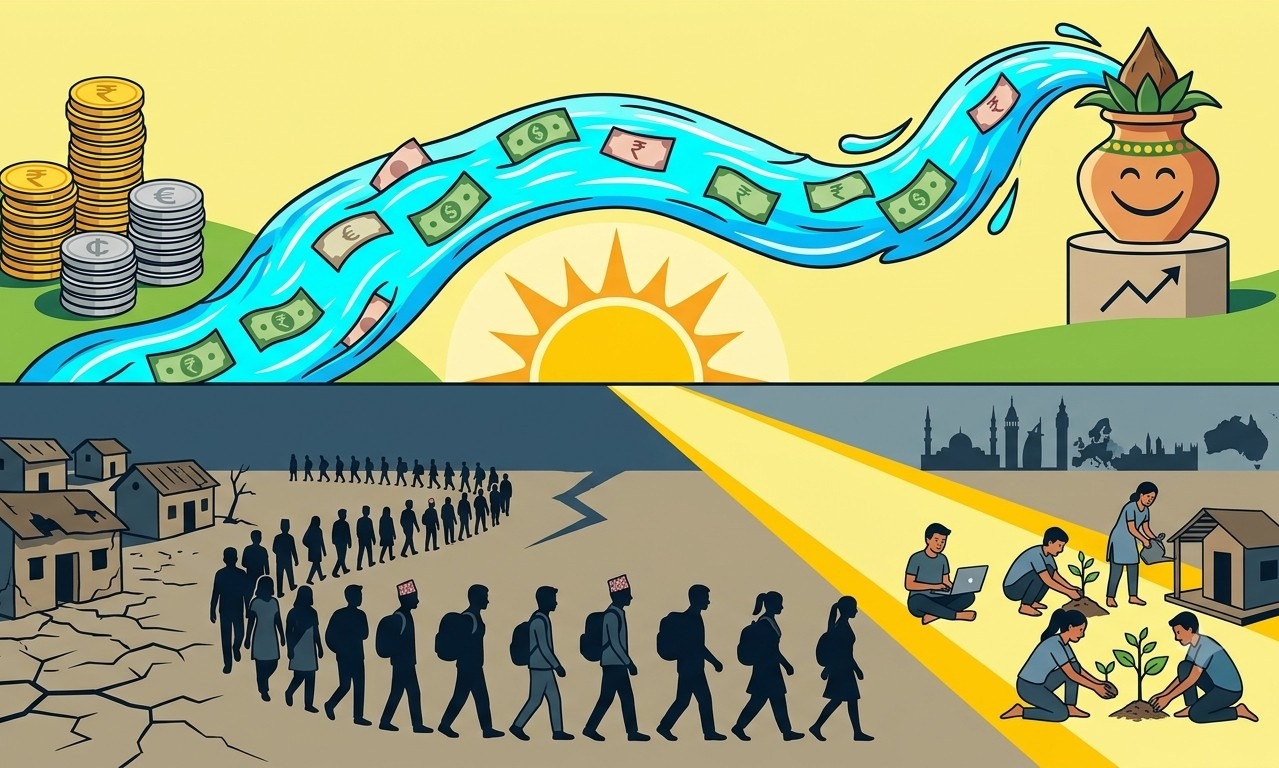
Turn to the economy, and the picture darkens further. Nepal’s economic strategy, if one can call it that, has been a patchwork of improvisation and opportunism. There is no coherent industrial policy, no serious investment in human capital, no roadmap for transitioning from a remittance-dependent economy to one that produces value within its own borders.
The youth who do not emigrate face a landscape of underemployment, where a graduate’s greatest aspiration is often a government job secured not through merit but through connection.
The private sector, when not being looted during protests—Bhatbhateni supermarkets vandalized, Kantipur media headquarters set ablaze—struggles under bureaucratic caprice and regulatory chaos.
Where is the financial acumen? Where are the economists who understand that Nepal’s trade deficit is not a temporary ailment but a structural wound? Where are the planners who see that hydropower, while promising, requires capital and expertise that cannot be conjured from slogans?
The old guard treated the economy like a family purse—spending on patronage, siphoning through contracts, leaving the nation to borrow its way into dependency. The Consumer Court, inaugurated in 2025 following a Supreme Court directive, is a welcome development, but courts do not create jobs. Institutions do not feed families.
Only vision, married to competence, can do that—and vision has been the scarcest commodity in Nepali politics.
Perhaps the cruelest aspect of this governance is the contempt it shows for the people themselves. Human rights, enshrined in the 2015 Constitution, remain ornamental for many.
Women with disabilities face justice mechanisms designed by and for the able-bodied, where police refuse to register rape cases because the survivor “cannot speak to give her own testimony.”
Arbitrary arrests and illegal detentions continue, with law enforcement officials rarely held accountable. Torture in custody—electrocution, beatings, sexual abuse, sleep deprivation—is documented year after year, and the perpetrators sleep soundly in their beds.
The right to assembly, the right to expression, the right to dignity—these are not abstract philosophical concepts. They are the daily bread of democracy.
When a government responds to peaceful protest with bullets, when it compensates the families of the dead with one million rupees and calls it justice, when it treats its young as disposable, it reveals its true nature.
The state is not a servant of the people; it is their master, and a cruel one at that. The Gen-Z protesters who filled the streets of Kathmandu in 2025 understood this. They were not merely demanding jobs or lower prices; they were demanding recognition. They were saying: We exist. We matter. We will not be governed by ghosts.
From the ashes of the September fires, something unexpected emerged. The Rastriya Swatantra Party (RSP), led by the unconventional duo of Balendra Shah and Rabi Lamichhane, rode a wave of protest votes to a historic majority in the March 2026 elections.
For a nation accustomed to the same faces in different chairs, this was nothing short of revolutionary. Balendra Shah, the former Kathmandu mayor who stepped down to contest a national seat, and Sudan Gurung, a youth activist and coordinator of the 2025 protests, running for Gorkha-1 under the same banner—these were not the heirs of dynasties. They were the inheritors of rage.
The interim government under Sushila Karki, who took office on September 14, 2025, had promised calm and reconstruction. She pledged to investigate conspiracies behind the violence, to spare nobody, to remain in power no more than six months.
She insisted Nepal would not “become another Bangladesh.” And in the transition, a record 120 parties contested the March polls, a third of them registered since the uprising. The political landscape, once a stagnant pond, had been stirred into a whirlpool.
But the question that haunts Nepal is whether the RSP can be different, or whether they too will don the armor of Don Quixote and charge at shadows. Arresting former leaders is cathartic, but it is not governance.
Issuing roadmaps is easy; paving roads is hard. The RSP was born from protest, and protest is a language of opposition. Governing requires a different vocabulary—one of compromise, patience, and the unglamorous work of institution-building.
Can Balendra Shah, who captured the imagination of Kathmandu as mayor, translate municipal charisma into national statesmanship?
Can a party forged in the fires of youth anger govern for all, including those who did not vote for them?
The jury is still out, and the courtroom is the nation itself.
The post-Gen-Z government’s early moves have been a mixture of boldness and caution. The arrests of former leaders signal a break from the culture of impunity that shielded the powerful.
The roadmap for political reforms, however vaguely articulated, acknowledges that the old ways cannot continue. Yet the challenges are mountainous—literally and figuratively. More than five thousand escaped inmates remain at large.
Hundreds of unaccounted firearms circulate in a society already frayed by inequality and frustration. The police force, compromised and demoralized, must be rebuilt from the ground up.
The judiciary, while issuing progressive orders on inclusivity and human trafficking, still struggles with the basics: timely justice, impartial benches, accountability for its own.
The RSP faces another test: geopolitics. India watches with a mixture of hope and suspicion. China maintains its strategic restraint, waiting to see if the new government will honor existing Belt and Road commitments or seek to renegotiate them.
The railway to Tibet, the Chinese-built airports, the Indian trade routes—these are not mere infrastructure projects. They are the threads of a web in which Nepal is caught. A misstep in foreign policy could tighten the noose.
The new government must navigate these waters with the dexterity of a tightrope walker, balancing national interest against the gravitational pull of its giant neighbors.
Moreover, the protest movement itself has fragmented. There is no single leader, no unified manifesto. Tensions over federalism, the scope of reform, and the pace of change threaten to dissolve the coalition of anger that brought the RSP to power.
The Maoist Center and Unified Socialist may have merged into a single communist bloc, but the left is not the only force watching for weakness. The Nepali Congress, under new leadership and fielding younger candidates, is not dead—merely wounded. And wounded beasts are dangerous.
So where does this leave Nepal? The windmills still turn on the ridges above Kathmandu, indifferent to the passions of men.
The mountains still stand, patient and eternal, witnesses to centuries of human folly. The question is whether the new generation of leaders—those who emerged from the Gen-Z Uprising, those who carry the mandate of a frustrated but hopeful people—can distinguish between the windmills of their own ambitions and the real dragons that threaten their nation.
Don Quixote, for all his madness, was at least sincere. He believed in his quest. The tragedy of Nepal’s old guard was not that they were mad, but that they were cynical—playing at governance while looting the treasury, speaking of democracy while building dynasties, wrapping themselves in the flag while selling the nation’s future piece by piece.
The RSP has a chance to be different, but it is only a chance. Sincerity alone does not build roads, negotiate trade deals, or reform a judiciary. Competence does. Vision does. The willingness to be boring—to sit in meetings, to read briefs, to make unpopular decisions for long-term gain—does.
Nepal’s youth have done the hardest thing: they have risen. They have bled. They have buried their dead and demanded change. Now the harder work begins.
The work of governance is not heroic. It is not cinematic. It is the slow, grinding labor of building institutions that outlast individuals, of creating an economy that offers dignity rather than exile, of respecting courts that do not bend to political winds, of treating citizens as ends rather than means.
The Don Quixotes of Kathmandu must lay down their lances and pick up their pens. The dragons are real, and they are not fought with theater.
They are fought with the quiet, relentless work of statecraft—diplomacy that understands Nepal’s place between giants, economic planning that sees beyond the next election, institutional reform that protects the weak from the strong, and above all, a humility that places the people’s welfare above the politician’s pride.
The windmills will keep turning. The question is whether Nepal’s leaders will finally stop charging at them and start building something that lasts.