

I have been working on the trends of the Nepalese Foreign Policy as the existing global order gets gradually altered in 21st century world ...
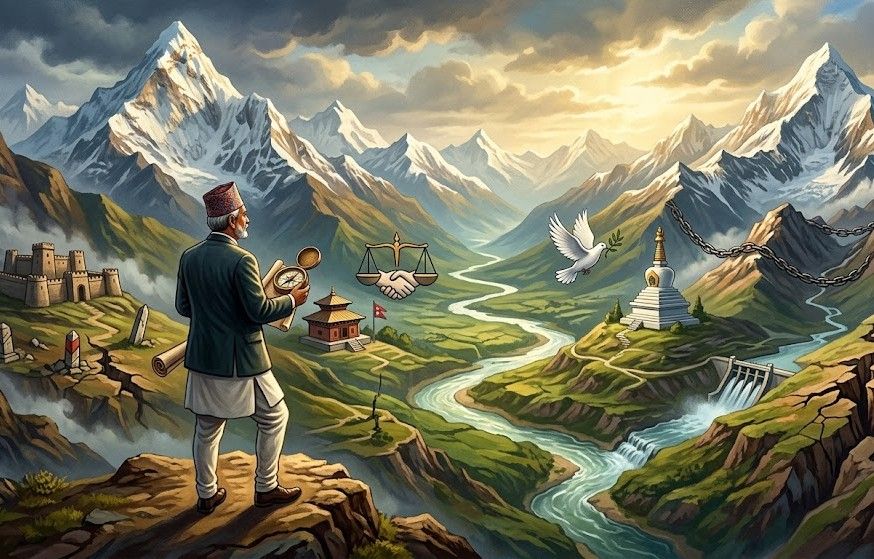
The fate of nations, like the course of great rivers, is determined not merely by the contours of geography but by the wisdom—or wantonness—of those who stand at the helm.
Nepal, that cradled between the two colossal civilizations of Asia, has throughout its history been both blessed by its position and cursed by the mediocrity of those who have governed it.
The Himalayan state possesses hydropower potential that could illuminate half a continent, cultural treasures that draw pilgrims from every corner of the earth, and a strategic location that makes it the natural bridge between the world’s two most populous nations.
These abundant opportunities, in contrast, have repeatedly been squandered by executives who have treated the delicate art of statecraft as though it were a village squabble, depriving their people of prosperity that should have been theirs by right. The tragedy of Nepal is not that it lacks potential, but that its leaders have so often lacked the elementary understanding that diplomacy is the poetry of power, the science of national interest, and the architecture upon which all socio-economic development must rest.
The first great juncture in Nepal’s modern diplomatic consciousness came with the Treaty of Sugauli in 1816, when the Gorkha kingdom, intoxicated by expansionist ambition and blind to the realities of British imperial might, lost one-third of its territory and learned the costly lesson that military bravado without strategic calculation is the prelude to national diminishment.
The Nepal-British India War was not merely a military defeat; it was a diplomatic catastrophe born of leaders who understood the grammar of conquest but not the syntax of survival. From this crucible of humiliation emerged the Rana regime, and with it, Jung Bahadur Rana, who demonstrated that statesmanship is the art of turning weakness into leverage.
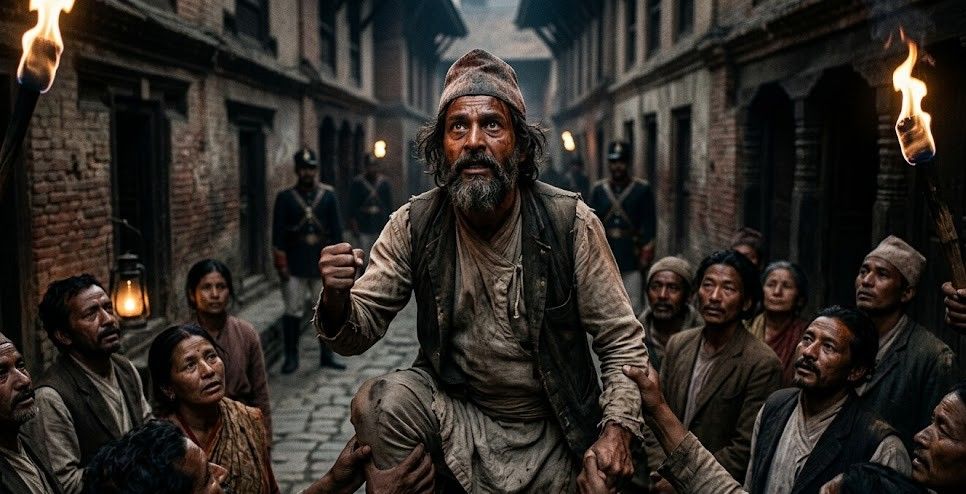
By dispatching troops to aid the British during the Sepoy Mutiny of 1857, by cultivating the Gurkha military connection, and by his audacious visit to England in 1850, Jung Bahadur transformed Nepal from a vanquished power into a recognized sovereign state, ultimately securing the Treaty of 1923 that formally affirmed Nepal’s independence. Here was the first masterclass in Himalayan statecraft: the weak must dance with the strong, but they must never forget the steps.
The second pivotal moment arrived with the democratic revolution of 1951, when the Rana oligarchy crumbled and Nepal emerged from its chrysalis of isolation into the modern world. The establishment of an independent Ministry of Foreign Affairs in that transformative year marked the beginning of Nepal’s engagement with the community of nations, and within a decade, the kingdom had established relations with over twenty-six countries, joined the United Nations in 1955, and embraced the Non-Aligned Movement.
However, this promising dawn was soon clouded by the 1950 Treaty of Peace and Friendship with India, an instrument that Nepal’s leaders signed without fully comprehending its asymmetrical implications. The treaty created a “special relationship” that, while providing security assurances, also established patterns of dependency that would constrain Nepal’s autonomy for generations. The statesmen of that era failed to recognize that true friendship between unequal neighbors requires not just goodwill but meticulous attention to the architecture of sovereignty, and that the finest treaties are those that anticipate the worst intentions.
The third historical watershed occurred in 1960 when King Mahendra dissolved the nascent parliamentary democracy and imposed the partyless Panchayat system, a decision that reverberated through Nepal’s foreign policy like a seismic shock. While the Panchayat era under Mahendra and later Birendra saw diplomatic diversification and the expansion of Nepal’s international footprint, it also represented a fundamental betrayal of democratic principles that weakened Nepal’s moral standing in the community of nations.
King Birendra’s 1975 proposal to declare Nepal a “Zone of Peace” was, in conception, a stroke of diplomatic genius—a bid to formalize Nepal’s neutrality between India and China and to transform its buffer-state vulnerability into a source of international legitimacy.
Over 130 countries endorsed the proposal, yet it foundered on India’s refusal to endorse it, revealing the cruel geometry of Nepal’s geopolitical predicament. The failure was not merely India’s; it was also Nepal’s, for its leaders had not cultivated the patient, granular diplomacy necessary to secure Delhi’s acquiescence, nor had they built the international coalition that might have overcome Indian resistance. A Zone of Peace endorsed by the world but rejected by one’s immediate neighbor is not a diplomatic triumph but a strategic mirage.
The fourth defining juncture came with the 1990 People’s Movement, which restored multiparty democracy and promised a new era of accountable governance and principled foreign policy. The democratic constitution of 1990 defined Nepal as a multi-ethnic, multiparty Hindu kingdom, and the country seemed poised to harness its democratic legitimacy for economic advancement.
The democratic experiment, though, quickly degenerated into political instability, with governments rising and falling like autumn leaves, each more preoccupied with survival than with strategy. The foreign policy of this era was characterized not by vision but by reaction, not by the pursuit of national interest but by the scramble for political survival. The democratic leaders who had fought so courageously for freedom proved singularly inept at wielding it, and Nepal’s international standing, which should have been strengthened by democratic credentials, was instead diminished by the spectacle of perpetual political chaos.
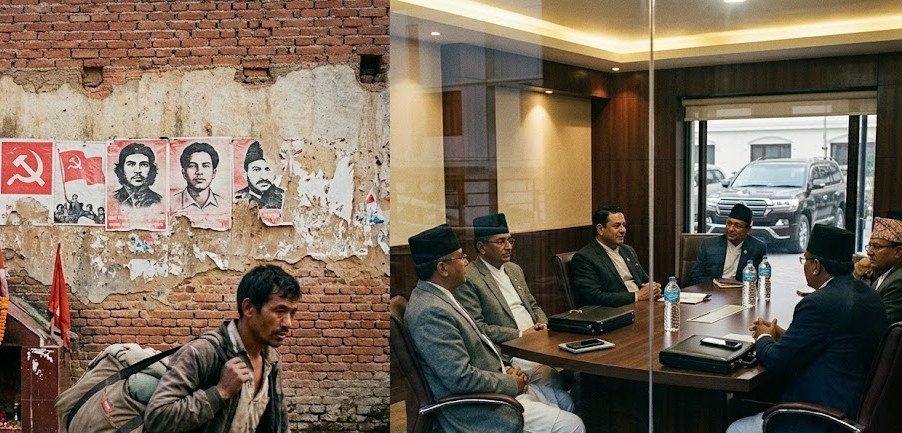
The fifth historical rupture was the Maoist insurgency that erupted in 1996, a decade-long conflagration that consumed over seventeen thousand lives and demonstrated how diplomatic myopia at the center can breed armed despair in the periphery. The Maoists’ forty-point demand, which included calls for renegotiating unequal treaties and ending foreign military recruitment, was rooted in legitimate grievances about Nepal’s subordinate position in the international system—grievances that the political class had consistently ignored.
The insurgency’s foreign policy dimensions were profound: India initially viewed the Maoists through the prism of its own Naxalite anxieties, while China refused to recognize them, and the United States, after September 2001, branded them terrorists. King Gyanendra’s 2005 royal coup, his attempt to seek Chinese support against international pressure, and India’s subsequent strategy of uniting the Maoists with democratic parties to oust the monarch—all these maneuvers revealed how Nepal’s internal conflicts had become chess pieces in a great power game that its own leaders barely comprehended.
The peace agreement of 2006, which brought the Maoists into mainstream politics, was less a diplomatic achievement than a recognition of diplomatic failure: the state had been forced to accommodate those who had taken up arms because its leaders had been incapable of addressing their concerns through the arts of persuasion and reform.
The sixth critical juncture was the promulgation of the new constitution in September 2015, an event that should have marked Nepal’s emergence as a federal democratic republic but instead precipitated one of the darkest chapters in its diplomatic history. The constitution, drafted without adequate consultation with Madhesi and other marginalized communities, provoked a crisis that India exploited to impose an undeclared economic blockade—a siege that choked Nepal’s lifelines just as it was reeling from the devastating April earthquake.
For four months, fuel, medicine, and essential supplies were withheld, costing the economy an estimated 200 billion rupees and causing a humanitarian catastrophe that far exceeded the earthquake’s damage in its economic impact.
Nepal’s leadership during this crisis displayed a staggering incompetence: they failed to anticipate Indian reactions, failed to engage constructively with Madhesi grievances before the crisis erupted, failed to internationalize the issue effectively, and failed to diversify supply routes with the urgency the situation demanded.
The blockade was a brutal reminder that for a landlocked nation, diplomacy is not an academic exercise but a matter of survival, and that the failure to maintain equidistant, respectful relations with both giant neighbors is an invitation to catastrophe.
The seventh and most recent juncture is the contemporary era of strategic hedging, where Nepal has attempted to navigate between China’s Belt and Road Initiative and the United States’ Millennium Challenge Corporation, between Indian economic integration and Chinese infrastructure investment.
The 2017 BRI framework agreement, followed by the 2024 formalization of cooperation, and the 2022 ratification of the MCC Compact, represent Nepal’s attempt to extract maximum benefit from great power competition. Yet this strategy, while rational in theory, has been executed with the subtlety of a bull in a china shop.
Nepal’s leaders have too often treated these agreements as opportunities for political theater rather than instruments of national development, signing memoranda without implementation plans, making commitments without institutional capacity, and promising alignment without strategic coherence. The result is a foreign policy that pleases no one, alarms everyone, and delivers little.
In the context of 2026, Nepal stands at a precipice. The country is scheduled to graduate from Least Developed Country status in November of this year, a transition that should be a moment of pride but instead exposes the hollowness of its development achievements. Foreign aid is declining as donors shift from grants to loans, and Nepal’s political class continues to treat governance as a zero-sum game of coalition manipulation rather than as the stewardship of a nation’s destiny.
The current leadership, whatever its partisan complexion, has shown little evidence of understanding that in the twenty-first century, a small state’s power lies not in its military might but in its diplomatic agility, not in its territorial expanse but in its capacity to convene, to connect, and to craft win-win propositions.
Nepal’s hydropower remains largely untapped, its tourism potential is undermined by infrastructure neglect, and its human capital is exported rather than invested in—all because its leaders have been too busy managing political crises of their own making to attend to the long, patient work of national construction.
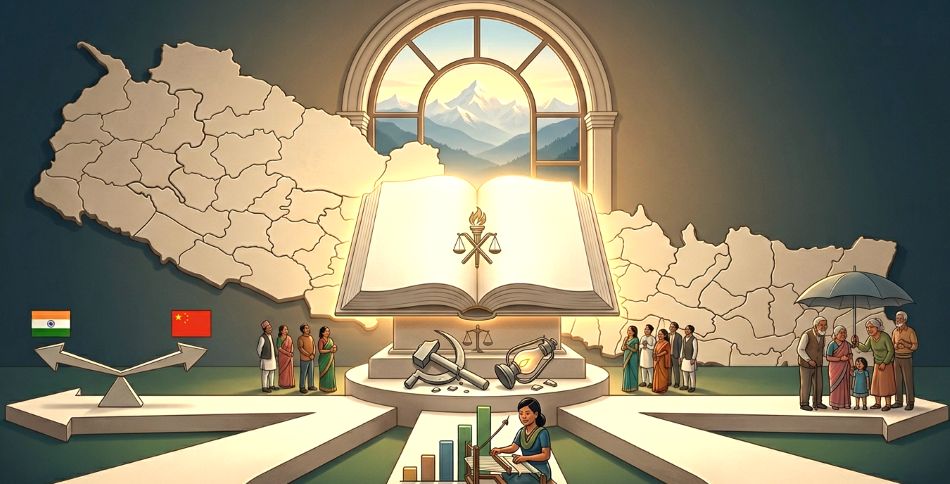
How, then, must a true statesperson act in a country like Nepal? First, such a leader must recognize that Nepal’s geography is its destiny, and that this destiny must be managed through what might be called “equidistant engagement”—not the cold neutrality of isolation, but the warm professionalism of a nation that refuses to be any great power’s vassal while refusing to be any great power’s enemy.
The statesperson must understand that the 1950 Treaty needs not abrogation but renegotiation, that the BRI and MCC are not ideological choices but development tools, and that India’s security concerns and China’s connectivity ambitions are not mutually exclusive but potentially complementary. Second, a Nepali statesperson must cultivate what ancient thinkers called “strategic patience”—the capacity to resist the temptation of immediate gratification in favor of long-term national interest.
This means building institutions rather than patronage networks, investing in human capital rather than political loyalty, and crafting foreign policy that outlives electoral cycles. Third, and most crucially, the statesperson must recognize that Nepal’s greatest diplomatic asset is its moral authority—the authority of a nation that has never been colonized, that has contributed peacekeepers to the United Nations, that hosts the birthplace of the Buddha, and that can speak to the world not from a position of power but from a position of principle.
A visionary statesperson would make hydropower the core of Nepal’s economic diplomacy. Nepal must use its strategic location to become a regional hub, not a bottleneck. It must educate its workforce for global markets. And it must build institutions capable of negotiating with great powers as an equal, not a supplicant.
Such a leader would understand that the blockade of 2015 was not merely India’s crime but Nepal’s failure—a failure to build the diversified partnerships, the alternate supply routes, and the international legal safeguards that could have prevented it. Such a leader would recognize that the Zone of Peace was not a failed initiative but an unfinished symphony, one that could be revived through patient coalition-building and creative diplomacy.
Such a leader would see in Nepal’s history not a litany of victimhood but a repository of lessons—lessons in how Jung Bahadur turned defeat into sovereignty, how the Ranas used military diplomacy to preserve independence, and how the democratic movements of 1951 and 1990 demonstrated the power of a people determined to shape their own destiny.
The course of a nation and the destiny of its people are not inscribed in the stars; they are written by the hands of those who govern, in the ink of their choices and the parchment of their policies. Nepal’s tragedy has been that too often those hands have been unsteady, that ink has been spilled in haste, and that parchment has been torn by factional strife.
So far, the potential for redemption remains, as enduring as the Himalayas themselves. A statesperson who combines the strategic cunning of Jung Bahadur with the democratic legitimacy of the 1990 movement, who possesses the patience of a diplomat and the vision of a builder, who understands that foreign policy is not a matter of personal pique but of national purpose—such a leader could yet steer Nepal from the shoals of missed opportunity into the open waters of prosperity.
The abundant opportunities for socio-economic development that Nepal has been denied are not lost; they are merely waiting for leaders worthy of them. In the end, the measure of a statesperson is not the height of the throne they occupy but the depth of the future they bequeath, and Nepal’s history cries out for leaders who will measure up to the grandeur of its mountains and the dignity of its people.
I have been working on the trends of the Nepalese Foreign Policy as the existing global order gets gradually altered in 21st century world ..
I have been working on the trends of the Nepalese Foreign Policy as the existing global order gets gradually altered in 21st century world. I am an MA in English and MPhil in International Relations a...
@ Copyright matrikapoudyal.com All Rights Reserved
Designed by Fortune Info Tech