

I have been working on the trends of the Nepalese Foreign Policy as the existing global order gets gradually altered in 21st century world ...
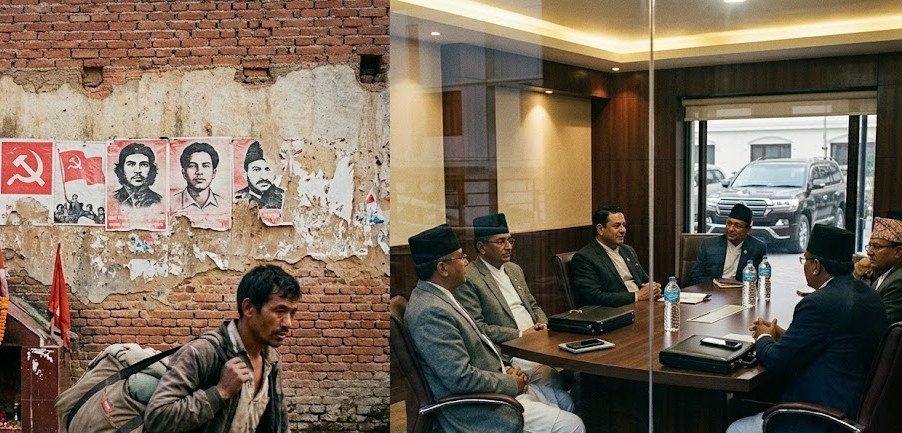
There is a peculiar cruelty to the way Nepal’s communist leaders have monetized martyrdom. The men who once marched through the mid-hills in rubber sandals, who buried comrades in unmarked graves and promised a nation of peasants that their suffering would be redeemed by history, now occupy the highest offices of the republic they helped build. They arrived with the vocabulary of the oppressed.
They govern with the arithmetic of the entitled. And somewhere between the jungle camps of Rolpa and the climate-controlled suites of Singha Durbar, the moral architecture of their movement collapsed into something indistinguishable from the rot they once claimed to oppose.
The arithmetic is not subtle. In 2025 alone, more than ten major corruption cases surfaced involving former prime ministers, ministers, and senior bureaucrats — from a 14 billion rupee embezzlement scheme during the construction of Pokhara airport to a 3.2 billion rupee procurement fraud in telecommunications monitoring systems, to a “visit visa” racket at Tribhuvan International Airport where immigration officers quoted fixed bribe rates for Nepalis desperate enough to work abroad illegally.
The children of these leaders — the “nepo kids,” as a viral social media campaign christened them — flaunt lifestyles of conspicuous consumption that would scandalize a Gulf emirate, let alone a nation where youth unemployment hovers near 20 percent and more than 2,000 citizens leave daily for low-wage labor in Malaysia and the Middle East. The revolutionaries who once spoke of class war now preside over a system of inherited privilege so brazen it would embarrass a Bourbon restoration.
What makes this betrayal particularly devastating is not merely the theft — though the theft is staggering — but the systematic manner in which able, reform-minded leaders have been bypassed, marginalized, or simply tuned out of the political conversation.
Consider the trajectory of Janardan Sharma, the Maoist Centre’s deputy general secretary, who after the September 2025 uprising demanded the resignation of Pushpa Kamal Dahal “Prachanda” only to find himself sidelined, then expelled, then politically orphaned. And the case of Madhav Kumar Nepal, a former prime minister against whom the anti-corruption commission finally filed charges — not because the system worked, but because his break with K.P. Sharma Oli made him expendable to the ruling coalition’s arithmetic of survival.
The message to any would-be reformer inside these parties is unambiguous: dissent is a career-ending condition. The message to the public is equally clear: the same three men — Oli, Dahal, Deuba — have cycled through 14 governments in 17 years not because they govern well, but because they have engineered a political cartel that treats the state as a joint venture among permanent incumbents.
This is not governance. This is enclosure — the fencing off of public power for private extraction. And it has produced a political culture so thoroughly transactional that even the bureaucracy, that last refuge of institutional memory, has been reduced to a battleground between political appointees and civil servants, each faction defending its parochial turf while the machinery of state rusts.
When a parliamentary committee unanimously agreed to bar civil servants from political appointments for two years after retirement, the provision was mysteriously diluted before reaching the floor — the hand of the chief secretary, Nepal’s top bureaucrat, detected in the tampering. The legislature, the executive, the anti-corruption bodies: all captured, all compromised, all operating under the same unspoken covenant that the big fish shall not be netted.
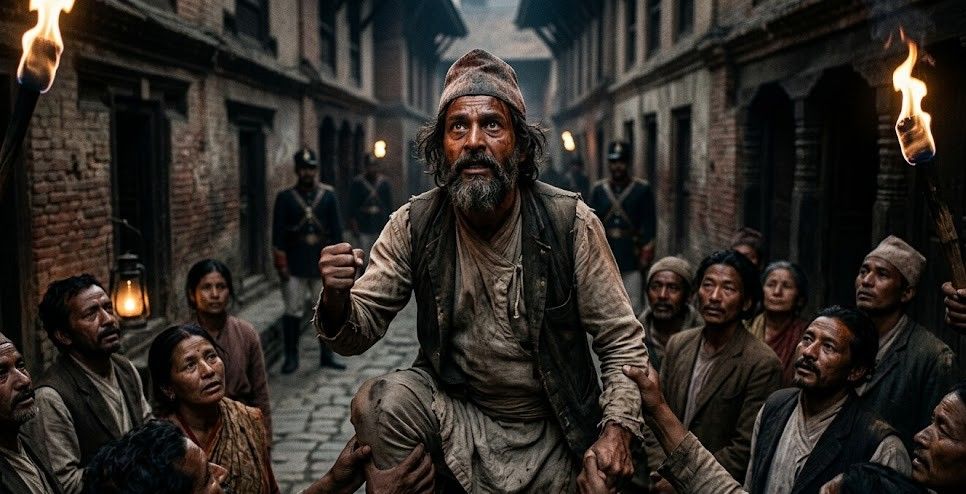
The question, then, is not whether Nepal’s communist establishment is corrupt. The question is what comes after it — and whether what comes after can avoid replicating the very pathologies it claims to oppose. The September 2025 uprising, in which 76 young protesters died and the prime minister’s office was set ablaze, was not a revolution in the classical sense. It was something more interesting: a generational repudiation of the entire political class, delivered by citizens who had concluded that the parties were not adversaries but partners in a syndicate.
The Gen-Z protesters who toppled Oli’s government did not carry Maoist manifestos. They carried smartphones, and they used them to expose the architecture of impunity with a precision that decades of investigative journalism had failed to achieve. Theirs was a politics of subtraction — remove the old, then see what remains.
What must remain — what must be deliberately constructed — is a new center-left politics that understands something the old left forgot: that the working-class Nepali is not an abstraction to be invoked in May Day speeches but a concrete human being who sends remittances home from Doha construction sites, who pays bribes to obtain a passport, who watches cooperative banks run by political affiliates abscond with depositor savings, and who knows, with the bone-deep certainty of the exploited, that the system is rigged.
This new politics cannot be a recycling of communist slogans with cleaner hands. It must be something else entirely: a movement that addresses the material conditions of Nepal’s laboring millions without surrendering to the authoritarian temptations that have corrupted every left project in South Asia from Dhaka to Kolkata.
The regional context is instructive, and sobering. In Bangladesh, the Hasina government’s collapse in 2024 revealed how a nominally center-left regime can degenerate into a family-run kleptocracy, enriching itself through infrastructure contracts and suppressing dissent through digital surveillance. In Sri Lanka, the Rajapaksa dynasty’s fall demonstrated how ethno-nationalist populism, married to Chinese debt diplomacy, can hollow out a state from within.
In India, the Congress party’s secular social-democratic tradition has withered into a dynastic rump, unable to articulate a coherent economic vision for the working class it once claimed to represent. Across South Asia, the center-left has either been captured by oligarchs or outflanked by ethno-religious majoritarianism. Nepal has the opportunity — perhaps the last opportunity — to break this pattern, but only if it builds a politics that is simultaneously redistributive and democratic, nationalist without being xenophobic, and realistic about the geostrategic cage in which it operates.
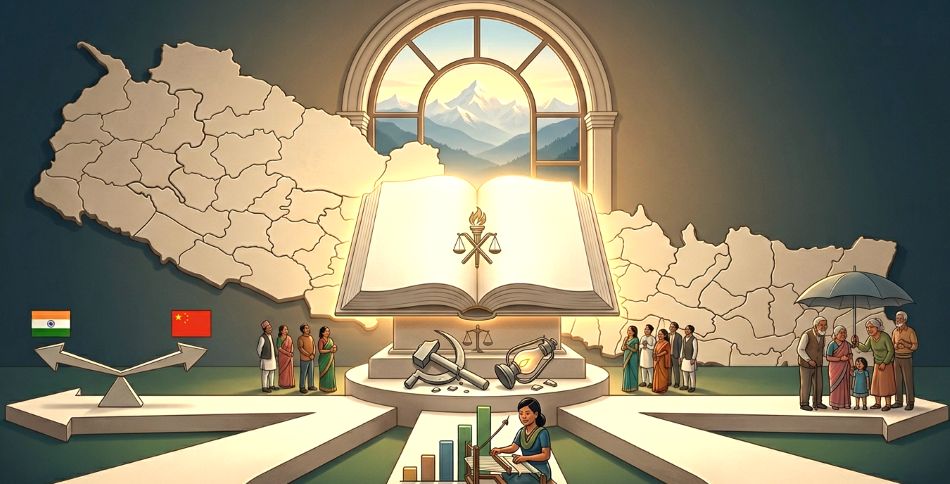
That cage is not metaphorical. Nepal is a landlocked nation of 30 million people sandwiched between a rising China and a muscular India, its economy dependent on remittances that constitute roughly 28 percent of GDP, its trade overwhelmingly oriented toward India, its infrastructure increasingly financed by Chinese loans at interest rates that would make a World Bank officer blanch. The Pokhara airport, built with Chinese financing, became a symbol not of connectivity but of graft. The proposed Trans-Himalayan railway, which would link Kathmandu to Tibet, remains more aspiration than engineering reality — a geopolitical promise rather than an economic proposition.
Meanwhile, India supplies the petroleum, the pharmaceuticals, the steel, and the transit routes without which Nepal’s import-dependent economy would seize within weeks. The 2015 blockade, which caused severe shortages and deepened anti-Indian sentiment, remains a living memory. So does the subsequent pivot toward Beijing, which has produced infrastructure projects of dubious utility and debt obligations of undeniable gravity.
A new center-left politics in Nepal must navigate this terrain with a sophistication that the current leadership has conspicuously lacked. It cannot simply tilt toward China as a counterweight to India, nor can it surrender to Indian hegemony under the guise of pragmatism. What it can do — what it must do — is articulate a development strategy that leverages Nepal’s unique position rather than being crushed by it. This means investing in the domestic productive capacity that has been systematically neglected: agriculture, hydropower, tourism infrastructure that benefits local communities rather than foreign contractors, and an industrial policy that does not treat Nepal as merely a labor-export zone for the Gulf states.
It means recognizing that Nepal’s greatest geopolitical asset is not its ability to play India against China but its potential to become a model of democratic development in a region where authoritarianism is ascendant — a proof of concept that a poor, multi-ethnic, federal republic can govern itself without descending into either kleptocracy or strongman rule.
This requires, above all, a reckoning with the internal socio-political fractures that the communist leadership has exploited rather than healed. Nepal’s federal structure, established after the 2015 constitution, was supposed to devolve power to provinces and local governments. In practice, it has created new layers of patronage, with provincial elites replicating the extractive behaviors of their Kathmandu counterparts.
The Madhesi communities of the Terai, who constitute roughly half the population, remain politically underrepresented and economically marginalized, their grievances periodically inflamed by Delhi’s opportunistic interventions and Kathmandu studied indifference. The indigenous nationalities of the hills, the Dalits, the women who were promised proportional representation and received tokenism — all of these constituencies have been mobilized rhetorically and abandoned programmatically by a left that speaks the language of inclusion while practicing the politics of exclusion.
The new politics must be different. It must be built from the ground up by leaders who have not been compromised by the existing cartel — by municipal reformers, by trade unionists who have not been co-opted, by young professionals who understand that Nepal’s brain drain is not an inevitability but a policy failure, by the rural cooperatives that have been looted and are now organizing for restitution.
It must be transparent in its financing, democratic in its internal structures, and explicit in its rejection of the personality cults that have reduced Nepal’s communist parties to vehicles for individual ambition. It must be willing to say, without euphemism, that the sacrifices of the People’s War were real — the dead are dead, the disappeared are not coming back — but that those sacrifices have been betrayed by the very men who claimed to honor them.
And it must be patient. The temptation, in the aftermath of a popular uprising, is to demand immediate transformation — to believe that the collapse of one regime guarantees the virtue of the next. But Nepal’s history counsels caution. The 2006 peace agreement that ended the monarchy was hailed as a new beginning; it produced, within a decade, a political class more corrupt than the one it replaced. The 2015 constitution was celebrated as a triumph of federalism; it entrenched the same three leaders in perpetual rotation.
The lesson is that institutional decay cannot be reversed by enthusiasm alone. It requires the slow, unglamorous work of building independent institutions — an anti-corruption commission that prosecutes without fear or favor, a judiciary that does not bend to political pressure, a civil service that is insulated from partisan appointment, a media that is free not merely in law but in practice.
The youth who filled Kathmandu’s streets in September 2025 did not ask for the impossible. They asked for accountability, for representation, for a political system that treated them as citizens rather than subjects. Their demand was not for a new ideology but for a functioning state — for roads that do not wash away in the monsoon, for hospitals that do not charge bribes for emergency care, for schools where teachers actually teach, for a passport office that does not require a middleman.
These are modest demands, but in Nepal’s current configuration, they are revolutionary ones. And they are the demands that any center-left politics worthy of the name must place at the center of its agenda.
Nepal stands at a hinge moment in South Asian history. To its south, India is redefining itself as a Hindu majoritarian state, with consequences for secularism and minority rights that will ripple across the subcontinent.
To its north, China is projecting power through debt and infrastructure, offering development without democracy to states desperate enough to accept the terms. In between, the smaller nations of South Asia — Bangladesh, Sri Lanka, the Maldives, Nepal itself — are being forced to choose between models of governance that neither reflect their histories nor serve their interests.
The old left, with its Soviet-era vocabulary and its Chinese-funded projects, has proven itself incapable of navigating this landscape with integrity. The new right, with its monarchist nostalgia and its ethno-nationalist appeals, offers only a return to the very exclusions that produced the 2006 revolution in the first place.
What is needed — what Nepal’s working class, its youth, its marginalized communities deserve — is a third way: a politics that is left in its redistributionist instincts, center in its commitment to democratic norms and institutional stability, and deeply Nepali in its refusal to be a pawn in someone else’s great game.
This politics will not emerge from the parliamentary maneuvering of the existing parties. It will not be delivered by foreign donors or diplomatic communiqués. It must be built, slowly and deliberately, by Nepalis who have looked at the wreckage of the past two decades and concluded that something fundamentally different is possible.
The revolutionaries who once marched through the mid-hills promised that history would vindicate them. History has not been kind. It is time for Nepal to stop waiting for vindication and start building the institutions that might, finally, justify the sacrifices that were made in the name of a republic that has yet to arrive.
The dead deserve better than the men who claim to speak for them. And the living deserve a politics that speaks to their conditions rather than their sentiments. Nepal’s future depends on whether its next generation of leaders can tell the difference — and whether the nation has the patience to let them try.
I have been working on the trends of the Nepalese Foreign Policy as the existing global order gets gradually altered in 21st century world ..
I have been working on the trends of the Nepalese Foreign Policy as the existing global order gets gradually altered in 21st century world. I am an MA in English and MPhil in International Relations a...
@ Copyright matrikapoudyal.com All Rights Reserved
Designed by Fortune Info Tech