





I have been working on the trends of the Nepalese Foreign Policy as the existing global order gets gradually altered in 21st century world ...
The Rastriya Swatantra Party’s first national congress has enshrined Constitutional Socialism as its guiding doctrine—a deliberate synthesis that rejects Maoist revolutionary rupture and Congress liberalism alike while accepting the 2015 federal republic as immutable terrain.
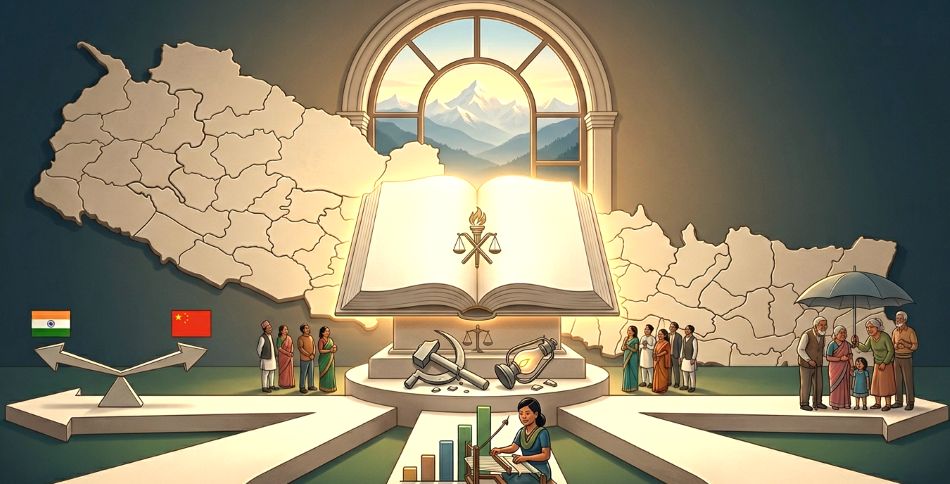
It codifies strategic non-alignment between India and China as a constitutional obligation, not a fleeting policy preference; economically, it treats domestic job creation as a justiciable fundamental right to arrest the remittance hemorrhage that consumes one-third of GDP and traps Nepal’s youth in cyclical exile.
By rendering the constitution’s socialist provisions—employment, social security, resource sovereignty—enforceable through judicial review and genuine fiscal federalism, the RSP wagers that law, not revolution, can discipline the state to deliver social justice in the world’s most precarious geopolitical theater.
Constitutional Socialism, though it is not a formal, widely codified school of thought in the same way as Marxism or liberalism, refers to a framework where socialist principles—such as social ownership, equitable distribution of resources, and welfare-state provisions—are embedded within and constrained by a constitutional democratic order. It represents an attempt to reconcile the socialist vision of economic justice with the constitutionalist commitment to the rule of law, separation of powers, fundamental rights, and democratic governance.
Unlike revolutionary socialism, which seeks to overthrow existing constitutional structures, Constitutional Socialism operates within them, using constitutional mechanisms to advance social and economic equality. It is closely related to democratic socialism and social democracy, but with a stronger emphasis on constitutional supremacy and institutional stability as prerequisites for sustainable social transformation.
Sandwiched between two nuclear-armed giants—India and China—this landlocked republic of roughly 30 million people faces a geopolitical reality that would test the wisdom of any statesman. Its constitution, promulgated in 2015 after years of political turmoil and a devastating civil war, declares Nepal a “socialist-oriented democratic republican state.”
This is not mere rhetorical flourish. It is, or ought to be, a strategic blueprint for navigating the treacherous terrain of the 21st century.
For Nepal, Constitutional Socialism—an approach that embeds socialist economic principles within the sturdy architecture of constitutional democracy—offers a plausible, perhaps necessary, path toward economic prosperity, political stability, territorial integrity, and the preservation of national interests in the world’s most geostrategically precarious geography.
And for the millions of young Nepalis who find themselves unemployed, underemployed, or compelled to seek their futures in the labor markets of the Gulf and Malaysia, this framework is not an abstraction. It is a matter of survival.
The constitutional text itself provides the foundation. Article 50 of the Constitution envisions a socialist-oriented economy built on the participation of public, private, and cooperative sectors, while Articles 31 through 43 guarantee fundamental rights to employment, social security, health care, education, and food sovereignty.
The document is ambitious, perhaps impossibly so. Yet ambition is not the enemy of progress; incoherence is. The tragedy of Nepal’s post-constitutional era has been the widening chasm between constitutional promise and governmental performance.
The constitution speaks of socialism, but the state behaves as if it were managing a remittance-dependent economy with no industrial strategy and no plan for its youth. Constitutional Socialism, properly understood, would close this gap by making the constitution’s socialist commitments justiciable, measurable, and institutionally enforceable.
Consider, first, the economic dimension. Nepal’s economy is a paradox. It is blessed with an estimated 42,000 megawatts of hydropower potential, fertile agricultural land, and a young, energetic population. Yet it remains one of the poorest countries in South Asia, with an economy dangerously dependent on remittances—money sent home by Nepali workers laboring in often exploitative conditions abroad.
The state has, in effect, outsourced its employment policy to foreign labor markets. This is not sustainable, and it is certainly not socialist. A Constitutional Socialist framework would treat the right to employment not as a campaign slogan but as a constitutional mandate requiring systematic state intervention.
This means industrial policy oriented toward domestic job creation, particularly in hydropower, agro-processing, and sustainable tourism; it means public investment in technical and vocational education aligned with labor market needs; and it means a renegotiation of Nepal’s trade and transit relationships to ensure that the country is not merely a transit corridor for others but a producer of value-added goods.
The transition to such an economy demands more than good intentions. It requires institutional capacity, and here Nepal’s federal structure—still struggling to find its footing—becomes both obstacle and opportunity. Provincial and local governments, which now account for roughly a third of national expenditure, remain under-resourced and over-dependent on federal grants.
Their capital expenditures are abysmally low, and their administrative capacity is constrained by staff shortages and legal ambiguity. Constitutional Socialism would address this by empowering subnational governments not merely as administrative units but as economic actors with genuine fiscal autonomy.
The constitution’s directive principles already call for equitable distribution of natural resource benefits; what is missing is the political will to implement revenue-sharing mechanisms for hydropower and other resources that currently enrich federal coffers while leaving local populations impoverished.
If Nepal’s youth are to find employment at home, the economic geography of the country must be transformed so that prosperity is not concentrated in Kathmandu but distributed across the provinces.
This economic transformation is inseparable from the imperative of political stability. Nepal has suffered from chronic governmental instability—coalitions form and dissolve with bewildering frequency, and the political class often appears more invested in intra-party maneuvering than in governance.
Constitutional Socialism offers a stabilizing logic: if the constitution’s socialist provisions are taken seriously, they create a baseline of policy continuity that transcends partisan cycles. A constitutional mandate for full employment, social security, and progressive taxation would constrain any government, regardless of its ideological complexion, from deviating too far from a developmental path.
This is not to suggest that politics should be depoliticized; rather, it is to argue that certain economic and social rights should be placed beyond the reach of transient majorities, just as civil and political rights are protected by constitutional courts. In this sense, Constitutional Socialism deepens constitutionalism rather than undermining it.
Political stability, in turn, is the precondition for territorial integrity. Nepal’s borders are not merely lines on a map; they are contested spaces where the interests of India and China collide. The Kalapani dispute with India, the management of the Himalayan watershed, and the construction of cross-border infrastructure all carry implications that extend far beyond bilateral relations.
For Nepal, territorial integrity requires not just military defense—an impossibility for a small state facing two giants—but diplomatic dexterity and the cultivation of what might be called strategic neutrality. This is not neutrality in the sense of isolation; Nepal is too dependent on its neighbors for trade, transit, and energy to pretend otherwise. It is neutrality in the sense of refusing to become a pawn in others’ strategic games.
Constitutional Socialism supports this posture by grounding Nepal’s foreign policy in constitutional principles rather than in the shifting preferences of political factions. A constitutionally mandated commitment to non-alignment, equitable trade, and the peaceful resolution of disputes would provide a stable framework for managing relations with both Delhi and Beijing.
The geostrategic reality is unforgiving. For India, Nepal is both shield and vulnerability—a buffer above the Siliguri Corridor, the narrow “chicken’s neck” that connects India’s mainland to its northeastern states. For China, Nepal is an opening to South Asia, a chance to turn altitude into access and to secure the southern flank of Tibet.
Both powers have invested heavily in Nepali infrastructure, and both view the country through the lens of their broader rivalry. Nepal’s hydropower sector has become a particular focal point of this competition, with India and China vying for contracts and influence.
A Constitutional Socialist approach would insist that Nepal’s natural resources serve Nepali interests first. This does not mean rejecting foreign investment or partnership; it means ensuring that such partnerships are governed by transparent, constitutional procedures that prioritize national benefit over short-term political gain.
The constitution’s provisions on natural resource management and intergovernmental fiscal relations, if properly implemented, would prevent the fire-sale of national assets to the highest foreign bidder.
For Nepal’s millions of unemployed youth, these grand strategic considerations may seem distant. They are not. The young Nepali who cannot find work in his own country, who watches his educated peers board buses to Kathmandu and then planes to Doha, is the human face of Nepal’s strategic vulnerability.
His unemployment is not merely an economic failure; it is a national security risk. A country that exports its most productive citizens is a country that hollows out its own future. Constitutional Socialism addresses this crisis directly.
The constitution already guarantees the right to employment and the right to social security; what is required is a constitutional jurisprudence that makes these rights enforceable against the state.
Courts in other jurisdictions have developed the concept of “positive obligations”—duties on the state to take active steps to realize fundamental rights. Nepal’s judiciary could, and should, do the same for the right to employment, compelling the government to articulate and implement credible job creation strategies.
The benefits for youth would be manifold. A domestically oriented industrial policy would create skilled manufacturing and technical jobs in hydropower, construction, and agro-industry. A reformed federal system with genuine fiscal devolution would allow provincial governments to tailor employment programs to local economic conditions.
A constitutional commitment to free education through the secondary level and subsidized higher education for the economically disadvantaged would ensure that the workforce of the future is equipped with the skills that a modern economy demands.
And a robust social security system—envisioned in the constitution but still largely unrealized—would provide a safety net that reduces the desperation that drives so many young Nepalis to accept precarious employment abroad.
Moreover, Constitutional Socialism would reframe the debate about remittances. Currently, remittances are treated as a boon, a lifeline that keeps the economy afloat. But they are also a symptom of failure—a sign that the state cannot provide for its own people.
A socialist-oriented constitutional order would treat remittances as a transitional phenomenon, not a permanent feature of the economic landscape. The goal would be to create conditions in which Nepali youth choose to stay and contribute to their country’s development, rather than being forced to leave.
This requires not just jobs but dignity: fair wages, safe working conditions, and the prospect of social mobility. The constitution’s guarantees of labor rights, including the right to form trade unions and engage in collective bargaining, are essential tools in this endeavor.
The path is difficult, and the obstacles are formidable. Nepal’s political class has shown little appetite for the kind of disciplined, long-term governance that Constitutional Socialism would require. Corruption, patronage, and the persistence of a Kathmandu-centric elite continue to undermine the federal experiment.
The central government remains reluctant to devolve genuine power and resources to the provinces, and the legal framework for fiscal federalism is still incomplete. Yet these are arguments for reform, not for surrender. The constitution provides the architecture; what is needed is the political will to inhabit it.
Constitutional Socialism, thus, offers Nepal a way to reconcile its socialist aspirations with the hard realities of its geography and its democracy. It is not a call for revolution but for constitutional fidelity—a demand that the state live up to the promises it has already made to its people.
For a country caught between two rising powers, for a nation whose youth are its greatest asset and its greatest export, for a republic that has endured civil war and political chaos to arrive at a constitutional moment, this is not too much to ask. It is, in fact, the very least that is required.
Nepal’s journey to economic prosperity, political stability, and territorial integrity will not be easy. But it is a journey that must begin with the constitution, not end there. Constitutional Socialism, understood as the rigorous, institutionally grounded pursuit of the constitution’s socialist commitments, is not a utopian fantasy. It is a pragmatic necessity. And for the young Nepalis waiting for their country to become a place worth staying in, it is long overdue.
I have been working on the trends of the Nepalese Foreign Policy as the existing global order gets gradually altered in 21st century world ..
I have been working on the trends of the Nepalese Foreign Policy as the existing global order gets gradually altered in 21st century world. I am an MA in English and MPhil in International Relations a...
@ Copyright matrikapoudyal.com All Rights Reserved
Designed by Fortune Info Tech