



I have been working on the trends of the Nepalese Foreign Policy as the existing global order gets gradually altered in 21st century world ...
Nepal’s symbiotic diplomacy encodes the patient art of converting the burden of location into the dividend of connection, so that proximity to two rival giants enriches all three parties rather than endangering one—this is not merely a policy, but an existential craft, and it merits a far more honest conversation than it usually receives. Since, geography, Napoleon is said to have remarked, is destiny—and no nation has lived that aphorism more intimately than Nepal.
From the buffer equilibrium of the nineteenth century to King Birendra’s Zone of Peace proposal, from non-alignment to what diplomats now call dynamic equi-proximity, Kathmandu has insisted on authoring its own identity rather than accepting the one assigned to it by great-power rivalry. And philosophy, fittingly, supplies the idiom: the land that gave the world the Buddha at Lumbini practices, in its foreign policy, a kind of Middle Way—neither attachment nor aversion toward either neighbor.
The classical statecraft offers Nepal little grounds for optimism. Kautilya’s mandala theory held that a state’s neighbor is its natural rival and the neighbor’s neighbor its natural ally; by that arithmetic, a country of thirty million wedged between two powers of a billion-plus each ought to be either satellite or battlefield. Small-state realism, likewise, predicts survival through bandwagoning or hiding; Nepal has quietly refused both scripts.
The winter of 2015, when essential supplies thinned amid differences over Nepal’s new constitution, remains a wound in the national memory, and Delhi has since labored to be more attentive. At the same time, genuine green shoots have appeared: a power-trade framework that speaks, ambitiously, of ten thousand megawatts flowing south, new rail and road corridors, and a quiet recognition that India’s own interest lies in a stable, prosperous Nepal. Symbiosis with India, then, is less about escaping dependence than about deepening interdependence until partnership becomes self-interest on both banks of the Mahakali.
Consider first the southern relationship, the older and warmer of the two, though historically the more combustible. India is not simply Nepal’s largest trade partner; it is an open frontier of nearly 1,800 kilometres across which flow not only goods but language, marriage, pilgrimage and memory—what the two peoples themselves call roti-beti, ties of bread and kinship. The 1950 Treaty of Peace and Friendship binds them still, even as its anachronisms leave the patient labors of the Eminent Persons’ Group awaiting a formal joint hearing.
Formal relations with the northern neighbor date to 1955 though a quieter transformation has been unfolding. The Arniko Highway threads up toward Kodari; and long before the treaties, Tibetan wool-and-salt caravans wrote the first draft of this bond. The hardship winter of 2015–16 accelerated the northward opening, and the results now stand in treaty form: a transit and transport arrangement granting Nepali goods passage to Chinese sea and land ports, the Belt and Road memorandum of 2017, Chinese investment now standing among Nepal’s largest sources of foreign commitments, and the distant but persistent dream of a Kerung–Kathmandu railway.
So far, this is no fairy tale, and honesty requires saying so. Questions of debt sustainability, the gap between BRI announcements and unbuilt projects, and the political expectations that shadow Beijing’s generosity all complicate the courtship.
By the same token, India’s sensitivities accompany every northern signature. Nepal’s task toward China is therefore one of graceful balancing: gratitude without subordination, openness without entanglement—the art of saying yes to both giants without saying no to either.
Here the biological metaphor earns its keep, for symbiosis spans a spectrum—from parasitism through commensalism to mutualism, the condition in which both organisms flourish. Mutualism is what Nepal must aim at, and international theory suggests why this is not naive.
Keohane and Nye taught us that under complex interdependence, power flows not from size alone but from asymmetries of dependence; and small states, as the hedging literature reminds us, survive uncertainty precisely by taking out insurance with several partners rather than betting the house on one. Nepal’s leverage is modest but real.
To India it offers a stable northern frontier, water, energy and a friendlier South Asia than any alternative; to China it offers a peaceful southern flank, trans-Himalayan trade corridors and a Himalayan endorsement of its global aspirations. Neither giant, in other words, profits from pushing Nepal into the other’s exclusive embrace—and that shared reluctance is itself a form of leverage, the tyranny of geography slowly turned to advantage.
Admittedly, the practice lags the promise, and candor demands naming the dangers. The gravest threats to symbiotic diplomacy are internal, not external. Kathmandu’s revolving-door politics—governments that rarely outlive their honeymoon—drain credibility from long commitments; foreign capitals have learned simply to wait for the next cabinet.
Kathmandu’s equidistance is not indecision but a mountaineer’s discipline—weight kept centered on a knife-edge ridge, in wind from both flanks, corrected daily by a diplomacy that can afford no stumble. Falling, after all, is easy; every path off the ridge falls. Only the middle one leads anywhere.
The temptation to externalize domestic failure by brandishing a “China card” or an “India card” has repeatedly backfired, for cards, once played, leave the hand. Cartography, moreover, has re-entered the vocabulary of grievance—Kalapani, Lipulekh and Limpiyadhura in the northwest, contested pillars in Humla—reminding all parties that maps, too, are diplomacy by other means.
And, the triangle has quietly become a square: the bruising debate over the Millennium Challenge Corporation compact, ratified in 2022, signalled that Washington also intends a say in Himalayan affairs. A symbiosis that exists only in speeches will, in the end, feed no one.
The agenda, as a result, must begin at home, for as B. P. Koirala understood, foreign policy is domestic policy pursued with a longer horizon. Nepal needs a doctrine, not a mood: a cross-party consensus, insulated from coalition arithmetic, on the non-negotiables—balanced engagement, genuine non-alignment, territorial integrity, and the refusal to let any neighbour’s dossier become a Nepali party’s manifesto.
It needs economic statecraft to match: hydropower as the national asset par excellence, tourism revived, and a deliberate graduation from remittance dependency toward production, so that diplomacy rests on something weightier than goodwill. It needs, too, a diplomacy of capacity and of ideas—a foreign service staffed and funded like the priority it is, and a Kathmandu confident enough to convene Himalayan dialogues rather than merely receive visitors. Landlocked, Nepal reminds itself, need not mean land-locked; the aspiration is land-linked.
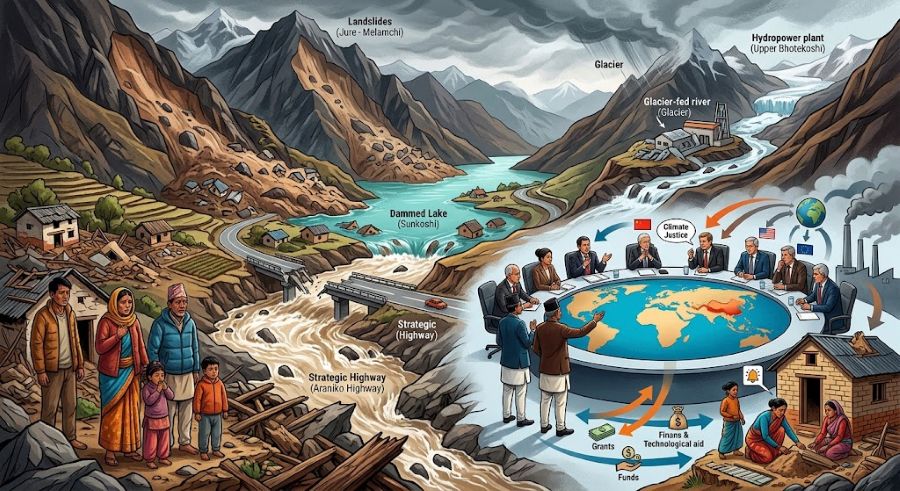
Ultimately, the deeper promise of symbiosis lies in a reframing: Nepal as bridge, not buffer. The Himalaya has too long been imagined as a wall, when it is in truth a watershed of civilizations—Indic and Sinic, Hindu and Buddhist, folded into a single weather system. Lumbini could bind pilgrim circuits from Bodh Gaya to Wutaishan; long-mooted trilateral cooperation deserves revisiting rather than polite burial; and above all looms the ecological commons, for the glaciers of the “third pole” water well over a billion people, making climate diplomacy the one arena where Delhi, Beijing and Kathmandu are allies by necessity rather than choice.
Rousseau’s old parable of the stag hunt applies: those who chase hares alone will dine poorly forever, while the feast belongs to those who hunt together. Vasudhaiva kutumbakam on one side, harmony without uniformity on the other—and between them, Nepal’s own oldest instinct: amity with all, enmity with none.
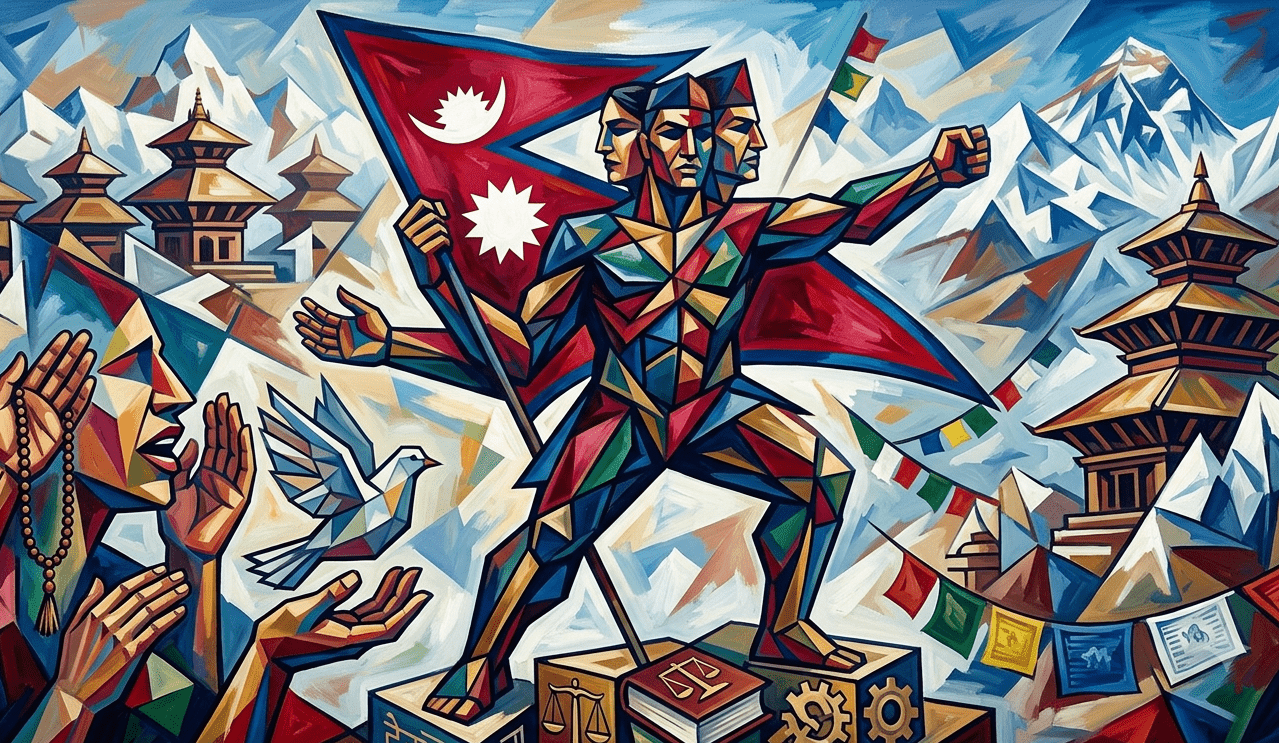
Symbiotic diplomacy, hence, is not a doctrine to be proclaimed but a discipline to be renewed each morning, like the prayer flags strung across a Himalayan ridgeline—tattered by wind, and therefore still flying.
The yam, naturally, flourishes not despite the boulders but in the soil their shade keeps moist. Nepal’s middle path is not the easy path; it demands a competence disproportionate to the country’s size and a patience disproportionate to its politics.
Kathmandu’s equidistance is not indecision but a mountaineer’s discipline—weight kept centered on a knife-edge ridge, in wind from both flanks, corrected daily by a diplomacy that can afford no stumble. Falling, after all, is easy; every path off the ridge falls. Only the middle one leads anywhere.
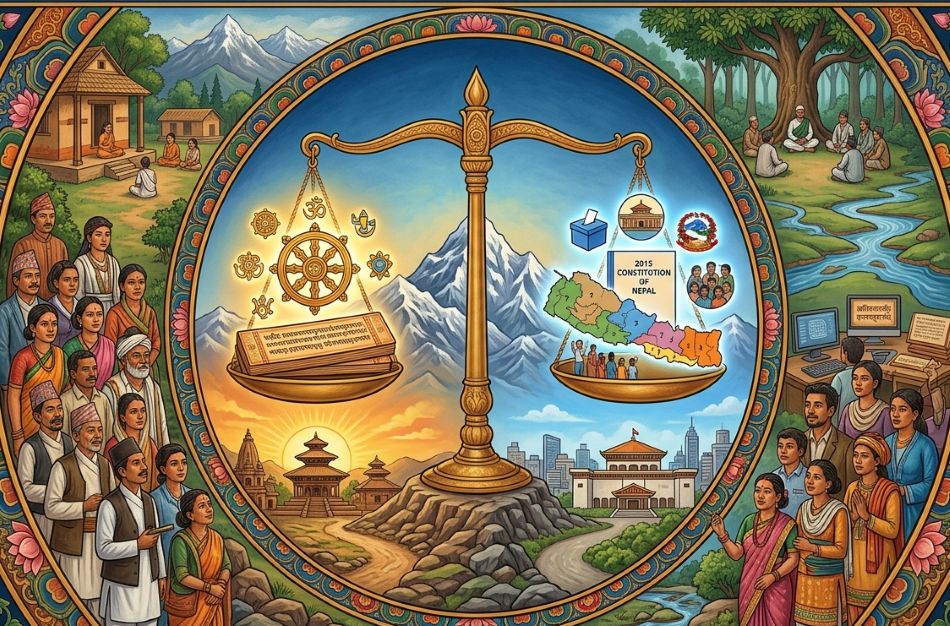
Nepal’s middle path is not the easy path—convenience, after all, lies at the extremes. To be sure, Aristotle warned that the mean is harder to hit than either excess, and the Buddha, born at Lumbini, taught the Middle Way not as comfort but as discipline; a small state caught between two giants inherits both the teaching and the burden.
Nepal, as a small nation, practices the oldest and newest of diplomatic arts between Holy Ganga River and the Holy Kailash Mountain. Should it succeed, the lesson will travel far beyond the mountains: that in an age of giants, the smallest states are not condemned to be chessboards, but may, with skill and dignity, become the bridges across which the giants themselves must pass.
I have been working on the trends of the Nepalese Foreign Policy as the existing global order gets gradually altered in 21st century world ..
I have been working on the trends of the Nepalese Foreign Policy as the existing global order gets gradually altered in 21st century world. I am an MA in English and MPhil in International Relations a...
@ Copyright matrikapoudyal.com All Rights Reserved
Designed by Fortune Info Tech