


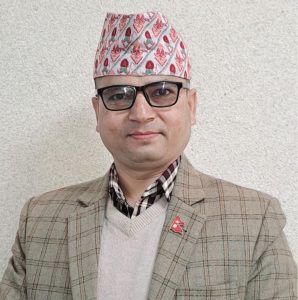
I have been working on the trends of the Nepalese Foreign Policy as the existing global order gets gradually altered in 21st century world ...
Recklessness here is not a mistake. It is extinction. Strategic blunders do not cost votes alone. They cost rivers. Borders. Generations. Past rulers knew this. They trembled before geography. In that trembling, they found wisdom. Today’s rulers must tremble too. Not with fear. With reverence.
Nepal stands between heaven and earth. Between memory and tomorrow. For two thousand years, this land has breathed. It has not merely survived. It has sung.
Today, a new song must rise. Not the tired tune of motherland politics, where old men clutch maps and egos. But motherboard politics, where circuits of wisdom connect the mountain to the microchip, the temple to the algorithm, the soil to the satellite.
The youth of Nepal—you who scroll and sow, who code and cultivate—must hear this. Your ancestors built a nation between empires. You must build a civilization between eras.
Begin with the Gopals. They were cowherds, not conquerors. Keepers of balance, not kings of greed. Then came the Kirats. They bowed to nature. They raised stones to the sky. Then the Licchavis arrived. And oh, Amshuvarma! He did not merely rule. He wove alliances. He married his daughter to the Tibetan king. He turned Kathmandu into a hub where silk met scripture.
That was the first juncture. Nepal chose connection over conquest. Marriage over war. Wisdom over swagger. The second juncture followed in stone and gold. Nepali craftsmen built the roofs of Lhasa. They shaped the minds of pilgrims. Nepal was small. But its shadow was long.
But empires forget. The third juncture came as warning. The Malla kings were brilliant in art. They were foolish in division. One valley became three kingdoms. Kathmandu, Bhaktapur, Patan. Sisters turned rivals. They built palaces. They forgot walls. They painted gods. They ignored geography. Then came the fourth juncture, sharp as a kukri.
Prithvi Narayan Shah looked south at the Company. He looked north at the cold plateau. He understood what the Mallas forgot. Nepal was not merely a kingdom. It was a geostrategic prayer. He unified not just territory. He unified destiny. He warned that Nepal was a yam between two boulders. That was not fear. That was clarity. That was love dressed as strategy.
Yet even clarity blurs. The fifth juncture arrived in fire and ink. The Anglo-Nepalese War, 1814. One miscalculation. One overreach. The Sugauli Treaty bled Nepal of its rivers, its plains, its pride. The mountains stayed. But the exits narrowed. This was the price of geostrategic recklessness. The sixth juncture proved Nepal could turn poison to medicine.
In 1857, the Sepoy Mutiny shook British India. Jang Bahadur Rana did not rush. He calculated. He sent troops not as servants, but as strategists. He earned autonomy by reading the mind of the empire. He played chess while others played dice. Nepal kept its independence not by arms, but by the sharp diplomacy of a man who knew: the smallest pawn, moved wisely, checkmates the king.
Then the people spoke. The seventh juncture: 1951. The Rana walls fell. Not from foreign cannons. From Nepali voices. The eighth: 1990. The streets became rivers. The rivers washed away the absolute. The ninth: 2006. The Comprehensive Peace Agreement showed that even the longest war can end in words, if the heart is sincere.
These were not mere politics. They were the slow, certain transfer of power. From palace to street. From throne to ballot. The real holder of state power—the farmer, the teacher, the student, the mother—stepped into the light.
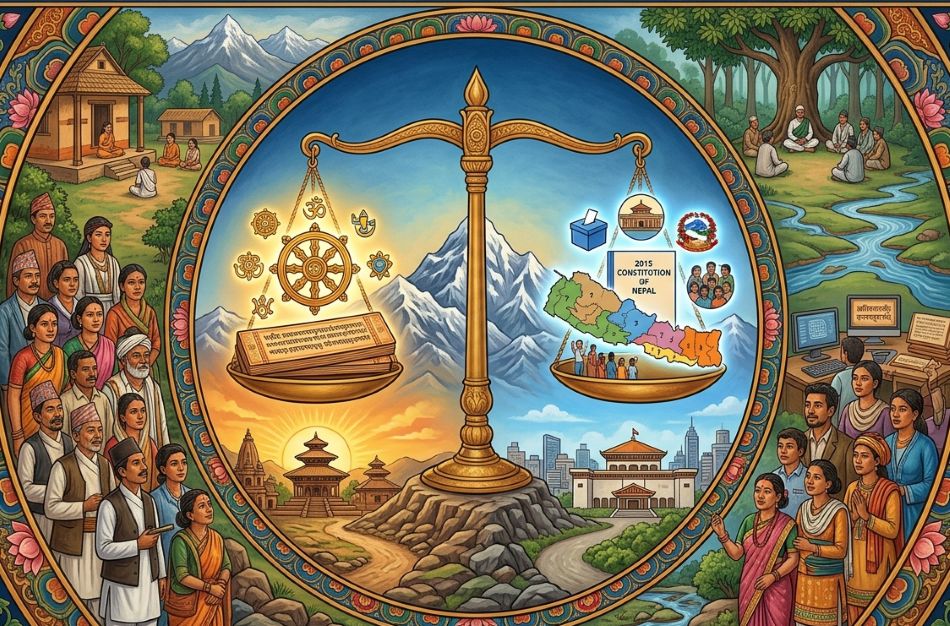
The tenth juncture is now. The constitution of 2015 was born through blockade and earthquake, through tears and ink. It should have been a covenant. Instead, it mirrors the petty ambition of those who confuse noise with vision.
Today’s statesmanship struts. It swaggers. It builds personal towers while the national foundation cracks. But look at the youth. The Gen-Z uprising is not mere protest. It is prophecy. It says: we will not inherit your bitterness. We will code your constitution into algorithms of inclusion.
We will trade not just goods, but ideas. The motherboard must serve the motherland. Modernization without westernization. Progress without Christianization. Nepal does not need to become the West. It needs to become itself, only louder.
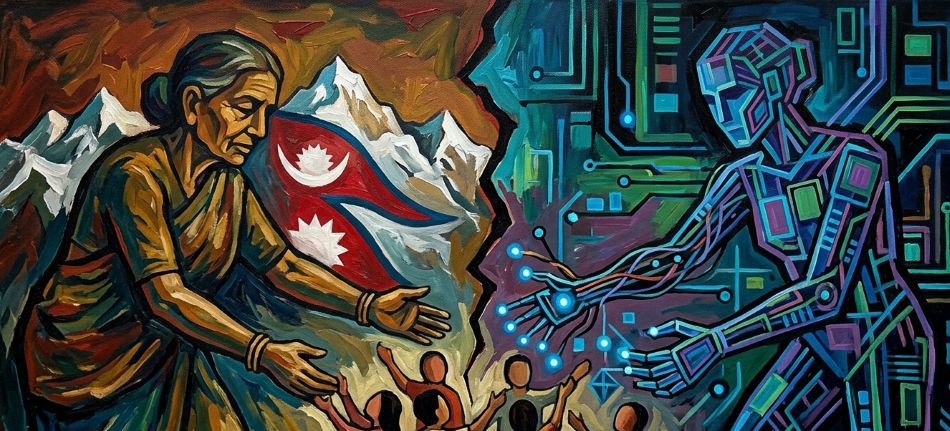
Imagine a Nepal where the algorithm knows the mountain trail. Where artificial intelligence translates ancient manuscripts into global wisdom. Where blockchain guards the Terai farmer’s land. Where digital diplomacy connects Kathmandu to the world, but the soul stays in Pashupatinath.
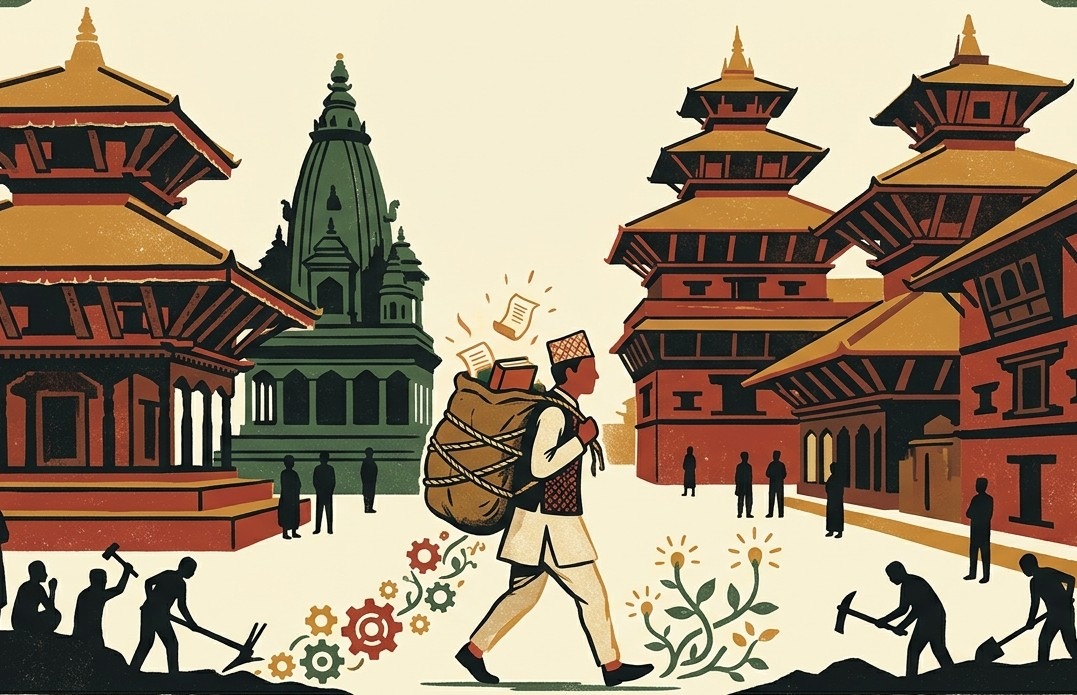
This is motherboard politics. Technology as servant, not master. Culture as root, not relic. The motherboard does not erase the motherland. It emboldens it. It carries the Himalaya into the cloud without losing the stone. It lets youth in Birgunj build startups. It lets artists in Bhaktapur build dreams. And it keeps the passport strong because the history runs deep.
However, machines alone do not save. The psyche must rise. The Nepali mind must be enriched. Sane. Sharpened. Highly motivated. Not the small ambition of a minister’s chair. But the vast ambition of national dignity. Not the swagger of a press conference. But the silence of a diplomat who knows when to speak, when to listen.
The people must demand leaders who understand geostrategic loci. Not as textbook words. As blood memory. Nepal is still that yam between two boulders. The boulders have grown. One breathes fire. The other builds walls.
Recklessness here is not a mistake. It is extinction. Strategic blunders do not cost votes alone. They cost rivers. Borders. Generations. Past rulers knew this. They trembled before geography. In that trembling, they found wisdom. Today’s rulers must tremble too. Not with fear. With reverence.
And so, the horizon opens. A new party will emerge. Not from old palaces. From new squares. Leaders with novel philosophy. Young enough to code. Old enough to pray. They will carry laptops and scriptures. They will speak global lingua franca and Nepali. Python and Sanskrit.
They will know that national interest is not a slogan. It is service to the people who hold real power. They will not seek to rule. They will seek to connect. And in their hearts will beat one truth. Nepal’s glory was never in its size. It was in its sanity.
The brave people of this land have survived two thousand years of wind and war. They deserve not just a government. They deserve a vision. The motherboard is ready. The motherland is waiting. The youth are rising. And Nepal, dear Nepal, will sing again.
I have been working on the trends of the Nepalese Foreign Policy as the existing global order gets gradually altered in 21st century world ..
I have been working on the trends of the Nepalese Foreign Policy as the existing global order gets gradually altered in 21st century world. I am an MA in English and MPhil in International Relations a...
@ Copyright matrikapoudyal.com All Rights Reserved
Designed by Fortune Info Tech