

I have been working on the trends of the Nepalese Foreign Policy as the existing global order gets gradually altered in 21st century world ...
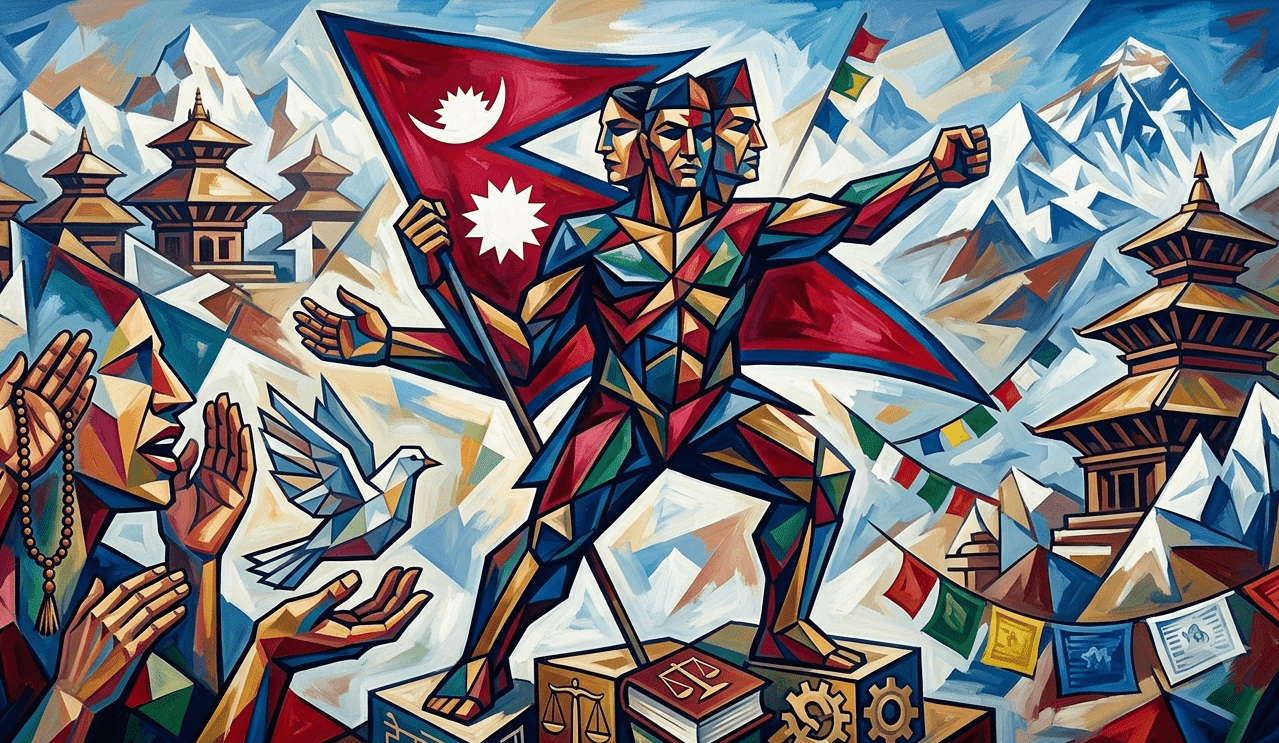
Politicians must stand their ground. They must stand for the constitution. They must stand for the rule of law. They must stand for the secular republic that guarantees every citizen the right to worship, speak, and live without fear.
The old Nepali proverb whispers a truth that leaders must hear: A single bamboo does not make a fence; a single tree does not make a forest. No leader, no party, no community can carry this nation alone.
The hour demands something rare and difficult. It demands the courage to stand firm in one’s convictions, and the wisdom to reach across the divide.
The evidence is not abstract. It is written in ash and broken glass. In Sunsari, a dispute over a loudspeaker near a temple spiraled into stone-pelting, police gunfire, and the death of a young man named Om Prakash Mehta. Curfews followed. The army rolled in.
Protesters defied orders, setting fires and vandalizing shops as anger spilled across the streets of Kaptanganj. Earlier this year, in Dhanusha, a mosque was vandalized after a social media post wounded religious sentiments.
In Birgunj, demonstrators burned tires, pelted stones at security forces, and left seven police personnel injured. Since January alone, at least five major communal incidents have scarred the Terai, from Rautahat to Kapilvastu.
The Home Ministry itself has flagged rising religious and political extremism in this belt as a leading security concern. These are not mere disturbances. They are symptoms of a deeper fracture.
Politicians must stand their ground. They must stand for the constitution. They must stand for the rule of law. They must stand for the secular republic that guarantees every citizen the right to worship, speak, and live without fear.
To compromise on these principles is to surrender the soul of the state. Every elected representative carries the hopes of a constituency, and those hopes deserve a voice that does not waver.
Nevertheless, standing one’s ground is not the same as digging a trench. It is not the same as turning a principled position into a permanent barrier. There is a difference between holding firm and refusing to listen.
Indeed, there is another proverb that cuts to the heart of the matter: When two elephants fight, it is the grass that gets trampled. The people of the Terai are that grass. They are the shopkeepers who watch their livelihoods burn. They are the mothers who cannot send their children to school when curfews fall. They are the farmers, the laborers, and the faithful of every tradition who simply wish to pray, work, and sleep in peace.
When leaders allow rhetoric to harden into hatred, they do not merely disagree. They set the field on fire. Consequently, finding common ground is not weakness. It is the highest form of statesmanship.
Moreover, the fires in the Terai are not spontaneous. They are kindled. Organized groups now move through these border towns with agendas that serve forces beyond Nepal’s interest. Social media amplifies every insult into a battle cry.
Cross-border currents stir identities into weapons. The same towns—Birgunj, Dhanusha, Sunsari—erupt again and again because the underlying architecture of distrust remains unaddressed. In this light, politicians must see that the enemy is not the opposition across the aisle. The enemy is the cycle itself. The enemy is the belief that one community’s rise requires another’s fall.
Therefore, the way forward must be concrete, not rhetorical. First, permanent inter-faith dialogue committees must meet at the municipal level long after the cameras leave. Second, procession routes, sound limits, and festival timings must be negotiated and enforced before tension ignites, with a single accountable committee for every event.
Third, police must follow de-escalation protocols that do not move from conversation to live fire within the same hour. Fourth, prosecutions must reach beyond bail hearings so that both communities see justice rather than a revolving door. Fifth, political parties must resist the temptation to treat religious blocs as vote banks, for once identity becomes currency, peace becomes a liability.
Above all, leaders must meet—regularly, publicly, and without preconditions—to demonstrate that the republic still has room for every voice.
Ultimately, Nepal’s story is not finished. The same rivers that water the Terai have carved canyons through stone not by force, but by persistence. The same mountains that touch the clouds stand together, not alone.
As another old saying reminds us: The thread of unity is stronger than the rope of division. Let every politician remember this. Stand your ground for justice. Yet bend your heart toward your neighbor. The nation is watching. The nation is waiting. And the nation still believes that its leaders can be both brave and wise.
I have been working on the trends of the Nepalese Foreign Policy as the existing global order gets gradually altered in 21st century world ..
I have been working on the trends of the Nepalese Foreign Policy as the existing global order gets gradually altered in 21st century world. I am an MA in English and MPhil in International Relations a...
@ Copyright matrikapoudyal.com All Rights Reserved
Designed by Fortune Info Tech