




I have been working on the trends of the Nepalese Foreign Policy as the existing global order gets gradually altered in 21st century world ...
Climate change now shapes Nepal’s politics, economy, and security. The country’s mountain landscapes face landslides, floods, glacial lake bursts, and violent river surges. These events destroy homes, roads, bridges, farms, and power plants. They also deepen poverty and strain public institutions.
The evidence from Sindhupalchok, Melamchi, Rasuwa, and Nuwakot exposes a basic injustice: Nepal contributes negligible emissions, yet mountainous communities absorb severe climate damage. Nepal’s climate policy, therefore, needs a clear diplomatic strategy with stronger domestic resilience and firmer international pressure for finance, compensation, and accountability.
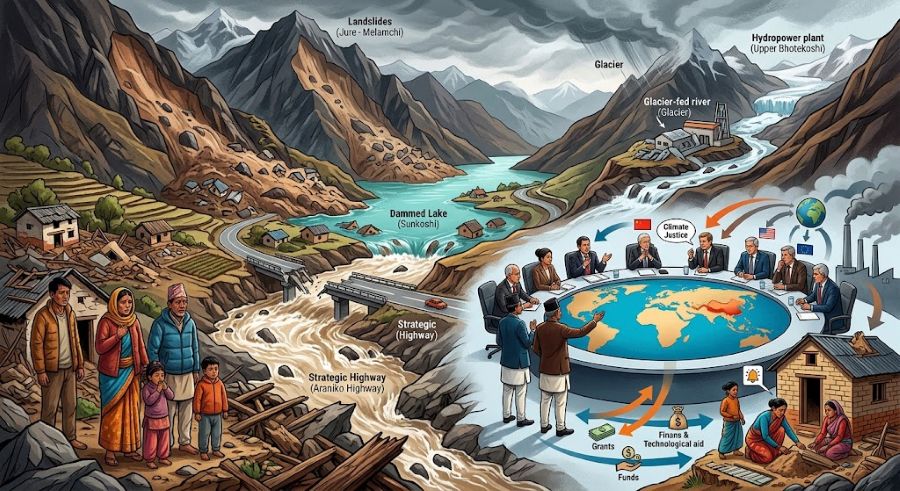
On August 2, 2014, torrential monsoon rainfall triggered the massive Jure landslide in Sindhupalchok District, eighty kilometers northeast of Kathmandu. The landslide killed 156 people, displaced hundreds of families, and buried entire settlements. Moreover, the moving rock mass dammed the Sunkoshi River and created a 55-meter-high natural barrier. This barrier formed a 3.1-kilometer-long lake that submerged upstream farms and homes.
Beyond this human tragedy, the landslide destroyed two kilometers of the Araniko Highway and interrupted Nepal’s crucial trade corridor with China. It also damaged local hydropower facilities. Furthermore, poorer rural households lost assets worth fourteen times their annual income. Such losses push vulnerable families into long-term poverty as it demonstrates how a single climate-linked event can erase decades of household progress.
Similarly, the 2021 Melamchi disaster repeated this destructive pattern on a wider scale. On June 15 and July 31, intense upstream rainfall and moraine dam breaches unleashed catastrophic debris floods. Massive sediment flows killed more than twenty people and swept away over 700 homes–burying the headworks of the $800 million Melamchi Water Supply Project under twenty meters of debris, losing primary drinking water source of the capital city.
The same flood destroyed six strategic bridges and 22 kilometers of access roads. Melamchi Municipality suffered $436 million in economic damage, while Helambu Rural Municipality lost $62 million. A typical affected household faced a loss of $52,113 but received only $380 in disaster assistance. This severe recovery gap reveals a second failure: emergency aid rarely matches the actual cost of climate destruction.
Furthermore, transboundary rivers carry additional danger into Rasuwa and Nuwakot districts. Glacial lake outburst floods and extreme rainfall from Tibet repeatedly strike the Bhotekoshi and Trishuli basins. In 2016, a Tibet-origin flash flood completely destroyed the 45-megawatt Upper Bhotekoshi Hydropower Plant.
Subsequent floods devastated market centers, destroyed road bridges, and damaged hydro-energy infrastructure across both districts. These recurring catastrophes produce humanitarian emergencies, drain national resources, and weaken economic infrastructure. Consequently, Nepal’s climate vulnerability extends beyond domestic policy. Transboundary water management now affects regional stability, public safety, energy security, and diplomatic trust.
Multilateral climate governance developed slowly through international negotiations and environmental agreements. Scientists established the Intergovernmental Panel on Climate Change in Geneva in 1988. Subsequently, the 1992 Earth Summit in Rio de Janeiro launched the United Nations Framework Convention on Climate Change, with the process centered in Bonn.
Negotiations advanced at COP 1 in Berlin in 1995. Later, COP 3 in Kyoto adopted the Kyoto Protocol in 1997 and introduced binding emission targets for developed economies. COP 21 in Paris adopted the Paris Agreement in 2015 and replaced strict mandates with voluntary Nationally Determined Contributions.
However, these diplomatic milestones produced insufficient results. Global emissions continue to approach the dangerous 1.5°C threshold. Voluntary national pledges fall short of required reductions whereas industrialized countries repeatedly miss the promised $100 billion annual climate finance target for developing nations.
Recent climate conferences highlight the continuing diplomatic gridlock. COP 26 in Glasgow, COP 27 in Sharm el-Sheikh, COP 28 in Dubai, COP 29 in Baku, and COP 30 in Belém all exposed persistent divisions over responsibility and finance. COP 28 operationalized the Loss and Damage Fund and completed the first Global Stocktake though actual financial commitments remain far below the needs of vulnerable countries.
At the same time, rivalry between the United States and China complicates international negotiations. Relations between these two major emitters heavily influence global climate diplomacy; the European Union’s Carbon Border Adjustment Mechanism adds another political concern.
This policy places economic pressure on developing countries without offering equal technology transfer or adaptation finance. Accordingly, Nepal’s diplomatic approach needs unity, legal precision, and broad international support rather than symbolic statements alone.
Domestic climate defense requires proven disaster-risk practices and carefully planned infrastructure. Real-time hydrological monitoring networks can track dangerous river levels. Automated early-warning systems can alert remote communities before floods arrive. Ecosystem-based watershed management can stabilize slopes and reduce erosion. In addition, engineers need strict geological assessments before approving roads, bridges, dams, and power plants.
Infrastructure designs should withstand severe hundred-year climate scenarios. Transparent loss-and-damage records can also improve emergency planning and public accountability. Furthermore, recovery systems should transfer grants directly to vulnerable citizens without unnecessary delays. These measures convert international climate commitments into practical protection for Nepali households.
Internationally, Nepal needs active leadership within the Least Developed Countries group and the Small Island Developing States coalition. At UN climate forums, Nepalese diplomats can connect mountain vulnerability with island vulnerability through shared arguments about climate justice. Through this unified front, vulnerable countries can demand enforceable emission reductions and grant-based loss-and-damage compensation.
Nepal needs, for meantime, formal agreements with China on real-time hydrological data sharing, joint glacier monitoring, and coordinated early-warning alerts. Likewise, hydro-diplomacy with India can support cross-border flood management, resilient energy grids, and joint investment in river protection. Such regional cooperation addresses the geographic reality behind Nepal’s flood risk. It also builds trust among neighboring states while protecting downstream populations.
Nepal, thus, faces a decisive political and environmental moment. The country produces negligible emissions compared with major industrial powers, yet its citizens bear devastating ecological and economic costs. Effective climate diplomacy gives Nepal a practical method for demanding fairness. The international community owes vulnerable mountain nations direct grants, advanced technology, and compensation for unavoidable losses.
In return, Nepal owes its citizens stronger infrastructure, transparent institutions, and well-prepared local communities. Climate diplomacy therefore combines national responsibility with international accountability. Nepal’s mountains, rivers, and people deserve a security strategy that recognizes both scientific evidence and global justice.
I have been working on the trends of the Nepalese Foreign Policy as the existing global order gets gradually altered in 21st century world ..
I have been working on the trends of the Nepalese Foreign Policy as the existing global order gets gradually altered in 21st century world. I am an MA in English and MPhil in International Relations a...
@ Copyright matrikapoudyal.com All Rights Reserved
Designed by Fortune Info Tech