


I have been working on the trends of the Nepalese Foreign Policy as the existing global order gets gradually altered in 21st century world ...
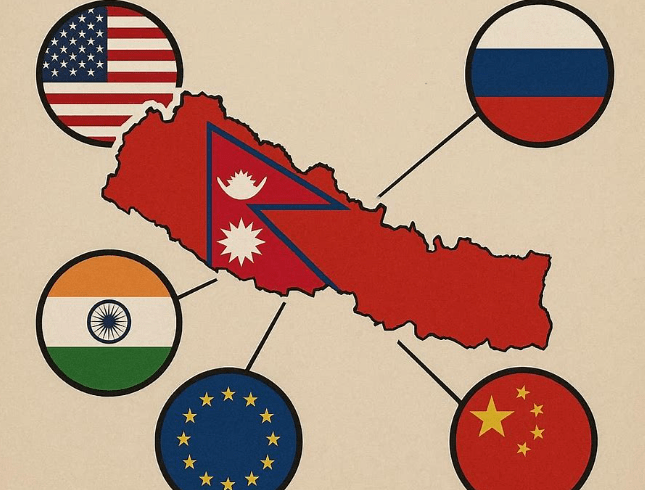
Can Nepal, a small Himalayan nation, afford to navigate its foreign policy with global powers like the US, Russia, China, India, and the European Union, each possessing diverse and contradictory foreign policies with contending strategic interests?
The question carries profound weight, suggesting Nepal’s geopolitical position as a delicate and challenging endeavor. To answer with a single ‘yes’ or ‘no’ would be a disservice to the intricate reality. Instead, a nuanced exploration reveals that while this journey is fraught with risks, it also presents a unique opportunity for shrewd diplomacy.
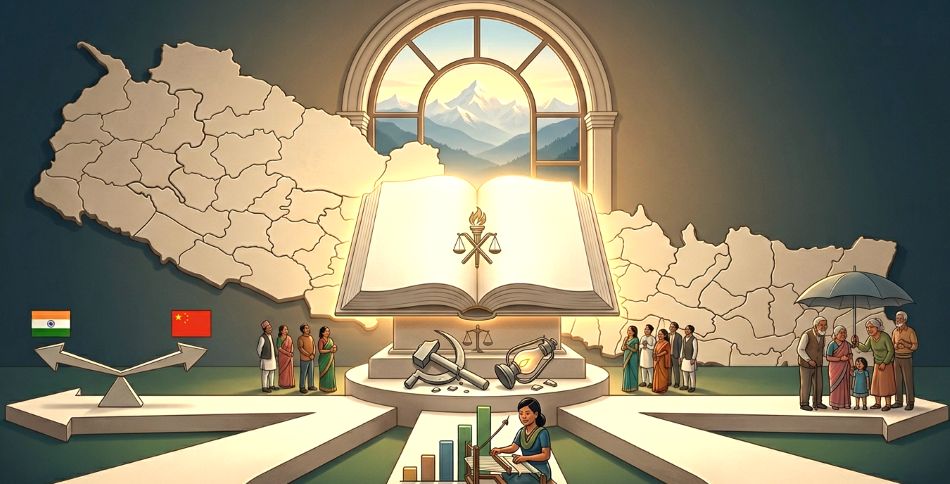
Nepal’s geographical location, perched between two rising economic and military giants—India and China—serves as a compelling analogy: a yam between two boulders, a phrase coined by its founder, Prithvi Narayan Shah. This metaphor remains as pertinent today as it was centuries ago.
The competing interests of these two regional heavyweights naturally demand Nepal’s constant vigilance and a masterful balancing act. While India shares deep cultural, historical, and economic ties, China has increasingly become a major investor, particularly through its Belt and Road Initiative (BRI). The challenge lies in leveraging these relationships for national benefit without becoming a pawn in a larger geopolitical game.
The entry of extra-regional powers further complicates Nepal’s diplomatic landscape. The United States, with its Indo-Pacific Strategy, and the European Union, with its development partnerships, add new layers of complexity. These global players often have their own interests in the region, which may conflict with those of India and China.
For instance, the Millennium Challenge Corporation (MCC) compact with the US, a significant grant for infrastructure development, sparked intense domestic debate and drew criticism from China. This incident underscored Nepal’s vulnerability to external pressures and the need for a unified, sovereign foreign policy vision.
A successful foreign policy for Nepal necessitates a paradigm shift from a reactive to a proactive stance. Past inconsistencies, often rooted in domestic political instability, have sometimes undermined Nepal’s credibility on the global stage. A lack of a cohesive national consensus on foreign affairs and frequent changes in government have hampered long-term strategic planning.
Consequently, Nepal must first secure its domestic foundation, ensuring political stability and a unified vision that transcends partisan politics. This internal strength becomes the bedrock upon which an effective external strategy can be built.
Nepal’s diplomatic survival, therefore, hinges on its ability to evolve from a “buffer state” to a “dynamic bridge.” Instead of simply being a passive landmass separating two powers, Nepal can position itself as a facilitator of regional cooperation and a hub for connectivity.
By championing principles of non-alignment and peaceful coexistence, as enshrined in its constitution, Nepal can attract diverse partnerships without aligning with a single bloc. This strategy of “strategic hedging” involves engaging with all major powers on an issue-by-issue basis, securing economic aid and development assistance while safeguarding its sovereignty and national interests.
Ultimately, can Nepal afford this delicate dance? The answer is not just a matter of financial or military power but of diplomatic acumen. It requires a clear articulation of national interests, a skilled diplomatic corps, and most importantly, a steadfast national resolve.
Nepal’s destiny does not lie in passively accepting its fate as a small nation hemmed in by giants. On the contrary, its future rests upon its capacity to wield its geography and principles as powerful diplomatic assets, transforming vulnerability into advantage.
The path ahead requires courage, clarity, and unwavering commitment. It demands that Nepal navigates the turbulent seas of global politics with the precision of a master sailor, using the contending winds of great powers to propel its own ship forward.
Through astute and visionary diplomacy, Nepal can not only survive but also thrive, proving that a nation’s true strength lies not in its size but in its spirit and strategic foresight.
I have been working on the trends of the Nepalese Foreign Policy as the existing global order gets gradually altered in 21st century world ..
I have been working on the trends of the Nepalese Foreign Policy as the existing global order gets gradually altered in 21st century world. I am an MA in English and MPhil in International Relations a...
@ Copyright matrikapoudyal.com All Rights Reserved
Designed by Fortune Info Tech