
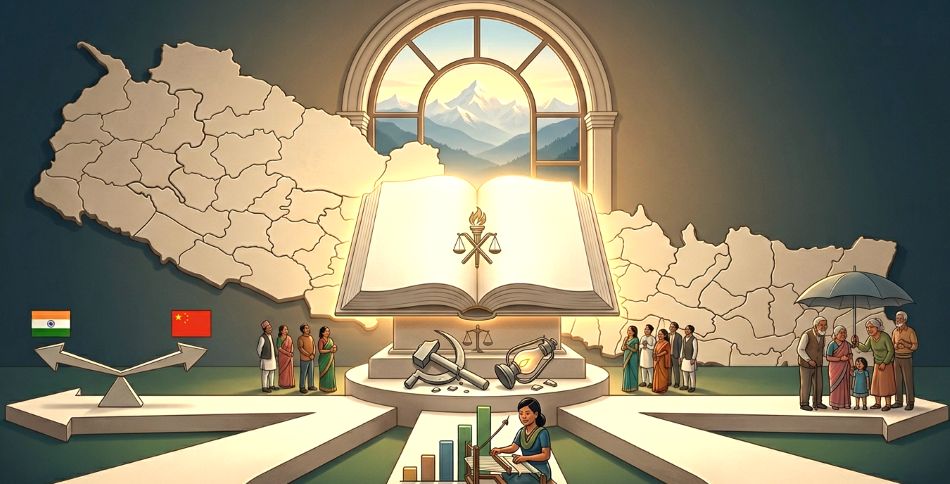

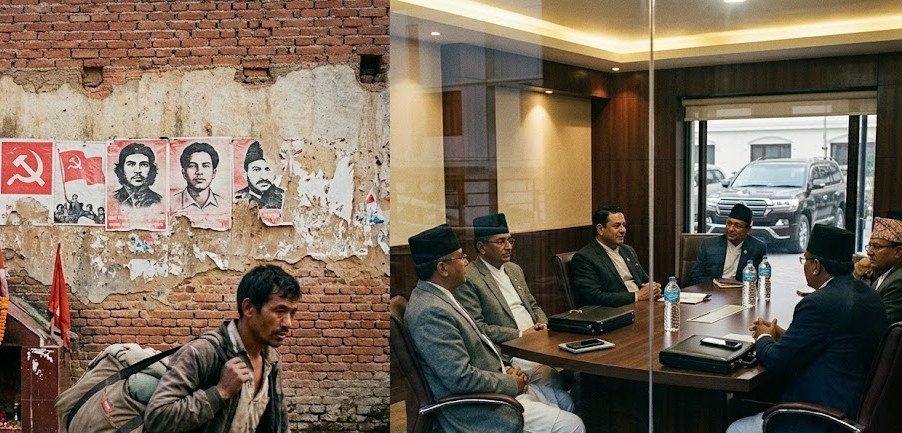


I have been working on the trends of the Nepalese Foreign Policy as the existing global order gets gradually altered in 21st century world ...
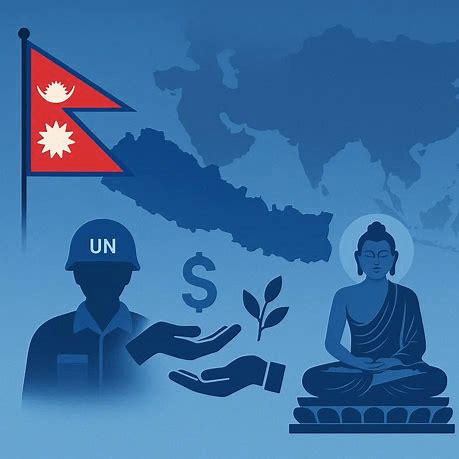
Nepal occupies a singular and strategically critical position as a sovereign nation situated between two of the world’s most rapidly ascending global powers, China and India. This geographic reality generates a persistent condition of external pressure, often termed “Geopolitical Trauma,” where the strategic interests of neighboring giants invariably influence and, at times, challenge domestic political stability and sovereignty.
Crucially, the external pressure is rendered truly destabilizing not merely by its existence, but by its convergence with profound “Internal Fragility,” which stems primarily from deep-seated institutional and governance deficiencies. International indicators assessing state fragility consistently identify Governance as the principal driver of weakness, noting that Nepal struggles across the essential dimensions of Authority, Legitimacy, and Capacity.
Analysis utilizing the Authority, Legitimacy, Capacity (ALC) model concludes that Capacity presents the largest systemic risk, significantly hindering the state’s ability to execute policy and provide public services. The primary challenge, therefore, is rooted in a self-reinforcing vulnerability where low institutional capacity allows external geopolitical competition to become a direct vector for internal instability.
The path to lasting stability and economic strength requires transforming this internal capacity deficit into a robust institutional framework capable of converting geopolitical complexity from a source of vulnerability into a catalyst for strategic autonomy, demanding a disciplined commitment to domestic rigor and proactive policy adoption.
Nepal’s foreign policy is perpetually conditioned by the security and political calculations of its neighbors. Historically, India’s strategic interests, formalized in the 1950 Treaty of Peace and Friendship, centered on securing its northern frontier following the annexation of Tibet, maintaining its sphere of influence, and holding a vested interest in the stability of the Terai region due to extensive ethnic, cultural, and economic connections.
Conversely, China’s influence has grown significantly, notably following the unofficial blockade of 2015, when China’s support underscored its increasing role as a vital counterbalance. Beijing remains a key development partner and its ambitious Belt and Road Initiative (BRI) is supported by Nepal. A critical achievement in mitigating external transit dependency was securing a transit treaty with China, providing an essential alternative route for third-country transport.
This dynamic mandates a strategic reorientation of foreign policy. The traditional non-alignment stance, which is often reactive, is increasingly giving way to the necessity of adopting a proactive strategy of Hedging. Hedging, in this context, involves meticulously managing multiple partnerships and utilizing the competitive dynamics between great powers to minimize security threats, maximize economic benefits, and preserve sovereign autonomy.
By maintaining clear and deliberate equidistance and maximizing leverage through diversification, Nepal transforms its geographical position from a passive liability into an active diplomatic asset, ensuring that national interests—specifically safeguarding sovereignty and promoting economic well-being—remain the central pillar of all bilateral engagements.
The root causes of internal fragility are institutional and societal, fundamentally undermining the democratic potential enshrined in the 2015 Constitution. As established by international analysis, the state’s limited capacity across its federal structure hinders the provision of reliable public services to all citizens, reducing the government’s overall legitimacy and creating the potential for a “capacity trap”.
This structural weakness is aggravated by persistent socioeconomic inequalities that remain deeply ingrained across axes of caste, ethnicity, language, and region. Long-standing social hierarchies systematically restrict access to political influence and economic opportunities for marginalized groups, despite general improvements in metrics like gender equality. These pervasive structural disparities diminish the national human capital pool and directly undermine the inclusive development goals necessary for cohesive federalism.
Moreover, the combination of low institutional capacity and persistent inequality severely inhibits state resilience. The government’s reduced capacity to manage internal demands or effectively respond to external environmental shocks means that regional instability or policy failure can be easily instrumentalized by external actors. This cycle reinforces dependency: the failure to generate productive, inclusive domestic growth perpetuates reliance on volatile external sources, notably expatriate remittances, rather than internally generated revenue and opportunity.
The governance capacity deficit translates directly into palpable implementation failures in the execution of public finances and development projects. The principal operational constraint to expansionary investment plans is weak implementation capacity, specifically the chronically low utilization of capital expenditure.
While total government expenditure is substantial, capital expenditure remains disappointingly low, confirming that the domestic economy remains relatively sluggish despite external financial stability. The causes of this fiscal paralysis are systemic: a lack of costed sector strategies within an aggregate fiscal framework, cumbersome spending procedures, late approval of the budget by Parliament, and the absence of integrated procurement plans.
This dysfunctional cycle leads to a detrimental rush to spend in the last trimester of the fiscal year, thereby diminishing the developmental impact of spending due to widespread irregularities and weak enforcement of rules. The failure to execute effective capital expenditure represents the single greatest self-imposed economic constraint, starving the productive sectors—such as infrastructure and energy—and ensuring the continuity of a consumption-led growth model.
Parallel to these fiscal challenges, democratic institutions face pressure concerning the shrinking space for civil society. Concerns have been raised regarding draft legislation, such as the proposed NGO Registration Bill (2025), which aims to shift regulatory authority to the security-oriented Ministry of Home Affairs.
Critics suggest that this security-focused approach threatens to criminalize independent civic action, transforming association from a constitutional right into a bureaucratic privilege subject to government approval. Such institutional choices risk eroding the public trust and democratic accountability essential for managing complex federal reforms and addressing deep-seated socioeconomic inequalities.
Nepal’s unique economic structure is characterized by both stabilizing factors and entrenched structural vulnerabilities. The most significant stabilizing factor is the immense inflow of expatriate remittances, which account for approximately 25% of the Gross Domestic Product (GDP). These financial flows, which saw substantial increases in 2024–2025, are crucial for supporting household consumption and maintaining a critical Balance of Payments (BoP) surplus, thus securing external financial stability.
This stability, however, masks a profound structural paradox. The internal economy remains fundamentally dependent on external factors; economic stability is heavily tied to the employment prospects of Nepali nationals abroad, particularly in the Gulf countries and India, making the economy highly vulnerable to adverse shifts in the global labor market.
Furthermore, Nepal remains highly dependent on external transit, being landlocked and reliant on Indian ports, with its currency pegged to that of its southern neighbor. The entrenched trade deficit and non-diversified export basket confirm the structural imbalance between what the country consumes and what it produces.
This reliance on remittances effectively functions as a continuous financial shock absorber, mitigating immediate fiscal crisis but simultaneously reducing the political pressure necessary to undertake difficult structural reforms in governance and public finance management. To achieve the goal of graduating from Least Developed Country (LDC) status, Nepal must transition away from this consumption-based, remittance-fueled model toward one driven by domestic productivity, capital investment, and export earnings.
The strategy for overcoming internal fragility and maximizing geopolitical advantage rests on proactive economic diplomacy. This approach elevates trade promotion, tourism boosting, Foreign Direct Investment (FDI) attraction, and the protection of migrant worker welfare as central components of national interest. The most viable transformative vector for the economy is the vast potential of the hydropower sector, estimated to be economically feasible at 43,000 MW, with national targets set to export 15,000 MW by 2035.
Realizing this potential would fundamentally shift Nepal’s economy from consumption-based dependency to resource-based export earnings, providing a reliable source of foreign exchange and strengthening strategic autonomy. However, the development of hydropower requires navigating complex geopolitical issues, as conflicting interests of neighboring countries have historically slowed the execution of cooperative projects and the development of necessary cross-border transmission infrastructure.
Diplomatic channels must be vigorously pursued to secure crucial energy export agreements and transit arrangements. Supporting this shift requires rigorous institutional and regulatory reforms focused on enhancing productivity and competitiveness. Essential policy prescriptions include streamlining customs duties and tariffs, particularly on intermediate goods, and urgently improving the national quality infrastructure, including Sanitary and Phytosanitary (SPS) standards, to enable entry into regional and global value chains.
Furthermore, comprehensive FDI reform is necessary to rationalize cumbersome processes for the repatriation of funds and ease entry barriers, such as sector caps and negative lists, ensuring that critical investment is successfully attracted, retained, and connected to the domestic economy.
Hence, Nepal’s future stability and prosperity are achievable outcomes, contingent upon the decisive resolution of its internal capacity deficit. The geopolitical environment, while presenting formidable challenges that require a sophisticated hedging strategy, also provides strategic opportunities for a small state determined to exert its sovereignty.
To fully capitalize on this potential, the nation must unite around three critical pillars of structural reform. First, there must be a renewed focus on Executive Discipline, resolving the capacity trap through rigorous Public Finance Management (PFM) reform, prioritizing the effective execution of capital expenditure, and ensuring that governance is deeply embedded in principles of inclusion and accountability.
Second, a concerted effort to address pervasive Structural Inequities and safeguard democratic space is essential, recognizing that a vibrant, independent civil society is democracy’s most reliable ally in achieving transparency and inclusive development.
Third, Economic Autonomy must be asserted by proactively leveraging strategic location through economic diplomacy, diversifying trade and investment partners, and diligently actualizing transformative sectors like hydropower, which serve as the ultimate litmus test for national implementation capacity.
Nepal’s historical resilience and strategic positioning are immutable assets awaiting disciplined application. By shifting decisively from a crisis of capacity to an era of rigorous execution, Nepal can transcend the paradox of external stability masking internal weakness, establishing itself not as a vulnerable ‘sandwich state,’ but as a confident, economically self-sufficient sovereign bridge, ensuring consolidated national prosperity for generations to come.
I have been working on the trends of the Nepalese Foreign Policy as the existing global order gets gradually altered in 21st century world ..
I have been working on the trends of the Nepalese Foreign Policy as the existing global order gets gradually altered in 21st century world. I am an MA in English and MPhil in International Relations a...
@ Copyright matrikapoudyal.com All Rights Reserved
Designed by Fortune Info Tech