Geostructural Calculus of Nepal’s Foreign Policy
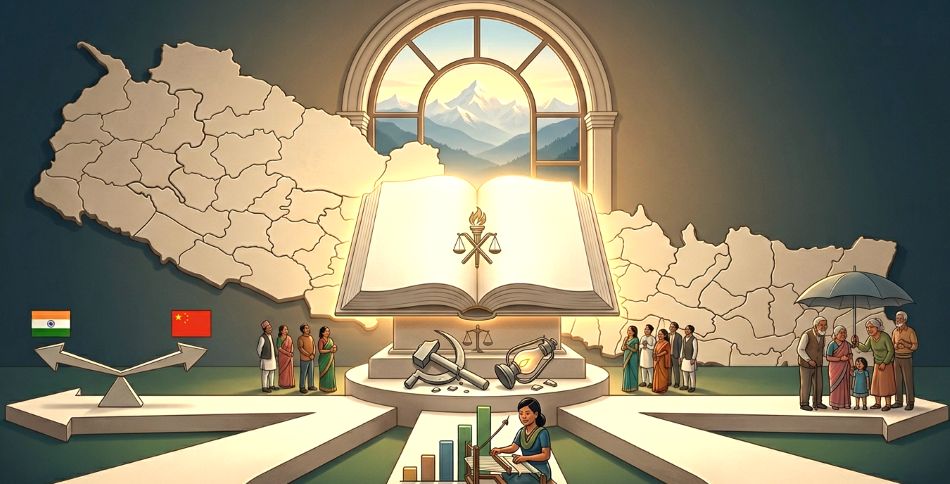
The foreign policy of Nepal needs a profound ontological transition from a historically defensive posture of survival to a proactive, multi-dimensional strategy of strategic autonomy. Modern Nepal functions as a geostructural pivot between two burgeoning nuclear-armed superpowers, the Republic of India and the People’s Republic of China, a condition that King Prithvi Narayan Shah famously encapsulated as a “yam between two boulders”.
This metaphor transcends mere geographical description, constituting a foundational theory of international relations that prioritizes cautiousness, gradualism, and the careful management of the security dilemmas of its larger neighbors.
As the global order shifts toward a multipolar configuration, Nepal must leverage its unique geostrategic positioning not as a liability of landlockedness, but as an asset of transit-linkage and normative leadership.
I concentrate here on a comprehensive framework for Nepal to enhance its foreign policy through the rigorous application of political science theories—specifically Neorealism, Constructivism, and Rational Choice Theory—while integrating evidence-based economic diplomacy and institutional modernization to secure its national interests on the global stage.
The evolution of Nepal’s diplomatic engagement demonstrates a persistent struggle to maintain sovereignty amidst shifting regional hegemonies, moving from the unification-era realism of the Shah dynasty to the British-centric bandwagoning of the Rana period.
King Prithvi Narayan Shah’s Divyopadesh provides the seminal intellectual architecture for this policy, suggesting that a small state must maintain friendship with all and enmity with none to avoid the crushing force of imperial competition.
During the nineteenth century, the Rana regime adopted a strategic alignment with British India to preserve internal autocratic stability, essentially sacrificing foreign policy independence for regime survival.
However, the post-1950 democratic dawn necessitated a rapid diversification of ties, a process propelled by King Mahendra, who utilized the Non-Aligned Movement (NAM) and formal relations with China to counterbalance the overwhelming asymmetric influence of India.
This historical trajectory validates the Defensive Realism paradigm, where Nepal seeks to minimize threats through a Balance of Power logic rather than aggressive expansion. Scientific reasoning identifies this as a rational survival strategy for a buffer state, where the state acts as a stabilizer between competing power blocs.
In the contemporary era, the traditional binary of balancing and bandwagoning collapses under the weight of the China-India-US competition, forcing Nepal to adopt a sophisticated multi-hedging strategy.
This strategy involves avoiding a rigid alliance with any single power while simultaneously deepening functional cooperation with all, thereby maximizing national utility.
Nepal’s formal accession to China’s Belt and Road Initiative (BRI) in 2017 and the subsequent ratification of the United States’ Millennium Challenge Corporation (MCC) compact in 2022 exemplify this approach.
While the BRI offers a pathway to transform Nepal from landlocked to land-linked through the Trans-Himalayan Multi-Dimensional Connectivity Network, the MCC targets critical power transmission and road infrastructure.
Using Game Theory, Nepal’s diplomatic maneuvers can be modeled as a non-zero-sum game where the objective is to maximize infrastructure gains (G) without triggering a Security Dilemma (S) that invites external interference.
Rational Choice Theory suggests that Kathmandu must bargain on the terms of these initiatives to preserve its sovereign agency, even as the US and China engage in a “war of words” and disinformation campaigns over their respective investments.
Furthermore, India’s Neighborhood First policy remains a cornerstone of Nepal’s engagement, as New Delhi provides the primary source of foreign trade and vital transit to the sea, yet the relationship continues to oscillate due to perceived sovereignty encroachments and historical grievances like the 2015 blockade.
The persistent trade deficit, which recently reached NPR 1.87 trillion, represents the most significant structural vulnerability to Nepal’s national interest. Economic diplomacy must therefore function as the primary engine for mitigating this dependency through the promotion of high-value niche exports, the attraction of foreign direct investment (FDI), and the utilization of hydropower as a strategic asset.
Nepal’s reliance on remittances to finance its current account creates a “Dutch Disease” dynamic, where the influx of foreign currency erodes the competitiveness of the manufacturing and agricultural sectors. To reverse this, the state must pivot toward “Green Production Technologies” and the integration of domestic production into global value chains.
Hydropower diplomacy serves as a critical multiplier; by aiming for the 10,000 MW export goal to India and orchestrating a tripartite energy trade agreement with Bangladesh, Nepal can transform its regional role from a consumer to a vital supplier of clean energy.
This shift aligns with Liberal Institutionalism, where economic interdependence creates a more stable regional security environment. The upcoming graduation from Least Developed Country (LDC) status in 2026 demands an immediate recalibration of trade policies, as Nepal will lose generalized system of preferences (GSP) benefits and face higher borrowing costs.
Institutional coordination between the Ministry of Foreign Affairs (MoFA) and the Ministry of Industry, Commerce, and Supplies (MoICS) must strengthen to identify and exploit new markets for indigenous products like tea, cardamom, and yarn.
Nepal’s engagement with regional organizations constitutes a vital strategy for diversifying its transit routes and reducing its geographic constraints. While the South Asian Association for Regional Cooperation (SAARC) remains institutionalized in Kathmandu, its functional paralysis due to Indo-Pakistani rivalry necessitates a pivot toward the Bay of Bengal Initiative for Multi-Sectoral Technical and Economic Cooperation (BIMSTEC). BIMSTEC offers a unique cross-regional bridge between South and Southeast Asia, providing Nepal with access to deep-sea ports in Chittagong, Mongla, and Laem Chabang.
Through the lens of Functionalism, Nepal leads the People-to-People Contact sector within BIMSTEC, a platform it should leverage to promote religious and cultural tourism centered on Lumbini and Sagarmatha.
Simultaneously, the South Asia Subregional Economic Cooperation (SASEC) program facilitates critical investments in trade processing, customs modernization, and national single-window systems. By actively participating in these sub-regional frameworks, Nepal can bypass the SAARC fatigue and negotiate better terms for trade and transit.
In addition, Nepal must champion a Himalayan Trilateralism involving China and India to foster shared prosperity in the mountains, transforming the region from a zone of security competition into a hub of transboundary water management and disaster risk reduction. This requires Nepal to act as a Norm Entrepreneur, proposing regional working groups on specific themes like glacial melt and agricultural resilience.
Nepal’s path to global prominence lies in the strategic projection of its “Normative Power,” primarily through its role as the world’s second-largest troop-contributing country to United Nations (UN) peacekeeping and its emergence as a champion of climate justice.
As the “Water Tower of Asia,” Nepal’s deteriorating mountain ecosystem—losing one-third of its ice in three decades—poses a direct threat to the hydrology of downstream nations, a crisis UN Secretary-General António Guterres described as “madness”.
The launch of “Sagarmatha Sambaad” in May 2025 serves as Nepal’s premier global platform for environmental diplomacy, bridging the communication gap between mountain nations and global climate policymakers.
By advocating for a “mountain-specific climate adaptation fund” and the principle of Loss and Damage, Nepal leverages its vulnerability to command moral authority in international forums like COP29 and COP30. This strategy aligns with “Constructivism,” where a state’s identity and international standing are shaped by its commitment to global norms and shared values.
Furthermore, Nepal’s consistent support for multilateralism and its principled stand on issues like the invasion of Ukraine—despite its neighbors choosing neutrality—reinforces its identity as an independent, moral actor on the world stage.
To solidify this prominence, Nepal must seek higher-level representation in the UN peacekeeping command structure and actively participate in the governance of emerging technologies like Artificial Intelligence (AI) through the Global South blocks.
To execute a 21st-century foreign policy, the Ministry of Foreign Affairs (MoFA) must undergo a radical institutional transformation, transitioning from traditional bureaucratic procedures to “Data-Driven Diplomacy”. The digital revolution has shifted diplomatic activity to virtual platforms, necessitating the induction of online passport and consular services to win the trust of the global Nepali diaspora.
A comprehensive “National AI Strategy” for diplomacy is imperative to navigate the technological divide and harness emerging innovations for national security and economic intelligence. Nepal must deploy “Tech Diplomats” to key innovation hubs in Beijing, New Delhi, and Silicon Valley to secure investments in healthcare, education, and language-specific “Sovereign AI”.
Furthermore, the professionalization of the diplomatic corps requires the immediate passage and implementation of the “Foreign Service Act” to ensure merit-based career paths and eliminate the “silo” mentality that hinders inter-ministerial coordination on economic and climate issues.
MoFA must function as a central node in a decentralized internal network, utilizing Standard Operating Procedures (SOPs) for foreign aid mobilization and crisis management. Scientific reasoning suggests that an institution’s efficiency is directly proportional to its ability to process information and adapt to rapid geopolitical shifts.
By investing in human resource capacity and cybersecurity, Nepal can protect its sensitive communications and engage more effectively in global governance discussions on AI ethics and digital sovereignty.
Nepal stands at a critical juncture where its geostructural conditioning requires a transition from a reactive “buffer state” to a proactive “bridge state” through the systematic application of multi-hedging and normative leadership.
The current socio-political landscape, characterized by fragile but functioning coalitions and the adoption of transitional justice laws, provides a unique window of opportunity to project a stable and democratic image to the world.
To enhance its foreign policy and achieve global prominence, Nepal must move beyond the rhetoric of non-alignment toward a policy of “Strategic Autonomy” that leverages its hydropower, climate vulnerability, and peacekeeping contributions. This transformation demands not only diplomatic skill but also a rigorous internal commitment to professionalization and technological modernization.
By orchestrating a unified national vision that transcends partisan divides, Kathmandu can ensure that its foreign policy serves as a powerful extension of its domestic developmental aspirations.
Hence, Nepal should enact the National AI and Tech Diplomacy Framework, establishing a dedicated “Tech Diplomacy Unit” within MoFA and appointing specialized diplomats to manage relations with global technology blocks. This initiative acquires critical healthcare and educational AI for national development.
The country should institutionalize the Sagarmatha Sambaad Secretariat, transforming the 2025 dialogue into a permanent biennial summit with a dedicated Kathmandu office to coordinate global mountain advocacy. It must also finalize the Tripartite Energy Trade Agreement, securing a formal treaty to institutionalize the transit of Nepal’s hydroelectric power through India, ensuring a long-term export market for surplus energy.
Nepal should launch the “Post-LDC Graduation Economic Roadmap,” formulating a comprehensive trade strategy targeting bilateral FTAs with major partners to compensate for lost preferential treatments.
The government must professionalize the diplomatic corps by ratifying the pending Foreign Service Act, establishing merit-based career paths, ensuring non-partisan ambassadorial appointments, and launching a world-class Foreign Service Academy.
Strengthening consular and diaspora diplomacy requires the full digitization of services through a unified global portal and the creation of “Diaspora Investment Funds” to channel remittances into priority hydropower and tourism projects. Finally, Nepal should champion the “Himalayan Climate Adaptation Fund,” proposing a formal UN mechanism for glacial melt and GLOF challenges to position itself as the lead negotiator for mountain nations.