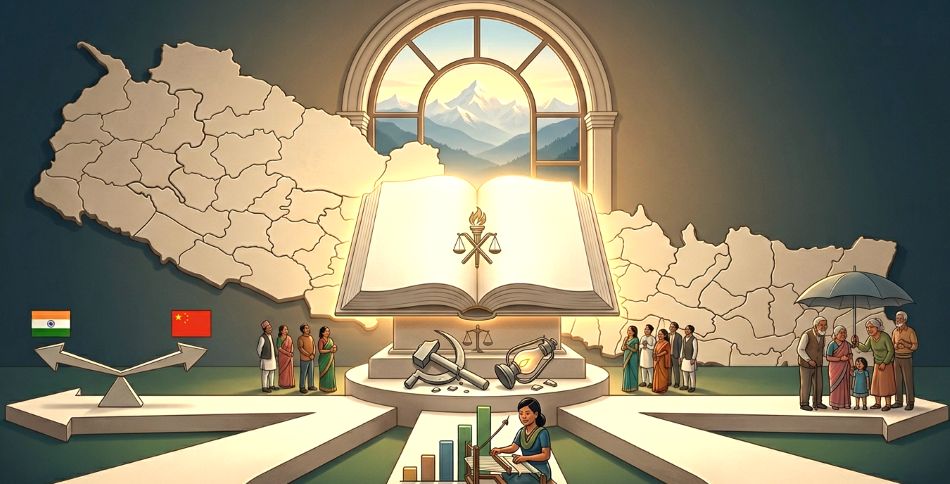
Nepal’s political landscape is not a spectrum of competing ideas that can be reconciled through compromise, but a set of fundamentally different and “perpendicular” worldviews that intersect only at a shared national identity while remaining mutually unintelligible. Conflicts over monarchy vs. republicanism, federalism vs. centralism, secularism vs. Hindu statehood, and divergent economic visions are not disagreements of degree but of entirely different ideological and moral frameworks, making consensus inherently fragile.
This structural disconnect extends across generations and emerging identity-based movements, producing chronic instability where governments form as uneasy coalitions rather than true syntheses.
There is a peculiar geometry to Nepal’s political imagination, one that defies the conventional arithmetic of democratic compromise. In most nations, competing ideologies clash and then converge, sliding toward one another on a spectrum until some messy, workable middle ground emerges.
Nepal, however, has never operated on a spectrum. Its political factions do not merely disagree; they exist on entirely different axes, perpendicular to one another, intersecting at a single point of national identity yet stretching toward irreconcilable horizons.
This perpendicularity is not a temporary dysfunction. It is the structural reality of a state where monarchy and republicanism, federalism and unitary longing, secularism and Hindu statehood, and Maoist radicalism and liberal constitutionalism do not debate within the same framework—they inhabit different dimensions altogether.
To grasp the depth of this condition, one must first abandon the comforting notion that political differences are merely matters of degree. In Nepal, they are matters of kind. A monarchist does not simply prefer a king to a president; he inhabits a cosmology where sovereignty descends from divine lineage and cultural continuity, not from popular mandate.
Conversely, a republican does not merely find the monarchy inefficient; she operates from the premise that legitimacy bubbles upward from the citizenry, rendering hereditary rule not just obsolete but morally offensive. These are not positions on a line. They are vectors shooting in opposite directions, meeting only at the coordinate of “Nepal” itself.
That intersection is precisely what makes the conflict so intractable, for neither side can fully secede from the shared national space, yet neither can translate its vision into a language the other comprehends.
Nevertheless, the perpendicularity extends far beyond the palace gates. Consider the federal restructuring that consumed the nation during the constitution-making process. For the architects of federalism, the devolution of power was not an administrative preference but an existential necessity—a remedy for centuries of hill-centric, caste-dominated centralism that had treated the Madhes, the plains, and the indigenous hills as peripheral subjects rather than co-owners of the state.
Federalism, in this rendering, was horizontal justice, a way of flattening the pyramid. Yet for its opponents, federalism represented not liberation but fragmentation, a foreign-imposed blueprint that risked dissolving the singular Nepali identity into ethnically balkanized fiefdoms.
To put it another way, one side saw federalism as the completion of Nepal; the other saw it as the beginning of Nepal’s dissolution. There was no overlapping area in this Venn diagram, no zone where both could claim partial victory. The constitution was ultimately adopted, but the adoption was procedural, not philosophical. The perpendicular lines remained intact, merely forced to share the same constitutional page.
In the same vein, the secularism debate reveals the same orthogonal incomprehension. For proponents of a secular state, the 2015 constitution’s declaration of secularism was a belated catching-up with modernity, a shield protecting minorities from majoritarian Hindu dominance. It was framed as inclusion, as neutrality, as the only viable architecture for a multi-religious, multi-ethnic republic.
By the same token, however, Hindu nationalists experienced this not as neutrality but as erasure. For them, Nepal’s Hindu identity was not a state policy to be toggled on and off; it was the metaphysical substratum of the nation, the civilizational continuity that had survived the Buddha’s birth, the Malla kings, the Gorkha unification, and the democratic transitions.
Stripping the state of its Hindu character was not reform; it was ontological vandalism. Consequently, when these two camps debate secularism, they are not arguing about policy. They are speaking past each other in mutually unintelligible moral dialects, each convinced the other is not merely wrong but existentially threatening.
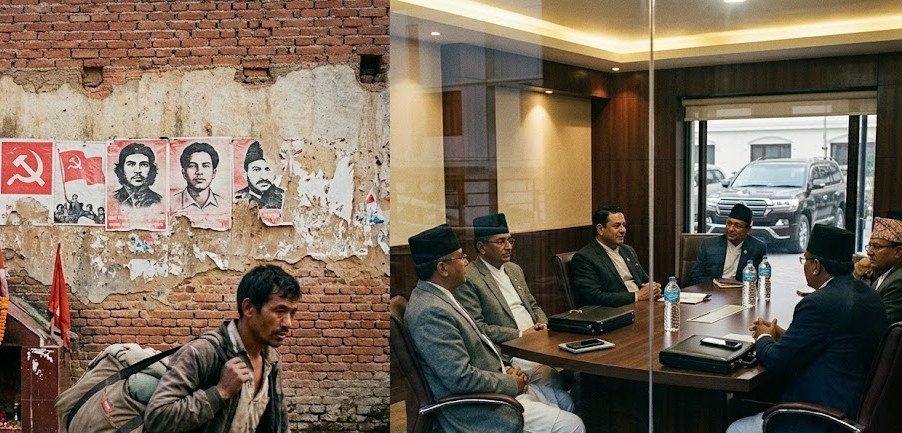
Furthermore, the economic and geopolitical perpendicularity adds yet another axis to this multidimensional gridlock. The Maoist movement, even in its post-insurgency incarnation, carries a structural suspicion of liberal capitalism, of open markets, and of the Nepali Congress’s historical alignment with mercantile and landowning elites. Its residual imagination still leans toward a controlled, redistributive state, suspicious of foreign capital and Western institutional conditionalities.
On the flip side, the liberal democratic camp views economic openness not as ideology but as gravity—a force one ignores at the price of national irrelevance.
To them, Nepal’s salvation lies in trade corridors, foreign direct investment, and integration into global supply chains, ideally balanced between its two giant neighbors. These are not competing development models.
They are incompatible cosmologies of how wealth, power, and sovereignty ought to flow. One sees the global economy as a trap; the other sees isolation as suicide. The lines do not bend toward compromise; they shoot past each other at ninety degrees.
At the heart of the matter lies a generational and identitarian perpendicularity that is only now fully revealing itself. The old guard—regardless of party—speaks the language of the 1990 democratic movement or the 2006 peace process, framing politics as a contest between established parties with established histories.
Yet beneath this familiar surface, a younger, more regionally and ethnically assertive politics is emerging, one that treats the old left-right, Congress-UML-Maoist categories as obsolete containers.
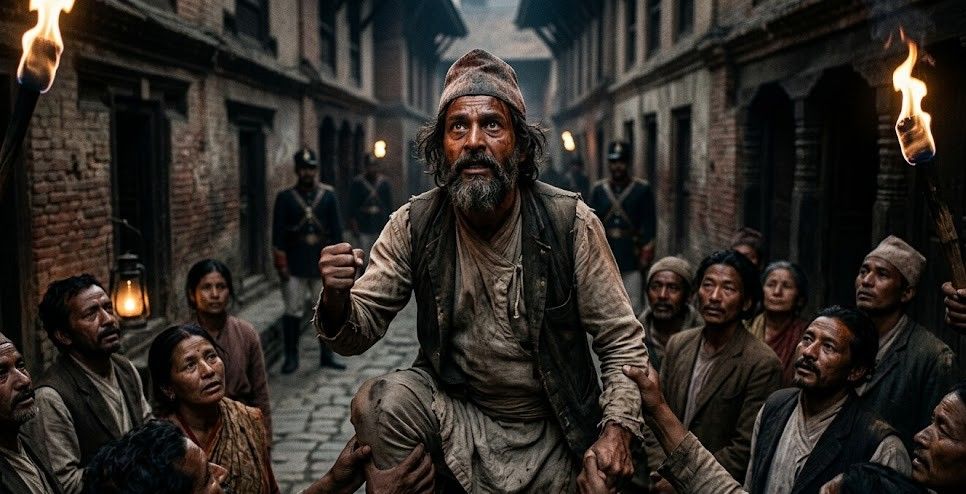
For this emergent politics, the question is not who rules Kathmandu but whether Kathmandu ought to rule at all. Madhesi autonomy, Thalangat demands, Limbuwan assertions, and indigenous governance models are not reformist requests within the existing structure; they are structural challenges to the very coordinate system of the Nepali state.
Be that as it may, the established political class continues to behave as if these demands can be absorbed through coalition cabinets and incremental amendments, utterly failing to recognize that perpendicular challenges cannot be met with linear adjustments.
This is why Nepal’s governance has acquired its characteristic quality of permanent instability without permanent crisis. The state does not collapse, yet it never truly coheres. Governments form and dissolve with metronomic regularity not because the players are uniquely incompetent—though incompetence abounds—but because the coalitions are structurally absurd from the outset.
A party that believes in the unitary spiritual state of Hindu Nepal sits in cabinet with a party that believes in secular federal republicanism; a faction that cut its teeth smashing the feudal order breaks bread with descendants of that very order. These alliances are not syntheses.
They are forced cohabitations of perpendicular worldviews, held together by the shared oxygen of ministerial portfolios and state resources. The moment the material incentive wavers, the perpendicular lines snap back to their natural divergence, and the government falls.
Notwithstanding this bleak architecture, there is a temptation to romanticize perpendicularity as pluralism, to argue that Nepal’s richness lies precisely in this refusal to flatten itself into a monochrome ideology. There is some aesthetic truth to this. Nepal is undeniably more intellectually alive, more politically textured, than nations where consensus has calcified into conformity.
Yet aesthetics is not governance, and texture is not stability. A nation can survive perpendicularity in its culture; it cannot indefinitely sustain it in its constitutional foundation. At some point, the perpendicular lines must either be bridged by a diagonal—a new political imagination that borrows from multiple axes without fully inhabiting any—or they will tear the national fabric at their intersection point.
All things considered, the rational conclusion is not that Nepal must choose one axis and suppress the others. That is the fantasy of authoritarian resolution, and Nepal has paid too high a price in blood and marginalization to entertain it. Rather, the imperative is to recognize that perpendicularity cannot be wished away, nor can it be “compromised” in the conventional sense. What is needed is a politics of translation: leaders and movements capable of rendering one ideological axis into the terms of another without betraying either.
This requires not merely tactical coalition-building but a deeper epistemic humility—the acknowledgment that the monarchist’s cultural anxiety, the federalist’s historical grievance, the secularist’s pluralist commitment, and the economic liberal’s developmental urgency each encode legitimate human aspirations, even when they appear mutually exclusive.
In essence, Nepal’s political future depends on whether its leaders can learn to inhabit the intersection without trying to straighten the lines. The perpendicular ideologies will not converge; they are too honest, too rooted, too structurally distinct for that. But a nation is not a geometry problem to be solved. It is a lived space to be navigated.
If Nepal’s political class can move beyond the illusion that one side must defeat the other, and instead build institutions robust enough to contain multiple perpendicular truths, then the very tension that now paralyzes the state might become the source of its resilience.
Until then, Nepal will remain a nation where every political agreement is a temporary armistice, every constitution an uneasy truce, and every election a fresh collision of lines that refuse to run parallel.