


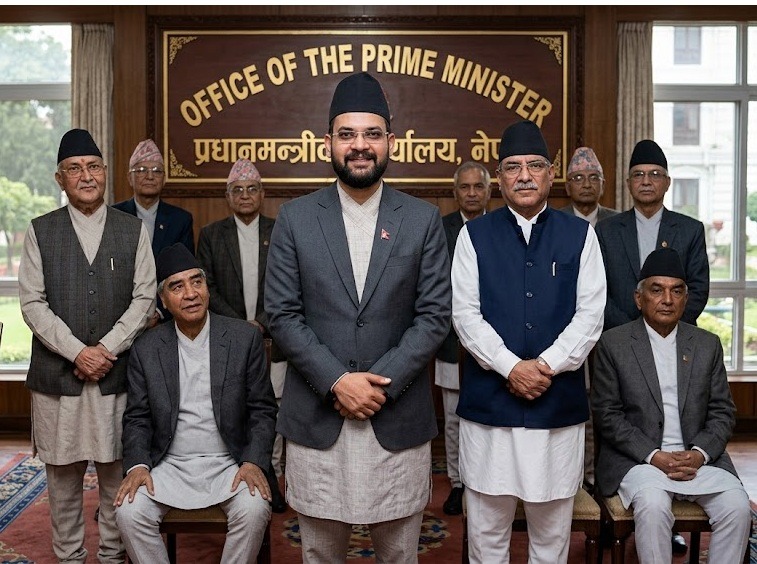


Nepal stands at a critical juncture where the language of justice must either confront its own postponement or risk complete erosion of public trust. Systemic différance cannot be resolved through incremental adjustments or rhetorical shifts; it demands a reconfiguration of how power, accountability, and time itself are structured within governance.
Nepal does not suffer merely from inequality; it suffers from a more elusive, structural delay—a systemic différance where justice is endlessly promised, deferred, and reinterpreted until it dissolves into abstraction.
The language of inclusion, federalism, and rights circulates widely, yet its material arrival to ordinary citizens remains perpetually postponed.
This is not accidental inefficiency; it is a patterned condition where the state speaks in the future tense while people survive in a stagnant present.
At the heart of this différance lies a political culture that thrives on symbolic fulfillment rather than substantive change.
Constitutions are rewritten, commissions are formed, and slogans evolve, but the lived experience of marginalized communities—Dalits, Madhesis, indigenous nationalities, and the rural poor—barely shifts.
Representation becomes a spectacle, a carefully curated image of progress, while structural inequities remain intact beneath the surface. The system does not deny justice outright; it delays it just enough to maintain legitimacy.
Economically, this deferral manifests in a peculiar paradox. Nepal’s macroeconomic indicators often project stability through remittance inflows and consumption patterns, yet this stability is hollow.
The state’s dependency on migrant labor exports effectively outsources its responsibility to generate domestic opportunities. Villages are emptied of youth, families are fragmented, and the economy survives on absence. Justice, in this context, is deferred not only within borders but exported abroad—where Nepali laborers endure precarity so that the nation can claim economic endurance.
Federalism, once heralded as the corrective to centralized exclusion, now illustrates the mechanics of différance at a subnational level.
Power has been redistributed geographically, but not democratized structurally. Provincial and local governments replicate the same hierarchies, patronage networks, and bureaucratic inertia that characterized the center.
The promise of proximity to power has not translated into accessibility or accountability; instead, it has multiplied sites where justice can be delayed.
The legal system further entrenches this condition through procedural excess and selective enforcement. Cases linger for years, sometimes decades, turning justice into a temporal burden that disproportionately punishes the poor.
Those with resources navigate the system through influence and delay tactics, while the marginalized confront an exhausting labyrinth. Here, différance is literal—justice is not denied in principle, but postponed until it loses meaning.
Education and opportunity follow a similar pattern. Policies emphasize inclusion and equity, yet the quality of public education remains deeply uneven.
Urban elites access globalized knowledge systems, while rural populations struggle with underfunded institutions and outdated curricula.
The rhetoric of equal opportunity becomes another site of deferral, where the promise of upward mobility is extended but rarely realized. The system produces aspiration without providing the means to fulfill it.
Even the discourse of development participates in this cycle. Infrastructure projects are announced with grand narratives of transformation, but delays, corruption, and mismanagement are routine.
Roads remain half-built, hydropower projects stall, and urban planning collapses under its own contradictions. Development becomes a perpetual project rather than a completed reality—a visible reminder of promises suspended in time.
What makes this différance particularly insidious is its normalization. Citizens have internalized delay as an inherent feature of governance.
Waiting becomes a civic habit, and skepticism replaces expectation. The state, in turn, relies on this lowered threshold of accountability.
When delay is anticipated, it ceases to provoke outrage, allowing systemic inertia to persist without significant resistance.
Yet, within this prolonged deferral lies a quiet tension. The same forces that normalize delay also accumulate frustration. Youth disillusionment, digital activism, and localized movements signal a growing impatience with symbolic politics.
The question is whether this impatience can disrupt the cycle of différance or whether it too will be absorbed, translated into rhetoric, and deferred once again.
Nepal stands at a critical juncture where the language of justice must either confront its own postponement or risk complete erosion of public trust. Systemic différance cannot be resolved through incremental adjustments or rhetorical shifts; it demands a reconfiguration of how power, accountability, and time itself are structured within governance.
Until justice is experienced not as a future promise but as a present reality, the gap between the state and its people will continue to widen—quietly, persistently, and dangerously.