Why Nepal Needs Rashtranirmata Party Now
The contemporary Nepali nation-state confronts a precarious existential threshold, where the centripetal forces of historical unification succumb to the centrifugal pressures of modern partisan fragmentation.
This disintegration demands the immediate formation of a political entity rooted in the lineage and legacy of the Rashtranirmata—those architects, warriors, and advisors who forged the sovereign contours of Nepal from the mid-18th century onward.
While current political factions anchor their legitimacy in imported ideologies, transitory economic classes, or narrow ethnic silos, a party comprising the descendants of the nation-builders offers a primordial stability derived from the very sacrifice that established the state.
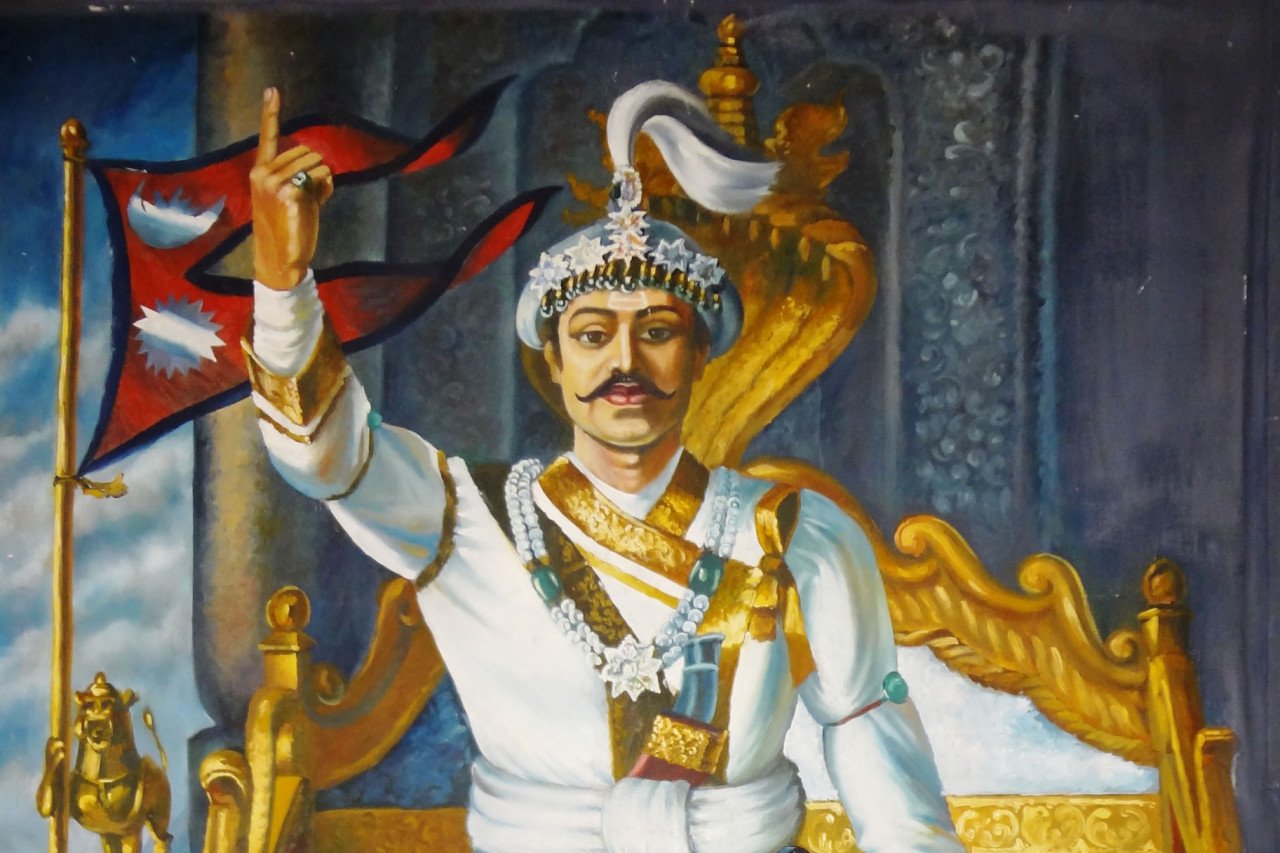
I am concerned to examine the historical trajectory of Nepal’s state-building, the socio-economic mechanisms of its consolidation, and the subsequent theoretical shifts that now demand a resurgence of ancestral leadership to restore the “common garden” envisioned by the founding father of modern Nepal, the King Prithvi Narayan Shah.
The mid-18th century witnessed the transformative ascension of the Gorkha Kingdom under King Prithvi Narayan Shah, who assumed the throne on April 3, 1743. Inheriting a principality of merely 2,500 square kilometers, the monarch envisioned a consolidated Himalayan empire capable of resisting the encroaching colonial influence of the British East India Company.
The Gorkhali military campaign began with the strategic annexation of Nuwakot in 1744, a victory that secured the vital trade routes between Tibet and the Kathmandu Valley while establishing a precedent for disciplined warfare.
This era of nation-building relied upon the synergy between the Shah monarchy and the Tharghar aristocracy, specifically the Pande and Basnyat families, who provided the martial and administrative intelligence necessary for expansion.
The conquest of the three Malla kingdoms—Kathmandu, Patan, and Bhadgaon—culminated in 1769, shifting the Gorkhali capital and birthing the modern state of Nepal. The military success of the Rashtranirmata transcended mere territorial acquisition; it facilitated an ontological shift toward a sovereign “Asali Hindustan,” a sanctuary for Hindu and local traditions against the predatory Mughal and British expansions.
The Dibya Upadesh, the King’s philosophical legacy, articulated a vision of a “common garden” where four castes and thirty-six ethnic groups would thrive in harmony—a metaphor for a pluralistic but unified nation. However, modern political parties have systematically dismantled this garden, replacing the inclusive unity of the builders with the bitter divisions of ideological tribalism.
The formation of a Rashtranirmata party fulfills the historical imperative to reclaim this sovereign vision, ensuring that those who inherited the responsibility of state-building also lead the effort to preserve its integrity.
Early state-building in Nepal functioned through a sophisticated Bhardari (aristocratic) system, where specific lineages—the Pandes, Basnyats, Thapas, and Kunwars including others—managed the state’s executive and military apparatus. Kaji Kalu Pande, appointed Commander-in-Chief during the Nuwakot campaign, exemplified the selfless commitment of these noble houses, advising the King to raise a standing army from diverse regions to ensure national loyalty.
Following Pande’s sacrifice at Kirtipur in 1757, the Basnyat family, led by Shivaram Singh Basnyat, continued the momentum of unification. This institutional synergy allowed the Gorkhali state to maintain continuity even during regency periods and minor successions, as the noble families prioritized the survival of the crown over individual gain.
These families established the “Marwat” policy— familial military succession exists in Nepalese history and a social contract that provided land to the families of fallen soldiers, thereby weaving the citizenry into the fabric of the state’s survival.
The institutional strength of this system persisted through the 19th century, even as the Rana dynasty consolidated power in 1846 through the Bhandarkhal massacre, which effectively sidelined the competing noble houses.
The modern era’s fragmentation reflects a vacuum of this historical stewardship; the current political leadership lacks the multi-generational tie to the land and the state that characterized the Rashtranirmata era. A political party of the descendants restores this missing link, utilizing ancestral legitimacy to bridge the gap between the state’s glorious past and its fractured present.
To understand the roots of current political fragmentation, one must analyze the economic history of Nepal through the lens of scholars like Mahesh Chandra Regmi. The state-building process shifted from an inclusive military enterprise to an extractive agrarian system, where land grants like Birta, Jagir, and Raikar sustained the military but concentrated wealth in the hands of the Kathmandu-based elite.
Regmi’s seminal work, “Thatched Huts and Stucco Palaces,” contrasts the opulence of the ruling class with the deprivation of the peasantry, illustrating how the fiscal system prioritized resource mobilization for the state over local development. This historical imbalance created a legacy of regional bias, where the Kathmandu Valley flourished as the political and economic center while the peripheries—specifically the Tarai, Karnali, and Far West—languished in underdevelopment.
The contemporary grievances of the Madhesi and Janajati groups stem from this historical economic structure, where the high-caste Hindu elite appropriated cultivatable lowlands and introduced private ownership models that superseded communal Tibetan and indigenous systems. While the 19th-century state remained sovereign, its economic policies sowed the seeds of the class warfare and regional alienation that modern parties now exploit.
A Rashtranirmata party must acknowledge these historical imbalances, proposing a wealth of knowledge approach that integrates traditional agrarian wisdom with modern equitable reforms. By addressing the economic roots of fragmentation, such a party can transcend the superficial “inclusion” of modern politics and foster genuine national prosperity.
The interpretation of Nepal’s unification remains a contested terrain between Nationalist, Marxist, and Subaltern schools of thought. The Nationalist school portrays the unification as a heroic and divinely sanctioned endeavor by the Shah monarchs to protect Hindu civilization from foreign threats.
Conversely, the Marxist school views the Gorkhali expansion as a feudal conquest driven by the need for resource extraction and class consolidation, ultimately leading to the “internal colonialism” of the 20th century.
The Subaltern school, drawing from Antonio Gramsci and Ranajit Guha, critiques both narratives for silencing the “small voices” of the marginalized—Dalits, indigenous tribes, and women—who provided the labor and blood for the state but received little in return.
The Nationalist school venerates Prithvi Narayan Shah as the divine architect of a unified, sovereign Nepal. The Marxist school condemns his feudal rule, highlighting class struggle and economic extraction for bourgeois expansion. The Subaltern school interprets his conquest as hegemonic exclusion, foregrounding the persistent resistance of marginalized identities.
The Postcolonial perspective identifies him as the founder of a sovereign state, emphasizing the subsequent decolonization of knowledge and identity. These divergent readings embody each historiography’s distinct ideological core, shaping Nepal’s contested narrative of nation building and state formation.
The proposed Rashtranirmata party offers a synthesis of these perspectives. It rejects the deterministic class warfare of the Marxists and the narrow identity politics of the Subalternists while embracing the Nationalist imperative for state survival.
This “Third Way” recognizes that the unification was a complex, multi-voiced process where the agency of the common soldier and the local chieftain was as vital as the King’s vision. By synthesizing these historiographical sketches, the party can present a narrative that honors ancestral sacrifice while actively dismantling the exclusionary structures of the past. This approach transforms the history of Nepal from a source of grievance into a foundation for collective pride and national cohesion.
The transition from the unitary monarchic state to a multi-party democracy in 1990, and subsequently to a federal republic in 2008, marked the beginning of an era of unprecedented political fragmentation. While intended to foster democracy, these shifts allowed political parties to fracture the nation along lines of race, region, and ideology.
The Maoist insurgency (1996-2006) weaponized long-standing social inequities, arguing that the Nepali state functioned as an instrument of H4 i.e. High-caste Hill Hindu Hegemony. This conflict resulted in a brutal fragmentation, where the national agenda was replaced by the sectarian demands of various ethnic and regional groups.
The current political landscape exhibits a chronic instability characterized by unstable coalition governments, pervasive corruption, and a dependency on foreign alliances. The 12-point Agreement of 2005, facilitated by India, brought the Maoists into mainstream politics but often resulted in elite bargains that watered down progressive reforms to protect the interests of a new partisan aristocracy.
As a result, the state’s monopoly on the use of force has weakened, and public faith in the democratic process has plummeted. The immediate formation of a Rashtranirmata party is essential to counter this centrifugal descent, reasserting the state’s primary role as the guarantor of national unity rather than a platform for partisan bickering.
The implementation of federalism under the 2015 Constitution was touted as a solution to historical exclusion, yet it has paradoxically exacerbated national fragmentation. The creation of provinces based on ethnic and regional identities has fueled secessionist rhetoric and deepened the divide between the Kathmandu-centric elite and the rural peripheries.
In regions like Karnali and Sudurpaschim, the lack of infrastructure and state services remains a stark reminder of the internal colonialism identified by subaltern scholars. Furthermore, the Madhesi movement in the south highlights the ongoing tension between the state and the populations of the Tarai, whose cultural ties often transcend the international border with India.
Foreign influence from India, China, and the United States further complicates this federal paradox, as these powers often support specific factions to advance their strategic interests. The Rashtranirmata party, drawing from the isolationist and neutralist foreign policy roots of the early Shah era, offers a path toward true sovereignty.
It advocates for a multiple identity federation that prioritizes economic integration and geographic reality over ethnic segregation, ensuring that the state remains a unified entity capable of resisting external pressures. This party provides the centripetal force necessary to bind the fragmented units of the nation into a cohesive whole once again.
The justification for a political party of the Rashtranirmata lies in the synthesis of historical legitimacy and modern inclusive governance. This party represents a vanguard of the ancestors, deriving its authority not from the fleeting trends of populist politics but from the enduring legacy of those who sacrificed their lives to build the nation.
By centering its platform on the principle of Rashtranirmana—Nation-Building, it can unite the disparate units of the Nepali nation—the Madhesi, the Janajati, the Dalit, and the Khas-Arya—under a shared banner of historical continuity. This party rejects the exclusionary nation-state model of the 1990s in favor of a truly participatory New Nepal that honors its diverse heritage while maintaining a strong, sovereign center.
The formation of this party is an act of historical necessity. As the current political factions continue to tear the fabric of the nation apart, the Rashtranirmata descendants must step forward to reclaim their inheritance. They must demonstrate that the “common garden” is not a relic of the past but a blueprint for the future.
By integrating the insights of economic history, subaltern scholarship, and nationalist sentiment, the Rashtranirmata party offers the only viable path toward a united, prosperous, and sovereign Nepal. The era of nation-building did not end with the death of Prithvi Narayan Shah in 1775; it continues today, demanding a leadership that understands that to build a state is to sacrifice for a nation, and to lead a nation is to honor the ancestors who built the state.