




I have been working on the trends of the Nepalese Foreign Policy as the existing global order gets gradually altered in 21st century world ...
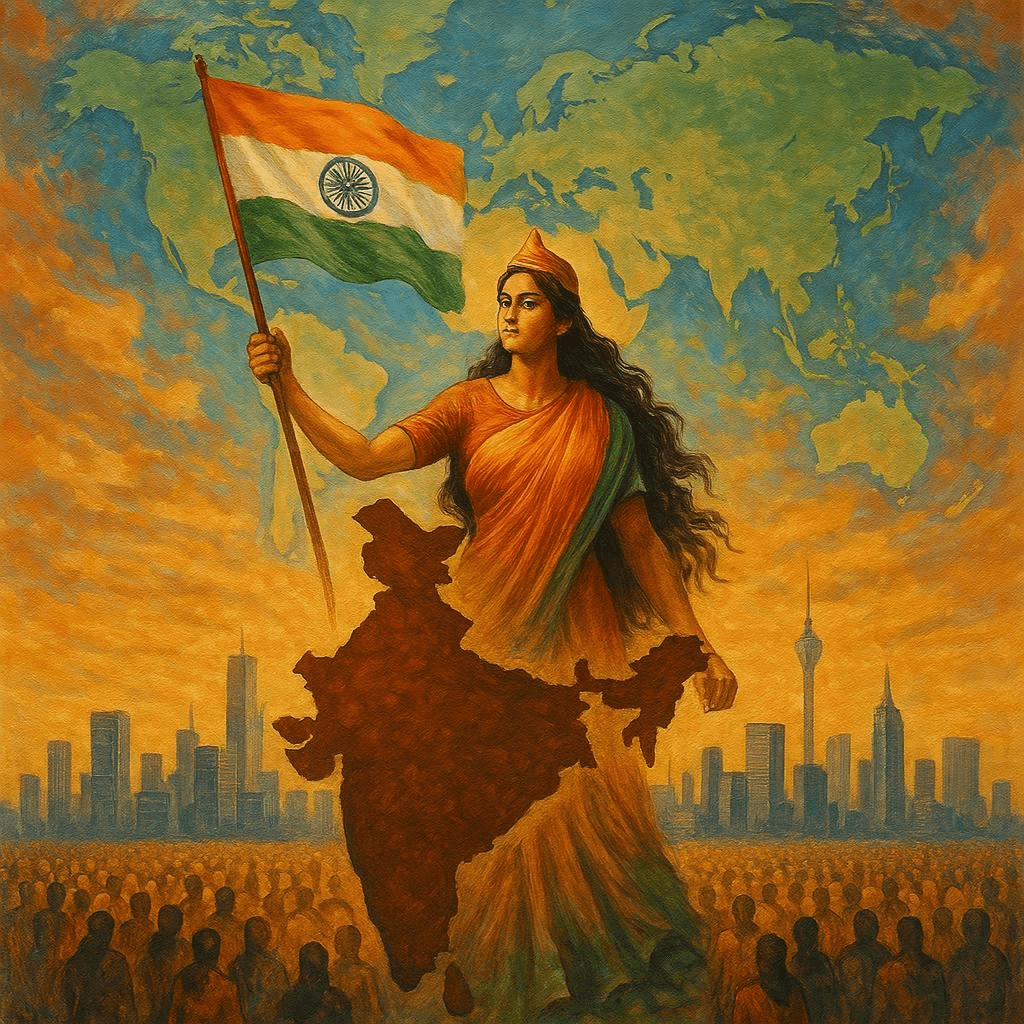
The global order pivots decisively away from unipolar dominance, navigating a turbulent new phase characterized by “multipolarization”. As the United States signals strategic shifts, diminishing its engagement in certain international spheres , a consequential vacuum emerges—a void demanding a reliable, democratic anchor to uphold liberal international norms.
This historic juncture compels India to transcend its status as a major regional power and seize the unique mandate to ascend as the alternative superpower of the democratic world. Success hinges not merely on accumulating economic or military weight, but on the rigorous, consistent execution of its vast inherent potential.
Consequently, India’s geopolitical opportunity is directly commensurate with its structural strengths. The nation asserts its economic dominance, maintaining the fastest growth rate among major economies and commanding projections that place it as the world’s second-largest economy within decades.
In fact, India commands a demographic dividend, possessing the world’s largest and youngest workforce, which offers an unparalleled window of opportunity to fuel per capita GDP growth over the next two decades. This economic surge, rooted in a competitive, services-led, market-based system , presents a compelling counter-narrative to state-led models, positioning India’s trajectory as a model for the Global South.
Furthermore, India’s diplomatic doctrine, Strategic Autonomy, empowers the nation to maximize its global agency. This pragmatic multi-alignment philosophy rejects rigid bloc adherence, focusing instead on partnerships guided strictly by national interest.
India strategically engages global rivals, effectively utilizing its unique position to mediate conflicts and secure diplomatic capital from leading democracies seeking to balance regional ambitions. Leveraging this leverage, India champions the priorities of developing nations within critical forums like the G20, advocating consulted and non-threatening leadership that resonates powerfully across the Global South.
However, realizing this superpower potential confronts formidable internal constraints that threaten to cap its trajectory. India must urgently address structural deficiencies, primarily the significant infrastructure financing gap that exceeds 5% of its GDP.
Compounding this challenge is the specter of extreme and widening socio-economic inequality, where chronic under-investment in human capital—education and public health—risks transforming the promising demographic dividend into a liability. Failure to execute comprehensive governance reforms, particularly those mobilizing patient private capital, limits the nation’s capacity to convert potential scale into sustained, credible global influence.
Addressing the security dimension demands systematic financial rebalancing. The persistent, non-negotiable threat of a two-front war, stemming from unresolved border disputes with China and Pakistan, compels substantial defense spending, often consuming capital critically needed for modernization.
India must therefore accelerate defense indigenization programs and implement systemic reforms, particularly reviewing pension structures and optimizing personnel, to liberate capital expenditure for technological leapfrogging and hard power projection. Securing maritime dominance in the Indian Ocean Region—leveraging its strategic position near key choke points—remains fundamental to safeguarding its economic stability and regional preeminence.
Crucially, the ideological pillar of India’s ascent necessitates democratic reinforcement. India’s status as the democratic alternative facilitates strategic cooperation with Western partners, yet the recent informal deterioration of liberal norms risks undermining this core advantage.
While Western governments prioritize the strategic counterweight India provides , persistent democratic backsliding introduces ideological friction that compromises the requisite trust for deeper collaboration in sensitive areas like intelligence and high-technology transfer. New Delhi must steadfastly defend the principles of liberal democracy to cement its credentials as a reliable, integrated democratic leader.
Ultimately, India’s rise to become the alternative democratic superpower remains a sovereign choice. The global stage invites New Delhi to shape the twenty-first century as a stabilizing force. Fulfilling this destiny demands an internal revolution: the conversion of its massive scale and democratic promise into effective, unified state capacity.
By relentlessly addressing socio-economic disparities, closing the infrastructure gap, and defending its liberal institutions, India confidently executes the domestic agenda that empowers its inevitable, conditional ascent to anchor the free world.
I have been working on the trends of the Nepalese Foreign Policy as the existing global order gets gradually altered in 21st century world ..
I have been working on the trends of the Nepalese Foreign Policy as the existing global order gets gradually altered in 21st century world. I am an MA in English and MPhil in International Relations a...
@ Copyright matrikapoudyal.com All Rights Reserved
Designed by Fortune Info Tech