





I have been working on the trends of the Nepalese Foreign Policy as the existing global order gets gradually altered in 21st century world ...
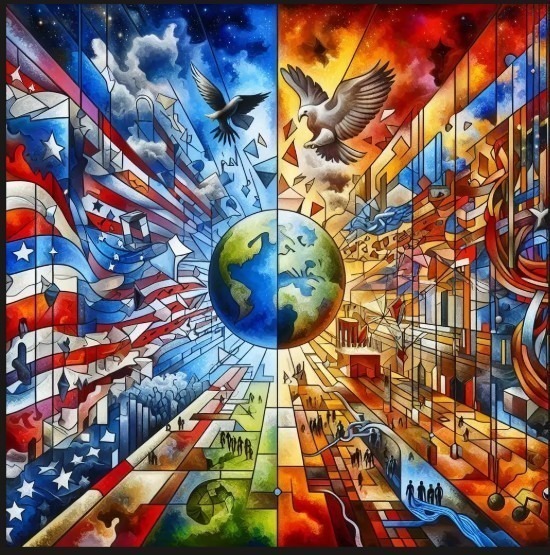
History delivers a definitive verdict on doctrinaire communism: it constitutes a catastrophic failure in governance and political economy. The 21st century, defined by digital globalization and existential ecological threats, presents challenges that the rigid, 19th-century framework of classical communism collides with irreconcilably.
Its theoretical foundations, rooted in a deterministic view of history and a utopian conception of human nature, shatter against the complex realities of modern statecraft. The system’s inherent political authoritarianism, its economic model of central planning, and its philosophical opposition to individual liberty render it a dangerous anachronism.
Politically, communism constructs a single-party vanguard state that systematically annihilates the pluralistic essence of civil society. This structure, justified by the Leninist principle of democratic centralism, concentrates absolute power within an unaccountable political class.
The Marxist-Leninist promise of the “withering away of the state” exposes itself as a cruel fiction; in practice, the party-state expands into a pervasive organ of surveillance and coercion. This model directly contradicts the fundamental principles of liberal democracy—separation of powers, minority rights, and competitive elections—which have proven their superior capacity for peaceful political succession and the mitigation of tyranny.
Economically, the communist commitment to central planning represents a fatal conceit. It attempts to manage the immeasurable complexity of a modern economy through bureaucratic fiat. Friedrich Hayek’s critique of the socialist calculation problem remains unassailable: no central body can aggregate the dispersed knowledge of millions.
The result, as history demonstrates, is endemic shortages, monumental waste, and a catastrophic stifling of innovation. The dynamism of the digital age, driven by decentralized networks and entrepreneurial risk-taking, depends upon the very price signals and market incentives that communism deliberately extinguishes.
Socially, the communist project engages in a violent assault on the complex tapestry of human identity. It subordinates all competing allegiances—ethnic, religious, or familial—to the monolithic identity of the “comrade.” This ideological flattening creates a profoundly alienated and atomized society, stripping away the organic social capital of genuine community.
The communist project in Nepal propagates a distant drama of equality, a theatrical promise staged upon the grim reality of profound and permanent inequality. This ideology, professing to annihilate class distinctions, merely reconstitutes them in a more perverse and entrenched form, replacing the alleged anarchy of the market with the rigid tyranny of the party-state. The theoretical journey from bourgeois “formal” equality to communist “actual” equality necessitates a transitional dictatorship that, in practice, becomes permanent, centralizing all power within a nomenklatura that operates as a new ruling class.
This vanguard, justifying its authority through a deterministic reading of history, seizes not only the means of production but the very means of thought, transforming the utopian goal of a classless society into the ideological fuel for its own unaccountable reign. The promised withering away of the state remains a cynical fiction, as the apparatus of coercion—the secret police, the censors, the gulags—expands infinitely to manage the inherent contradictions between dogma and human nature. Consequently, the socialist fraternity corrodes into a Hobbesian state of universal suspicion, where the collective good serves as a pretext for the surrender of all individual rights, and the pursuit of material equality produces only the equal distribution of misery, stifling the human drive for excellence and distinction under the dead weight of bureaucratic conformity.
The egalitarian dream thus culminates not in liberation, but in a sterile landscape of mandated uniformity, where the only equality guaranteed is an equal powerlessness before the party, proving the entire endeavor a monumental failure that sacrifices liberty for a phantom and human dignity for a disastrous, unattainable ideal.
Additionally, the doctrine’s inherent atheism and hostility toward traditional morality dismantle the ethical foundations of social cohesion. These actions stand in direct opposition to the 21st-century values of multiculturalism and individual self-determination.
The global challenges of this century demand international cooperation and the free exchange of technology and knowledge. The closed, secretive nature of communist states, bred by their inherent suspicion of external influence, fundamentally impedes such collaboration.
Managing a global pandemic, for instance, requires transparent data sharing and an independent civil society—institutions that cannot exist within a one-party framework. The communist state’s default position of defensive paranoia makes it a liability in the face of transnational threats.
This failure extends with particular severity to a nation like Nepal. A communist usurpation of Nepal’s hard-won federal democratic republic would dismantle its nascent, inclusive social contract. The doctrine’s class reductionism offers no viable mechanism for addressing the historical grievances of the Madhesi, Tharu, and Janajati communities, whose demands require a pluralistic, dialogic political process that single-party rule extinguishes. Imposing a command economy would catastrophically undermine Nepal’s market-dependent pillars of remittances, tourism, and foreign investment, triggering capital flight and isolation.
Hence, the socio-political and economic architecture of communism represents a philosophical and practical dead end. Its political structure institutionalizes tyranny, its economic model guarantees stagnation, and its social program fosters alienation. The 21st century demands systems of flexibility, accountability, and freedom.
Communism offers only the brittle rigidity of a bygone era, a prescription for failure that the world must resolutely reject in favor of frameworks that acknowledge both modern complexities and the inviolable rights of the individual.
I have been working on the trends of the Nepalese Foreign Policy as the existing global order gets gradually altered in 21st century world ..
I have been working on the trends of the Nepalese Foreign Policy as the existing global order gets gradually altered in 21st century world. I am an MA in English and MPhil in International Relations a...
@ Copyright matrikapoudyal.com All Rights Reserved
Designed by Fortune Info Tech