


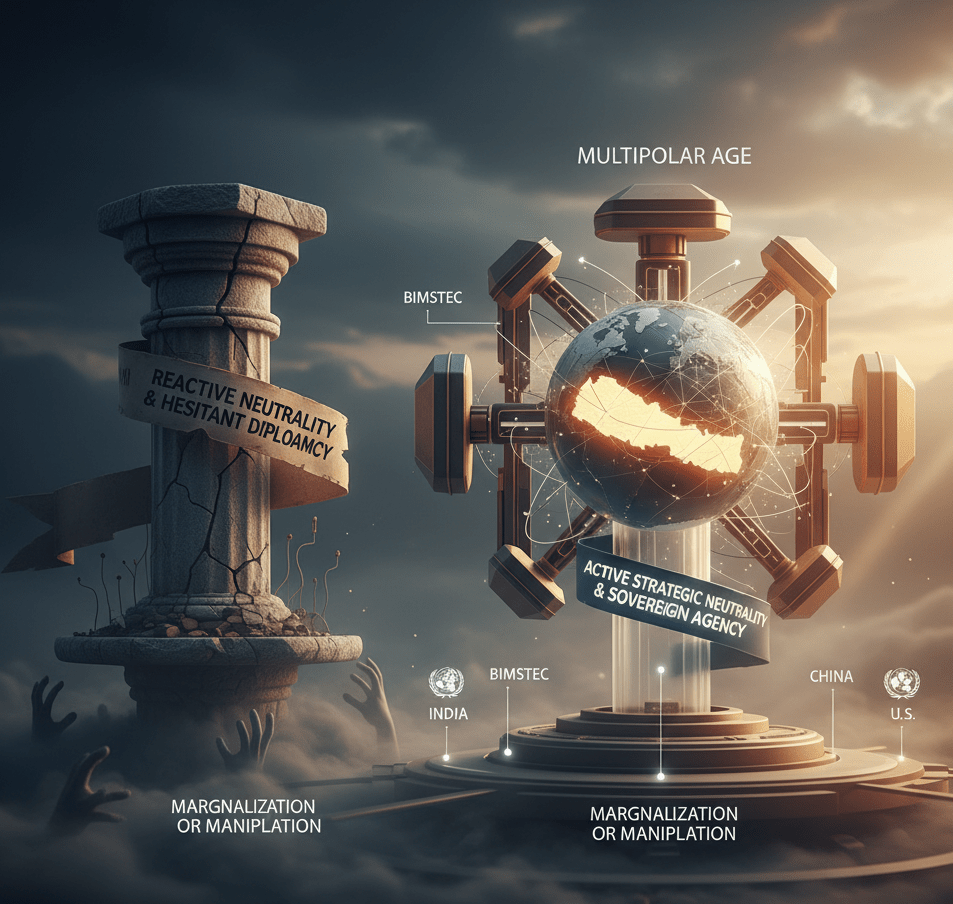


I have been working on the trends of the Nepalese Foreign Policy as the existing global order gets gradually altered in 21st century world ...

Nepal’s journey toward political stability and sustained socio-economic development has encountered significant obstacles, rooted in a complex interplay of historical, institutional, and geopolitical factors.
Since the shift to a federal republic in 2008, the nation has grappled with frequent government changes, fractured political parties, and deep-seated corruption, which collectively impede a cohesive national agenda.
As a result, despite considerable progress in certain social indicators, Nepal’s economic potential remains largely unrealized. To escape this cycle of instability, the country must fundamentally restructure its political framework, strengthen its institutions, and forge a new national consensus.
A historical perspective reveals the deep-seated origins of Nepal’s political malaise. The legacy of the autocratic Rana regime and the subsequent periods of monarchy cultivated a political culture defined by patronage, personal loyalties, and a zero-sum mentality, rather than public service.
The shift to a multi-party democracy in 1990 did not dismantle this deeply ingrained system; rather, it merely transferred the power struggle to a new arena. Political parties, instead of acting as unified bodies with clear ideologies, devolved into highly factionalized entities, perpetually consumed by internal rivalries and the pursuit of short-term gains.
This historical inertia continues to dictate the present, with frequent coalition breakdowns and a lack of policy continuity, making long-term planning an impossible feat.
The institutional framework itself, a direct consequence of the 2015 constitution, contributes to the current predicament. While the constitution established a federal structure, the implementation has proven deeply flawed.
The proportional representation system, while aiming to ensure inclusivity, has ironically led to the proliferation of smaller parties, creating unwieldy coalition governments that collapse with remarkable frequency.
Consequently, political leaders prioritize maintaining power over effective governance. A prime minister’s primary focus shifts from enacting impactful policy to appeasing coalition partners, paralyzing the administrative state and breeding public cynicism. This institutional flaw acts as a gravitational pull, constantly dragging the nation back to square one.
In parallel, the economic landscape reflects the profound consequences of political instability. Nepal’s economy, which relies heavily on remittances and tourism, lacks a robust, domestically-driven engine for growth. While remittances have played a crucial role in poverty reduction, they mask a fundamental weakness: a lack of productive job creation at home.
Political uncertainty discourages foreign and domestic investment in critical sectors like hydroelectricity and infrastructure. Investors shy away from an environment where policy changes with every new government, and corruption pervades every level of bureaucracy.
This vicious feedback loop—where political instability stunts economic growth, and economic stagnation fuels public discontent—further perpetuates the cycle of political fragility.
To break this cycle, Nepal must execute a comprehensive reform agenda. Foremost, constitutional amendments are imperative to simplify the electoral system and incentivize a more stable, two-party or multi-party system with clear mandates.
This reform would reduce the frequency of government changes and allow for a more consistent national vision. Furthermore, strengthening anti-corruption institutions is paramount. A truly independent and empowered anti-graft body, shielded from political interference, would hold officials accountable, rebuild public trust, and create a more transparent business environment.
Beyond institutional reform, a fundamental paradigm shift in political culture is essential. Political leaders must move beyond personal and partisan interests to embrace a collective vision for the nation’s future. This involves fostering a culture of constructive dialogue and compromise, rather than perpetual confrontation.
The political elite must reconnect with the public, addressing the deep-seated grievances related to inequality, social exclusion, and a lack of opportunity that have long been a source of unrest. Engaging with civil society and the youth—a significant portion of the population—can help build this new consensus and provide fresh impetus for change.
Ultimately, Nepal’s path to a prosperous future hinges on its ability to reconcile its democratic aspirations with the pragmatism of governance.
By implementing targeted constitutional reforms, fortifying institutions against corruption, and cultivating a political culture of accountability and collaboration, Nepal can transform its political instability from an enduring characteristic into a historical footnote.
This transformation will finally unlock the nation’s immense socio-economic potential, channeling its human capital and natural resources toward a trajectory of sustained development and shared prosperity.
I have been working on the trends of the Nepalese Foreign Policy as the existing global order gets gradually altered in 21st century world ..
I have been working on the trends of the Nepalese Foreign Policy as the existing global order gets gradually altered in 21st century world. I am an MA in English and MPhil in International Relations a...
@ Copyright matrikapoudyal.com All Rights Reserved
Designed by Fortune Info Tech