






I have been working on the trends of the Nepalese Foreign Policy as the existing global order gets gradually altered in 21st century world ...
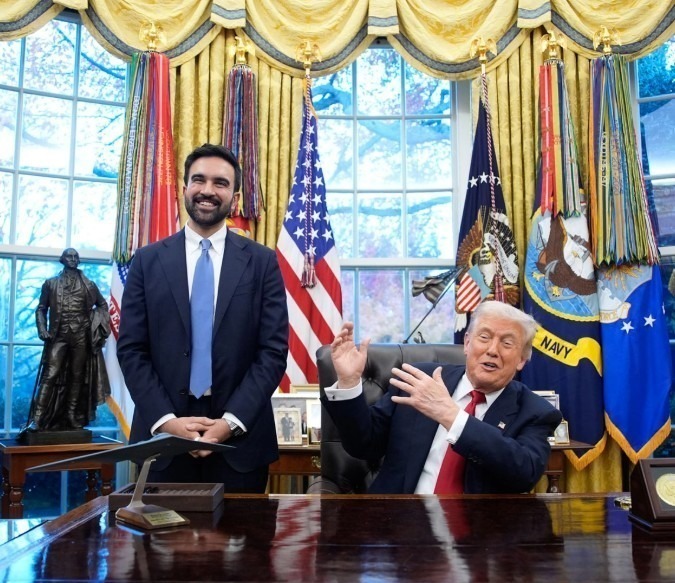
On this momentous day, November 21, 2025, the nation’s focus sharpened on the Office of the US President, the White House, Washington D C. Two formidable visions for America’s soul—President Trump’s steadfast belief in national sovereignty and the Mayor-elect of New York City, Johran Mamdani’s passionate advocacy for community-driven governance—converged, demanding an immediate response to the crisis gripping the American worker.
This monumental clash of ideologies transcended mere policy debate; it forged the very future of the US federal and local landscapes. Since polarization, the easy retreat of lesser leaders, fails the people; only a principled commitment to pragmatic action compels true governance.
History judges leadership by results, not rhetoric. That day, the friction of opposing truths ignited a transformative fire, charting a new course that insists upon solutions and rejects the paralysis of ideological purity.
This historic partnership addressed a shared adversary: the unrelenting economic stagnation crushing working-class New Yorkers. For decades, New York City’s relentless housing underproduction limits mobility, drives up costs, and drains the economic vitality of the city.
This scarcity elevates housing from a local issue to an existential threat against national economic security. Local analysis confirms the non-negotiable mandate: low-income residents, especially essential workers, identify higher wages and deeply affordable housing as their top priorities for achieving economic advancement.
The struggle for dignified life dictates political strategy. The sheer pressure of this human cost demands immediate, radical intervention, establishing the economic dignity of the worker as the sole common denominator that subordinates all political difference.
President Trump seizes this mandate, deploying the massive power of the federal government not for counterproductive broad protectionism, but for targeted, internal construction and capacity building. Traditionally, policies based purely on quantitative protectionism risk failure, often raising input costs that adversely affect downstream manufacturers and diminish employment across crucial sectors.
The ratio of jobs in steel-using industries to steel production jobs stands approximately 80 to 1, demonstrating the danger of generalized tariffs. This compact decisively pivots: the Administration reorients national sovereignty toward investment, commanding federal capital—such as the Pathways to Removing Obstacles to Housing (PRO Housing) funding —to shatter local structural barriers, including outdated zoning and regulatory inefficiencies.
This executive action elevates housing production to critical national infrastructure, demanding exclusive use of American materials and union labor, ensuring that federal strength defends domestic industry through construction, not merely through trade defense.
In reciprocal action, Mayor Mamdani provided the essential local imperative, securing equity and community control over this federal investment. His administration dictated the terms of engagement. Mamdani’s platform insists upon local control, fighting corporate exploitation and guaranteeing that every New Yorker secures the foundation for a dignified life.
The City employs its legislative muscle, transforming the regulatory landscape. Crucially, the City enacts the Universal Affordability Preference (UAP) program, moving decisively beyond failed voluntary inclusionary housing.
This local command leverages new density bonuses to simultaneously mandate deep affordability, requiring larger projects utilizing the UAP to deliver twenty percent of their total income-restricted units at forty percent Area Median Income or below. Mamdani successfully weaponizes local zoning authority, guaranteeing that federal dollars serve community equity, not speculative profit.
The Strategic Policy Compact formalizes this alignment, synthesizing national power and local necessity. The agreement establishes housing supply expansion as a national infrastructure project, mirroring the critical collaborations achieved in transportation and environmental policy.
Federal infrastructure funds meet the City’s accelerated zoning overhaul, which includes expanded residential conversions of non-residential buildings and increased density allowances. Trump’s investment drives demand for domestic steel, construction, and high-road labor agreements; Mamdani’s streamlined permitting and regulatory mandates supply the construction pipeline and ensure the equitable distribution of housing outcomes.
This convergence utilizes the density and zoning flexibility provided by the UAP to dramatically expand supply while simultaneously imposing the deep affordability mandates , delivering quantity and equity in one synchronized movement.
This partnership shatters the outdated paradigm of ideological opposition. The collaboration insists that mutual trust and principled prudence compel cooperation when the working class suffers. This radical alignment—populist nationalism meeting populist socialism—redefines effective governance.
The agreement rejects the comfortable dogma of gridlock, proving that leaders, recognizing the volatility of shifting political fortunes, prioritize immediate results over rhetorical posturing. This singular focus on economic populism allows both principals to claim an indisputable victory over policy paralysis, confirming that true political strength resides in the capacity to transcend internal conflict and deliver tangible relief to constituents. This unification validates the power of the mandate secured by the people.
The New York model establishes the national doctrine. This convergence proves that federal strength must empower, not subsume, local equity; that the commanding power of the state and the passion of community governance must align on the singular goal of economic populism.
This unprecedented success demands that leaders across America replicate this synthesis, ending manufactured conflict and focusing legislative energy on tangible working-class relief. History records November 21, 2025, as the day ideology yielded to disciplined, courageous action, confirming that a government focused solely on the common good of the worker prevails against all opposition and charts the inevitable course toward a more just and prosperous American future.
I have been working on the trends of the Nepalese Foreign Policy as the existing global order gets gradually altered in 21st century world ..
I have been working on the trends of the Nepalese Foreign Policy as the existing global order gets gradually altered in 21st century world. I am an MA in English and MPhil in International Relations a...
@ Copyright matrikapoudyal.com All Rights Reserved
Designed by Fortune Info Tech