


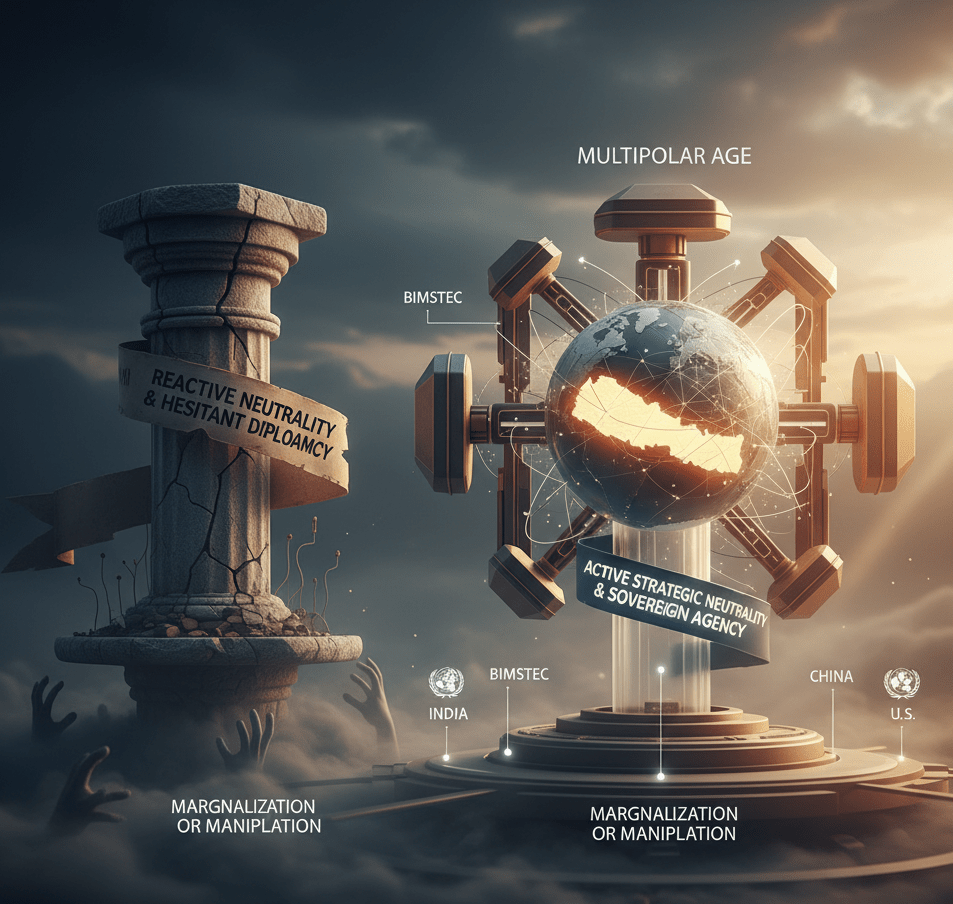


I have been working on the trends of the Nepalese Foreign Policy as the existing global order gets gradually altered in 21st century world ...

The contemporary global economic order, a sprawling architecture of neoliberal capitalism, currently hemorrhages under the weight of its own systemic contradictions, leaving landlocked nations like Nepal to navigate a treacherous landscape of debt, environmental decay, and social fragmentation.
Traditional economic metrics, which obsessively celebrate the growth of Gross Domestic Product (GDP) while ignoring the erosion of social capital and ecological integrity, fail to provide a sustainable roadmap for a nation situated at the fragile crossroads of the Himalayas.
Nepal’s current economic trajectory—characterized by an unsustainable reliance on remittances that fuel a voracious import appetite and a “Dutch Disease” that hollows out domestic productivity—necessitates a radical departure from the “dog-eat-dog” competition of the West.
The Majjhima Patipada, or the Middle Path propounded by Lord Buddha, offers more than just a spiritual retreat; it provides a rigorous, sophisticated economic strategy that seeks the maximization of human well-being through the minimization of resource depletion.
By eschewing the extremes of predatory accumulation and crushing deprivation, the Middle Path establishes a balanced framework where economic activity serves as a vehicle for liberation (Bodhi) and the cessation of suffering (Dukkha) rather than as an end in itself.
The philosophical architecture of the Middle Path Economic Strategy rests upon the ontological realization of Pratityasamutpada, or dependent origination, which acknowledges the profound interconnectedness of all sentient beings and their environment.
Capitalism thrives on the delusion of separation, treating the natural world as a “non-priced resource” and marginalized communities as “externalities” that exist outside the balance sheet.
In contrast, the Buddha’s teachings demand a “Right View” (Samma Ditthi) that recognizes the true nature of the current crisis: a collective intoxication with sensory pleasures and material accumulation that fuels an infinite craving (Tanha) within a finite planetary system.
This strategy advocates for a shift from “exterior” sciences—which prioritize quantitative data like consumption rates—to an “interior” science that values the mental stability and contentment of the citizenry.
Nepal’s policy framework must therefore integrate the Four Noble Truths as an analytical tool: identifying the Dukkha of systemic inequality, tracing its Samudaya (origin) to greed and dependency, envisioning the Nirodha (cessation) of this suffering through sufficiency, and implementing the Magga (path) through ethical governance and Samma Ajiva (Right Livelihood).
Right Livelihood (Samma Ajiva) serves as the operational engine of the Middle Path, demanding that the nation cultivate industries that nourish the human spirit while forbidding those that traffic in harm, such as weapons, intoxicants, and environmental destruction.
The global capitalist system reduces the worker to a mere “unit of production,” a subhuman component in a vast machine of mass production that prioritizes the product over the person.
A Buddhist economic strategy for Nepal resurrects the dignity of labor by promoting “production by the masses,” favoring small-scale, locally appropriate technologies that allow artisans and farmers to develop their faculties and overcome ego-centeredness through communal tasks.
This approach offers a powerful antidote to the remittance curse; by fostering an environment where youth find meaningful, non-exploitative work within their own communities, the nation reclaims its most valuable asset—its people—from the “dog-eat-dog” labor markets of the Middle East and East Asia.
The transition from a service-based dependency to a productive, self-reliant economy requires the government to incentivize “Right Livelihood” sectors like organic agriculture, creative handicrafts, and eco-spirituality.
Energy sovereignty represents a critical pillar of the Middle Path, where Nepal must navigate between the destructive extremes of fossil fuel dependency and the ecological violence of mega-hydro projects.
Large-scale hydroelectric dams often function as instruments of neo-colonialism, displacing indigenous communities, eviscerating biodiversity, and burdening the national treasury with insurmountable debt.
The Middle Way advocates for decentralized, community-managed micro-hydro power (MHP) and solar installations that provide clean, “run-of-the-river” energy without the need for massive reservoirs. In districts like Baglung and Nuwakot, community-owned MHPs already power local industries, from noodle factories to furniture workshops, demonstrating that energy access can flourish through cooperation rather than centralized control.
Recent breakthroughs in interconnecting these micro-grids with the national grid illustrate the Buddhist principle of interdependence; excess local power supports the national whole, ensuring that small-scale investments remain sustainable and profitable for rural citizens.
Environmental stewardship in Nepal finds its most successful expression through community-led governance, which mirrors the Buddhist ethic of mindfulness (Sati) and non-violence (Ahimsa).
The Community Forestry Program, engaging one-third of the nation’s population, has reclaimed 1.2 million hectares of land from the brink of degradation, proving that the Middle Path of participatory environmental governance outshines the “command-and-control” models of centralized bureaucracy.
Forests provide essential natural capital—wild edibles, medicinal plants, and fodder—that supports the “livelihood system” of the rural poor, yet this success remains threatened by the persistent exclusion of women and marginalized castes from executive decision-making.
To truly embody the Middle Path, Nepal must dismantle the systemic hierarchies that concentrate 61.15% of civil service participation within a single group (Khas Brahmin Kshatriya) while relegating Dalits to a mere 1.4%, despite their significant population share.
An economy that fails to practice equity (Upekkha) invites social disintegration, as the marginalized are forced into deeper environmental dependence and migration to survive.
Comparative wisdom from neighboring regimes, specifically Bhutan’s Gross National Happiness (GNH) and Thailand’s Sufficiency Economy Philosophy (SEP), provides a robust shield against the shocks of global capitalism.
Bhutan’s four pillars—sustainable development, environmental conservation, cultural preservation, and good governance—operationalize the Middle Path by giving preference to “happiness and peace” over unbridled economic growth.
Similarly, Thailand’s SEP advocates for “self-immunity,” moderation, and reasonableness, helping communities build resilience against volatile fuel prices and global financial downturns.
Nepal’s adoption of the Green, Resilient, and Inclusive Development (GRID) strategy represents a tentative step toward this Middle Way, yet it often remains trapped in narrow, technical “3R” (Reduce, Reuse, Recycle) frameworks rather than embracing the systemic transformation required for true sustainability.
A Middle Path Economic Strategy must move beyond “conceptual recycling” to integrate indigenous circular practices and the “Sangha-style” cooperative mindset that fosters solidarity over competition.
The relentless march of global capitalism facilitates a form of “neo-cultural colonialism,” where the sacred artifacts and traditions of Nepal undergo a violent transformation into mere commodities for Western markets.
The commercialization of paubha and thangka paintings, alongside the literal theft of archaeological treasures from valley monasteries, demonstrates how “economic temptation” deviates from established cultural norms.
Furthermore, the introduction of war-themed video games and plastic military toys—even within the sanctity of Buddhist monasteries—ignites a fascination with violence that undermines the foundational principle of Ahimsa.
A Middle Path strategy protects these “interior dimensions” of culture, recognizing that the Guthi system of the Newar community, with its ontology of relationality and reciprocal care, provides the social capital necessary for grassroots sustainable tourism.
By repositioning Nepal as a high-value, year-round destination for spiritual and nature-based pilgrimage in sites like Lumbini, the nation can transition away from “hit-and-run” tourism toward a model that delivers inclusive benefits to local communities while preserving the sanctity of its heritage.
The implementation of a Middle Path Economic Strategy for Nepal necessitates the harmonization of fiscal discipline with compassionate resource allocation, ensuring that the fruits of macroeconomic stability reach the most vulnerable.
While the nation has successfully rebuilt policy buffers—reaching $20 billion in foreign exchange reserves—domestic demand remains subdued and investor confidence wanes under the shadow of unresolved structural issues.
A Middle Path approach demands that the government accelerate budget execution toward “project readiness” in hydropower and trade-related infrastructure, while simultaneously expanding targeted social protections for those crushed by the current transition.
Policymakers must move from a remittance-led growth model toward a diversified, job-rich economy that leverages the nation’s demographic dividend and unique natural assets.
The integration of Buddhist values into the 2030 development strategy offers a path to “equitable peace, prosperity, and progress for all,” provided that the state commits to the eradication of systemic hierarchies and the cultivation of an ethical, value-driven market.
The Middle Path Economic Strategy serves as the only rational conclusion for a nation seeking to survive the predatory impulses of late-stage capitalism. By anchoring economic planning in the virtues of love, compassion, appreciative joy, and equanimity, Nepal can emancipate its accounting and governance from the ethical constraints of traditional neoliberalism.
This “Middle Way” does not reject wealth; it rejects the attachment to wealth and the craving that drives exploitation and overconsumption. A truly rational economy acknowledges the universality of fear and suffering, thereby finding a natural compassion for all beings and the environment.
Nepal stands uniquely poised to model this alternative for the world—a nation reimagined where success is measured not by the height of its consumption, but by the depth of its contentment and the resilience of its ecosystems.
In the age of crises, the choice remains stark: either continue the descent into capitalist instability or ascend the Noble Eightfold Path toward a sustainable, sovereign, and compassionate future.
I have been working on the trends of the Nepalese Foreign Policy as the existing global order gets gradually altered in 21st century world ..
I have been working on the trends of the Nepalese Foreign Policy as the existing global order gets gradually altered in 21st century world. I am an MA in English and MPhil in International Relations a...
@ Copyright matrikapoudyal.com All Rights Reserved
Designed by Fortune Info Tech