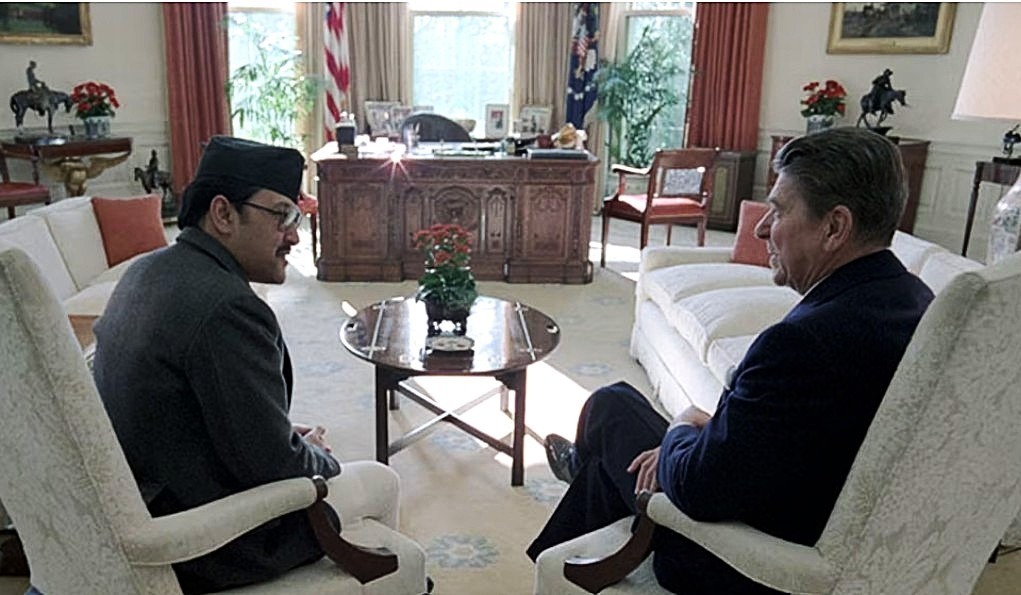
The Birendra Doctrine and the Reagan Legacy in Nepal-US Relations
The conceptual architecture of modern diplomacy often rests upon the evocative power of metaphor to bridge the chasm of geography. In October 1983, during a state dinner at the White House, President Ronald Reagan articulated such a vision while welcoming King Birendra Bir Bikram Shah Dev, describing Nepal as a neighbor on the other side of the world.
Far from being a mere pleasantry of statecraft, this statement established a paradigm of “virtual proximity” that continues to define the strategic logic of Nepal-US relations in the 21st century.
By collapsing the physical distance separating the Potomac from the Himalayas, Reagan signaled that the survival and prosperity of the Nepalese state remained a vital concern for the American-led international order.
The Birendra Doctrine, in this respect, centers Nepal’s foreign policy on strict non-alignment and active neutrality. It proposes a formal Zone of Peace, seeking to insulate the nation from regional power rivalries. This strategy asserts sovereign equality and prioritizes balanced relations with all countries.
Amidst escalating great power rivalries, the Birendra Doctrine offers Nepal critical protection. Its principles of strict neutrality and sovereign equality ensure diplomatic autonomy. This framework preserves national sovereignty, prevents entrapment in external conflicts, and maintains balanced regional engagement.
Today, as Nepal navigates a complex transition toward a socialist-oriented federal democratic republic amidst the burgeoning rivalries of China, India, and the United States, the resonance of Reagan’s “neighborly” proximity requires a rigorous re-examination of Nepal’s geostrategic value and the structural imperatives for its socio-economic development.
The 1983 state visit of King Birendra occurred at a critical juncture of the Cold War, a period characterized by the Reagan administration’s efforts to bolster “courageous and convicted” partners against expansionist ideologies. Indeed, the historical evidence surrounding this visit reveals a relationship grounded in both personal affinity and strategic necessity.
President Reagan, known for his ability to identify common ground, humorously noted that while King Birendra possessed a talent for parachuting, the two leaders found their shared interest in horseback riding to be a more practical commonality. This personal rapport reflected a broader diplomatic tradition that began with the establishment of relations in 1947 and was reinforced by King Mahendra’s visit in 1967.
Moreover, Reagan’s speeches during the 1983 visit highlighted the miracle of modern communications and transportation as the mechanism that permitted a landlocked Himalayan nation to function as a virtual neighbor to the United States. He emphasized that despite the distance, friendship and cordiality based on shared ideals can exist between countries that are geographically far apart.
The historical significance of this rhetoric lies in its endorsement of Nepal’s Zone of Peace (ZoP) proposal. King Birendra, seeking to insulate Nepal from regional conflicts and nuclear tensions between its giant neighbors, proposed that Nepal be recognized as a sanctuary of neutrality.
Reagan’s explicit endorsement provided Nepal with essential international leverage at a time when regional powers remained skeptical. Consequently, it proved to be not just a milestone in Nepal-US relations but also emphasized the dire need for trans-global partnership in the democratic world.
This legacy extends to the present with the US geostrategy of virtual proximity in the 21st century. Specifically, the transition of Nepal from a buffer state to a bridge represents a significant evolution of the Reaganite legacy.
In the contemporary era, the geostrategic value of Nepal is no longer merely defensive; it is, in fact, central to the Free and Open Indo-Pacific (FOIP) vision. The United States recognizes that instability or insecurity in the heart of Asia constitutes a direct threat to its interests.
The 21st-century iteration of Reagan’s “neighborly” proximity is manifested through substantial economic and security investments, thereby fostering the “self-reliance” and “resilience” that Reagan championed.
Furthermore, the United States has upscaled cooperation with Nepal under the Indo-Pacific Strategy (IPS), viewing the nation as a potential partner in a rules-based regional order. This strategy prioritizes good governance, democratic values, and security stability.
By fostering a more capable national government and security sector, the US aims to deter malign influence and enhance regional security. For Nepal, this needs a policy of multi-alignment or hedging, where the state leverages relationships with the US, India, and China to preserve its autonomy while maximizing developmental aid.
A fundamental pillar of the Nepal-US relationship is the shared commitment to the dignity of man and democratic institutions. The 2015 Constitution of Nepal, which designates the state as a socialist-oriented federal democratic republic, represents a unique synthesis of ideologies designed to stabilize a society recovering from a decade-long insurgency. Thus, liberal-social democracy is not merely a political preference in the Nepalese context; it is a structural necessity for maintaining national cohesion.
The importance of a socialist-oriented democracy lies in its capacity to address the socio-economic grievances that have historically fueled instability. By integrating progressive tax systems, substantial social transfers, and redistributive measures, the state seeks to mitigate the adverse impacts of unrestrained neo-liberal capitalism and extreme poverty. This model, thus, aims to create an inclusive society where assets and resources are distributed justly—a goal Reagan explicitly supported during his welcoming remarks to Birendra.
Nevertheless, the implementation of this vision faces rampant corruption, bureaucratic hurdles, and immoral alliances among elite groups. As a result, the failure of consecutive governments to translate socialist rhetoric into practice has led to broad dissatisfaction and a loss of faith in government institutions, exemplified by the youth-led protests of 2025. So, global powers must support the democratization, decentralization, and engagement of citizens to ensure that Nepal’s democratic experiment does not collapse into authoritarianism or state failure.
Critically, Nepal sits at the intersection of the national security interests of the United States, China, and India. Each power views the stability and orientation of Kathmandu through a distinct strategic lens, creating a trilateral push that defines Nepal’s security landscape.
For Beijing, Nepal is a traditionally friendly neighbor and a critical component of its periphery diplomacy. China’s primary security concern in Nepal is the Tibet question. Consequently, Beijing has upscaled closer cooperation in border management, providing logistic support and capacity building for Nepali security personnel to monitor the northern border.
Similarly, India’s security calculus is dominated by the more than 1,850 km open border, which it views as a conduit for transnational terrorist threats and illegal infiltration. Moreover, India perceives China’s infrastructure development close to its border as a direct threat to its influence. Hence, the Himalayan Frontier Policy continues to guide India’s insistence on a special relationship that prioritizes its security interests.
For its part, the United States considers a stable, democratic, and sovereign Nepal essential for regional security. Washington’s security challenges involve countering state-sponsored disinformation, coercion, and censorship that could undermine democratic principles. Accordingly, the US focuses on professionalization of the military, disaster preparedness, and humanitarian response as means to strengthen Nepal’s strategic autonomy.
In this context, the promotion of Nepal’s socio-economic development is not merely an act of benevolence but a supreme strategic necessity for the major powers. Simply put, a fragile democracy in the heart of Asia is a liability for regional peace. If the minimum of basic needs is not met, the resulting instability and extremism can spill over borders. Thus, by supporting Nepal’s battle against illiteracy, disease, hunger, and poverty, global powers create a resilient partner rather than a source of regional contagion.
Besides, Nepal’s tremendous hydroelectric potential offers a mechanism for complex interdependence. The development of energy exports to India, facilitated by US investment, fosters a web of economic interdependency that raises the cost of conflict for all parties. In this way, King Birendra’s 1983 vision of a creative effort for prosperity through water resource management remains the most viable path toward eliminating the perils of hunger and the danger of instability.
Hence, President Reagan’s 1983 welcoming of King Birendra as a neighbor on the other side of the world remains a prophetic insight into the interconnected nature of 21st-century geopolitics. The historical evidence confirms that the United States and Nepal are linked in peoples’ common commitment to peace and human progress. In an era of escalating rivalry, the “Birendra Doctrine” of non-alignment and the “Zone of Peace” find new relevance as a guiding framework for drafting Nepal’s sustainable diplomatic policy.
The international community must recognize that the trajectory of Nepal’s political stability will shape the Himalayan security dynamics for decades to come. Indeed, the inevitable promotion of Nepal’s socio-economic and political development is the only viable strategy to ensure that this trans-global neighbor remains a vibrant bridge for cooperation rather than a flashpoint for conflict.
The Generation Z Uprising signals a profound shift in the domestic landscape. This upheaval, triggered by bad governance and social media censorship, reflects a deeper crisis of representation. For the United States, this instability demands a recalibration of engagement—shifting from sweeping democracy-promotion to selective engagement that prioritizes practical cooperation.
Meanwhile, the Chinese recalibration after Oli’s fall underscores Beijing’s concern that external powers might exploit the youth-led political volatility. Similarly, India remains cautious, viewing the Gen Z Uprising through the lens of its immediate security concerns.
In this complex environment, the highest diplomatic tone must be maintained to ensure that Nepal’s multi-dimensional foreign policy can navigate extraordinary power rivalry. Eventually, the 1983 statement of President Reagan serves as a reminder that even the most distant neighbors are bound by the wisdom and will to protect the deepest treasures of the human spirit.