

Technocratic Resuscitation of the Himalayan Republic

Picture of Matrika Poudyal

Matrika Poudyal

I have been working on the trends of the Nepalese Foreign Policy as the existing global order gets gradually altered in 21st century world ...
Downloads

Recent Posts

Technocratic Resuscitation of the Himalayan Republic

The violent paroxysms seizing the Kathmandu Valley in September 2025 signify a fundamental phase transition in the thermodynamics of Nepali statehood, where the latent heat of decades of corruption finally reached a critical boiling point. For generations, the political establishment maintained a stagnant equilibrium—a low-energy state where systemic graft and nepotism acted as friction, slowing national progress to a near-halt.
The draconian suspension of twenty-six social media platforms on September 4, 2025, ignited a pressurized vessel of generational fury, shattering the old guard’s illusion of stability. This Gen Z Uprising obliterated the traditional landscape, demanding a radical reconfiguration of the social contract that mirrors liquid-to-gas conversions: when internal pressure exceeds structural integrity, explosion becomes inevitable.
To rescue this derailed democracy, technocratic stabilizers—Sushila Karki, Rameshwar Khanal, Kulman Ghising, Mahabir Pun, and Lt. Gen. Balananda Sharma—now act as anchors and accelerators, leveraging the Gorkhali spirit of resilience to reconstruct a nation currently bleeding its vital youth.
The collapse of the K.P. Sharma Oli administration followed the laws of social physics with startling precision, illustrating that political stability never represents a static state but a dynamic balance of opposing forces. The “Nepo Kid” phenomenon—where the children of the corrupt political leaders flaunted lavish lifestyles on digital platforms while the common working class faced 22.7 percent youth unemployment—accumulated massive potential energy within the system.
The social media ban functioned as a vacuum seal, preventing the natural dissipation of this energy and forcing a rapid conversion into kinetic violence on the streets. Investigative journalists  served as the optical lens, focusing the light of truth on elite impunity and exposing the parasitic structures of the political-business nexus.
As thousands of students bypassed the inertia of traditional parties, they applied maximum torque to the axis of the state, storming the Parliament and targeting residences with unprecedented leverage.
This digital infrastructure enabled a “hive mind” decision-making process, allowing the Discord revolution to supersede the corrupt, analog governance of the past. The force exerted by this movement resembles a piston stroke within an internal combustion engine; the compression of dissent led to an ignition that drove the state machinery toward a new cycle.
Protesters demonstrated the resilience of a distributed network, where the removal of traditional leadership nodes failed to paralyze the organism. Through online polls, Gen Z selected former Chief Justice Sushila Karki to lead, transforming digital democracy from a theoretical ideal into a functional reality.
This networked movement functions as a decentralized command center, ensuring that no single node of power can again lobotomize the nation’s communication pathways or stifle the collective voice of the working class.
The most dire problem facing common working-class Nepalis remains an economic model mimicking biological osmosis, where vibrant labor flows across semi-permeable borders while cash remittances flow back in.
While this keeps the nation hydrated in foreign exchange, it leaves domestic cell walls of industry and agriculture withered and unproductive. Over 2,000 young Nepalis depart daily, turning rural villages into geriatric wards where farms lie fallow and food insecurity looms—a process akin to soil exhaustion where fertile nutrients are continuously exported without replenishment.
This parasitic dependency, constituting over 25 percent of the GDP, masks the state’s failure to provide local livelihoods, effectively treating citizens as an export commodity rather than human capital. The Gorkhali spirit demands an end to this external life-support dependency, seeking instead a self-sustaining domestic metabolism.
To resolve this, Finance Minister Rameshore Khanal must implement an economic photosynthesis model, converting the light of digital innovation and renewable energy into the glucose of domestic jobs. This requires dismantling the political-business nexus that acts as a vascular blockage, preventing capital from reaching small-scale entrepreneurs and farmers.
The working class demands a structural metamorphosis where the state transitions from a facilitator of migration to a generator of manufacturing and service-sector growth. The remittance trap acts like a strangler fig in the national forest—it provides a deceptive appearance of vitality while slowly choking indigenous trees of local industry until they collapse.
Only by removing these parasitic structures can development agents like Swarnim Wagle help cultivate a sustainable and self-reliant economic ecosystem that honors Nepal’s historical glory of economic sovereignty.
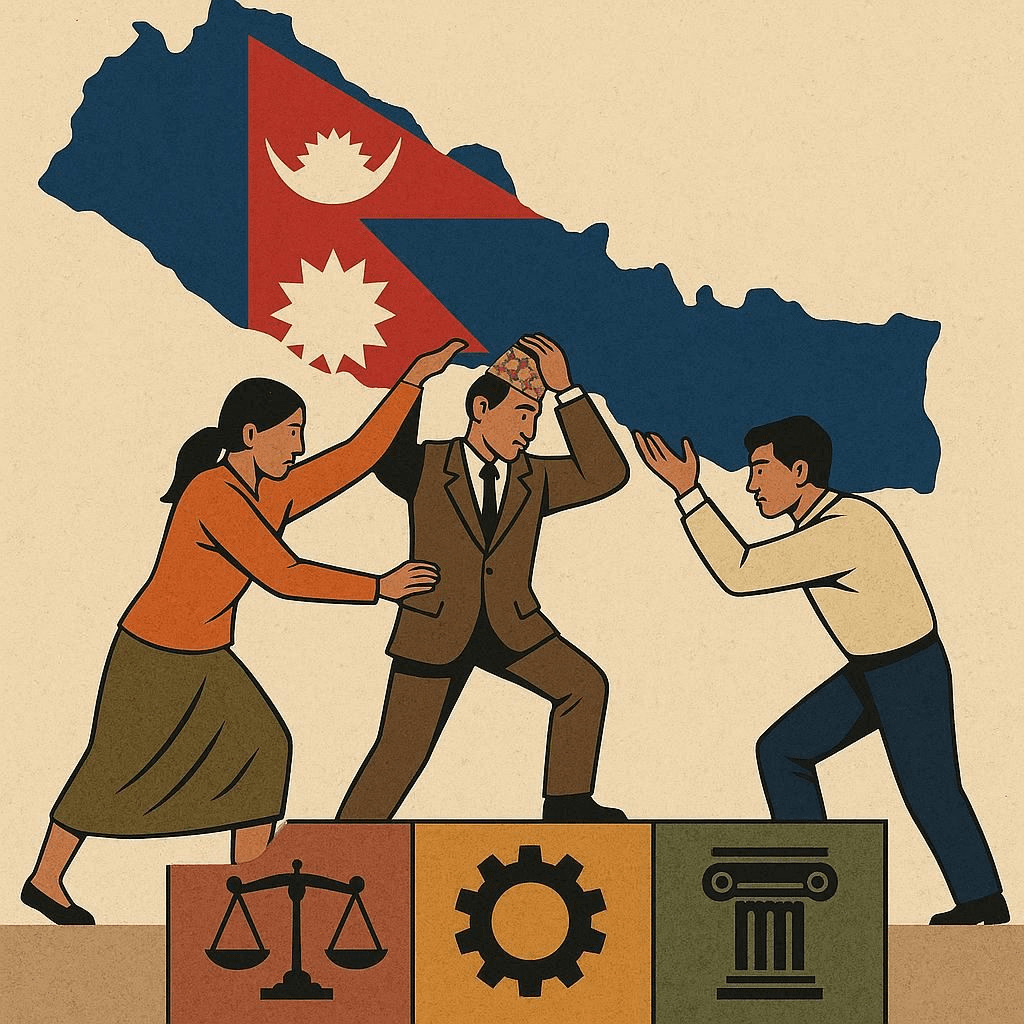
Rescue requires a return to judicial equilibrium, where the rigid anchor of the law prevents centrifugal forces of corruption from tearing the state apart. Former Chief Justice Sushila Karki’s appointment serves as molecular reinforcement, as her reputation for independence acts as a magnetic north for a political compass spinning wildly for decades.
The previous administration treated the Constitution as a flexible polymer, stretching it for partisan interests and contracting it to stifle dissent. Karki must lead constitutional repair, ensuring the executive piston remains constrained by the judicial cylinder to prevent the overheating of authoritarian power.
Accountability demands a law of conservation of responsibility—the principle that no act of state violence disappears without an equal and opposite reaction of justice, balanced through independent commissions and judges like Anand Mohan Bhattarai.
Kulman Ghising, managing the circulatory system of energy and infrastructure, represents the energetic pulse of this rescue plan. By ending power cuts, he proved technocrats deliver work to a public accustomed to institutional failure. He must now energize industrial zones to absorb youth who would otherwise migrate, creating high-voltage circuits of productivity connecting rural labor to urban markets.
Electricity functions as the ATP of a modern economy; without it, national metabolism grinds to a halt. By prioritizing industrial supply over wasteful leakages, Ghising builds high-efficiency circuits that make domestic production cheaper than imports, neutralizing trade deficit pressures. His apolitical pragmatism provides the insulation necessary to protect the energy sector from the short-circuits of political interference and elite graft.
Education Minister Mahabir Pun serves as the genetic engineer of a new Nepal, rewriting the DNA of the educational system. Pun recognizes that classroom politicization acts as a heat loss, where student energy wastes on slogans rather than acquiring the technical torque needed for the global economy.
His plan to decouple the academic motor from the political transmission allows universities to spin at their natural frequency of innovation. This applied science approach replaces voodoo economics with empirical statecraft, treating the nation as a laboratory for progress.
Pun’s objective grafts a significant budget portion onto research, creating a symbiotic relationship between laboratory and marketplace. National Innovation Centers serve as seed banks for the future, ensuring Gen Z creators find nutrients to grow domestically rather than seeking fertile soil abroad.
Hence, Nepal’s democracy exists in a complex field of forces requiring a delicate balancing of vectors to maintain sovereignty. Prime Minister Karki appoints Lt. General Balananda Sharma to steer the Foreign Ministry, utilizing his security diplomacy to transform the “Yam between boulders” into a resilient tectonic plate.
Sharma leverages Nepal’s historical glory of resisting colonization to assert national interest amidst great-power competition, while General Ashok Raj Sigdel maintains the structural integrity of the state’s military chassis.
This technocratic cabinet must work in concerted catalysis to lower the activation energy required for systemic change, ensuring the working class drives the machine. By grafting Gorkhali bravery onto digital literacy, Nepal fulfills its destiny as the Golden Peak of South Asian democracy, replacing institutional extinction with a sovereign, transparent, and prosperous future.

Leave a Reply

Your email address will not be published. Required fields are marked *

Picture of Matrika Poudyal

Matrika Poudyal

I have been working on the trends of the Nepalese Foreign Policy as the existing global order gets gradually altered in 21st century world ..