






I have been working on the trends of the Nepalese Foreign Policy as the existing global order gets gradually altered in 21st century world ...
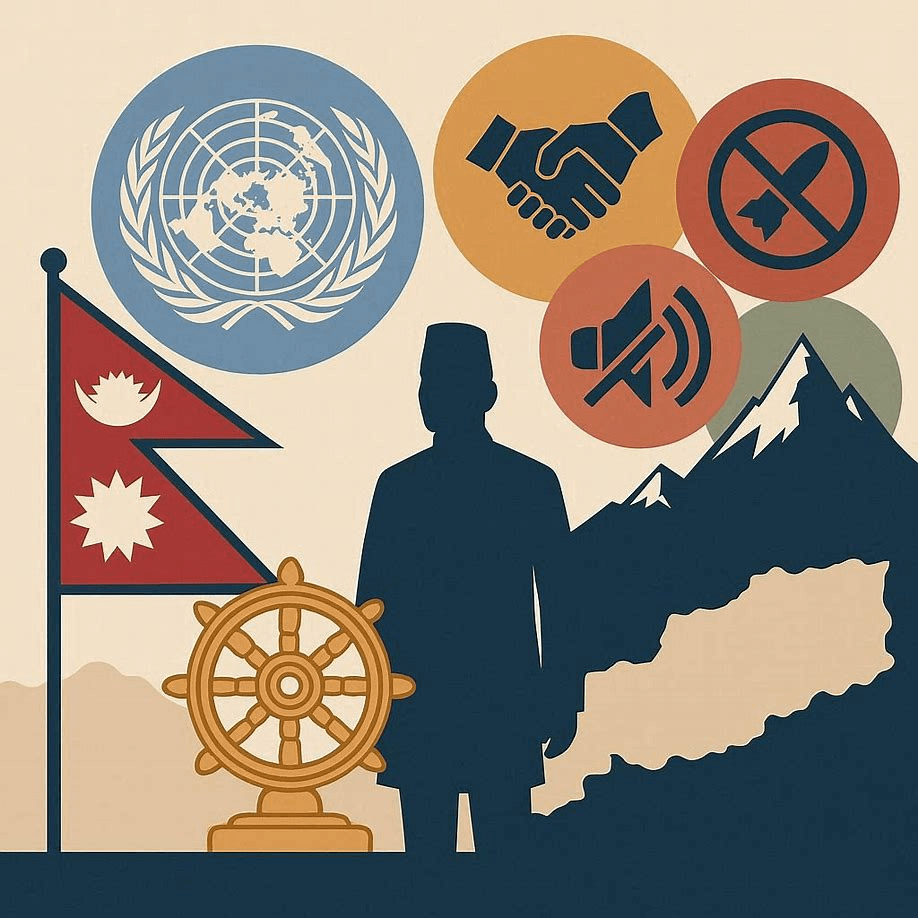
The contemporary global order navigates a complex transition, demonstrating less a clear multipolar system and more a volatile process of “multipolarization,” characterized by a diffused distribution of power yet simultaneously afflicted by acute polarization, both international and domestic.
This environment sees a greater number of state and non-state actors wielding influence over critical global issues, significantly increasing the operational complexity for strategically situated small states such as Nepal.
While a multipolar landscape presents theoretical opportunities for diversification and increased political agency, heightened competition among rising “poles” and their distinct order models actively impedes joint global responses to shared threats, demanding that Kathmandu adopt a meticulous and unified foreign policy posture.
Given that few states currently pursue policies focused purely on the common good—and internal political divisions further complicate such attempts—Nepal’s primary diplomatic challenge involves translating its principled non-alignment stance into practical strategies that actively safeguard national interest and foster a constructive path toward international depolarization.
In an era where geopolitical rivalry amplifies external pressure, these historical doctrines transition from abstract ideals into active diplomatic tools, establishing the necessary moral and legal foundation to repel undue pressure and justify neutrality.
Furthermore, the constitution mandates the review of historical treaties and the formation of new agreements based solely on equality and mutual interest. Successfully defending the doctrine of non-interference requires robust institutional mechanisms and political consensus, ensuring that foreign policy decisions maintain fidelity to these core tenets regardless of transient political transitions.
Navigating the strategic dynamics between India and China compels Nepal to employ a sophisticated hedging strategy, rejecting conceptually flawed arguments for “soft-balancing”. This approach seeks to maximize benefits from both neighbors without formalizing alignment or incurring excessive dependency on either, viewing engagements like the Millennium Challenge Corporation (MCC) compact primarily as diversification measures rather than ideological commitments.
Historic frustrations stemming from unsolicited Indian interference, vividly recalled through the 2015 unofficial economic blockade, propelled Nepal to diversify its economic and transit dependencies toward China. However, the strategic imperative demands calculated prudence; actions such as initiating the cartographic dispute or pursuing deeper connectivity with China must be meticulously managed to avoid conveying signals of alignment, particularly amidst heightened Sino-Indian tensions.
Securing genuine economic autonomy—by fully operationalizing transit treaties and diversifying trade routes and partners —constitutes the most effective long-term security measure against unwanted external political intrusion, structurally reinforcing political non-alignment.
Critically, the successful execution of Nepal’s external hedging strategy relies fundamentally upon achieving domestic political cohesion, as internal fragmentation represents the single largest operational vulnerability. Nepali politics often displays a multi-polar course, creating factional rivalry that warps the cohesive process of governance. Geopolitical competition actively exploits this internal instability, fueling societal cleavages and ethnic polarization.
When political factions utilize anti-neighbor rhetoric or assign external blame for domestic gain, it undermines Nepal’s diplomatic credibility and provides external powers with explicit entry points for interference, thus challenging the integrity of non-interference principles.
Therefore, policy recommendations prioritize the insulation of strategic foreign policy decisions from partisan squabble through institutionalized consensus-building mechanisms, transforming policy unity into the prerequisite defense against external influence. Furthermore, institutionalizing evidence-informed policymaking, recognizing think tanks as crucial contributors, ensures strategic clarity and consistency across administrations.
The impending Least Developed Country (LDC) graduation scheduled for November 2026 introduces a critical economic deadline that demands aggressive and focused economic diplomacy. This transition risks the loss of preferential market access and key technical assistance. Economic resilience therefore becomes the vanguard of sovereign capability.
Nepal’s smooth transition strategy prioritizes robust trade and investment measures, compelling diplomatic missions to expedite foreign direct investment (FDI) mobilization and market exploration. Key actions include simplifying export and import procedures, operationalizing the Nepal National Single Window System, and significantly strengthening institutional capacity for Rules of Origin (RoO) compliance, while simultaneously negotiating less stringent RoO with major partners.
Moreover, the diversification of high-value exports, specifically electricity, leverages Nepal’s hydropower potential to establish leverage in regional trade. Accelerating engagement in regional economic blocs like BIMSTEC and RCEP secures the necessary preferential market access required for sustainable growth post-2026.
As major powers intensify competition, joint action on existential global crises like climate change falters; Nepal assumes a crucial role in initiating a process of depolarization by leveraging its moral authority on shared global threats. Despite contributing negligibly to global greenhouse gas emissions (approximately 0.1 percent), Nepal faces disproportionate and devastating climate impacts, demonstrating acute climate injustice.
Nepal’s submission to the International Court of Justice (ICJ) powerfully frames the obligations of states through the lens of human rights and ethical governance, asserting the principle of Common but Differential Obligation (CBDR). This stance demands that obligations relate to historic emissions contributions and economic status, reframing necessary assistance from developed countries not as charity but as compensation for environmental damage.
By transforming climate change from a divisive environmental policy issue into a universally recognized human rights imperative focused on intergenerational and intragenerational equity, Nepal carves out independent diplomatic space and compels global engagement toward collective action.
In synthesis, navigating the turbulent waters of global multipolarization requires Nepal to adopt a strategic posture defined as Assertive Prudence. The highest priority remains the mitigation of domestic polarization, transforming policy unity into the structural firewall against external geopolitical exploitation. Concurrently, aggressive, deadline-driven economic diplomacy must secure resilience post-LDC graduation, treating connectivity diversification as a core component of national security.
Finally, Nepal must assert its principled voice on the global stage, leveraging its moral authority on climate injustice to advance shared global governance outcomes, thereby actively contributing to the necessary depolarization of international discourse. The consistent, principled, and unified application of its founding doctrines offers the most viable path toward sustainable sovereignty and enhanced national dignity in this changing world.
I have been working on the trends of the Nepalese Foreign Policy as the existing global order gets gradually altered in 21st century world ..
I have been working on the trends of the Nepalese Foreign Policy as the existing global order gets gradually altered in 21st century world. I am an MA in English and MPhil in International Relations a...
@ Copyright matrikapoudyal.com All Rights Reserved
Designed by Fortune Info Tech