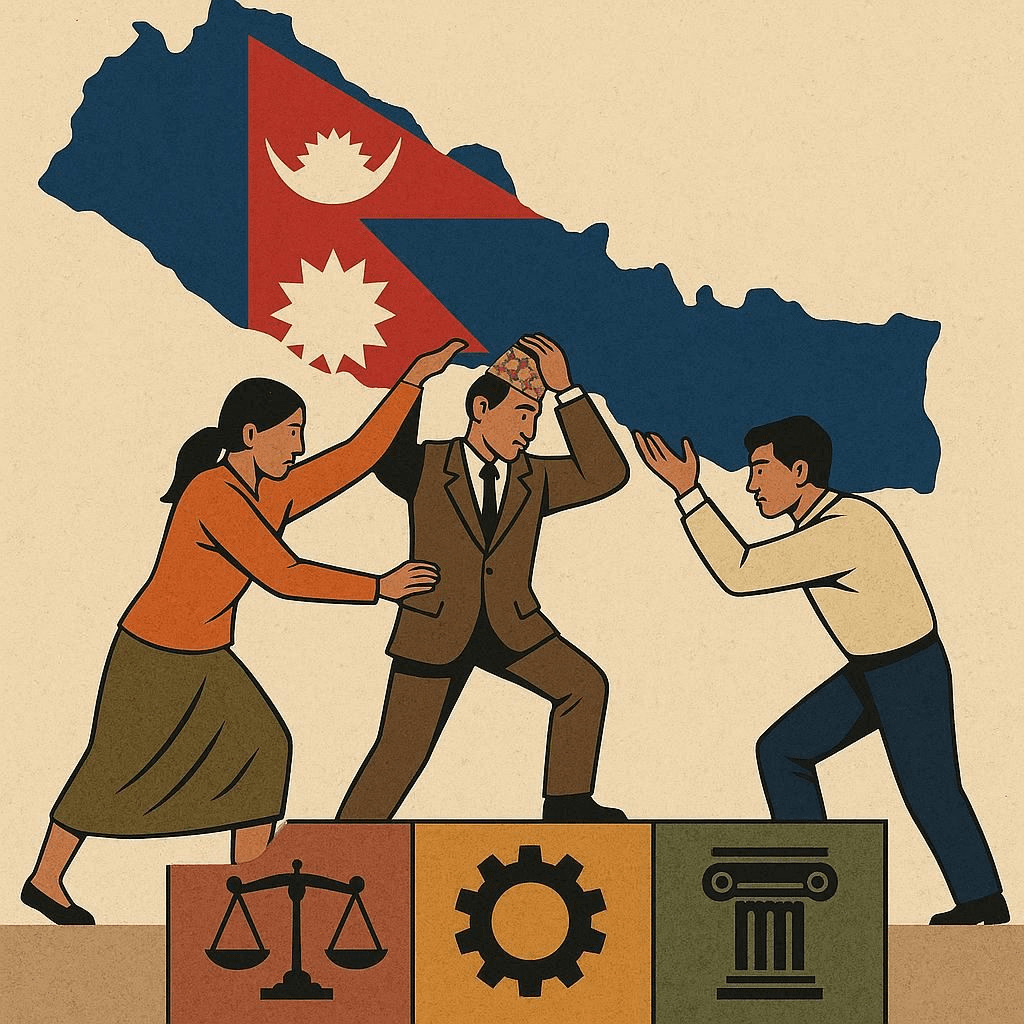
Nepal’s Geopolitical Pivot in the 21st Century
Nepal now navigates a perilous geopolitical landscape, defined by the West’s perceived retreat from its own proclaimed rules-based order. Consequently, this Western inconsistency creates a profound dilemma for Kathmandu.
Revisionist powers, notably China, expertly weaponize this hypocrisy, leveraging such criticisms not to strengthen international law, but to legitimize their own coercive agendas and dismantle normative constraints.
Critically, global geopolitical competition aggressively fractures the liberal international order, demanding that buffer states like Nepal confront systemic normative decay. Nepal, historically likened to a “yam squeezed between two giant boulders”—India and China—occupies a critical buffer position.
This systemic erosion compels Nepal to shift from principled non-alignment toward purely transactional strategies , transforming the nation into a geopolitical “focal point” where great power rivalry intensely converges.
Small states fundamentally rely on stable rules to restrain great power politics , meaning this normative decay profoundly compromises Nepal’s systemic security.
Critics widely allege that U.S. foreign aid prioritizes American strategic interests over recipient nations’ practical development needs. The $500 million Millennium Challenge Corporation (MCC) compact in Nepal clearly illustrates this tension.
The controversy escalated due to the compact’s perceived linkage to the U.S. Indo-Pacific Strategy (IPS), viewed locally as a mechanism for containing China.
Opponents framed this conditionality as an attempt to compel Nepal into a security alliance, fundamentally compromising its enshrined non-aligned foreign policy. In effect, this decision to embed strategic conditionality within crucial development financing transforms aid into a strategic weapon.
Ultimately, this maneuver validates the perception that Western actions prioritize egoistic national security interests, confirming the cynical allegation that universal principles merely mask great power pursuits.
This normative corrosion accelerates the ideological cover used by competitors to legitimately dismiss concerns about their own geopolitical opportunism, intensifying the competition in Nepal’s strategic space.
Responding forcefully, facing intense political opposition and pervasive concerns over potential foreign legal overrides, the Nepali Parliament ratified the MCC compact in 2022 only by affixing a critical 12-Point Interpretative Declaration.
This Declaration functions as a proactive defense mechanism, meticulously outlining the limits of Nepal’s commitment. Key stipulations explicitly declare that Nepal rejects alignment with the IPS or any other military alliance.
Crucially, the Declaration mandates the supremacy of the Constitution of Nepal over the Compact and any related agreements, effectively negating any clause that might compromise national laws.
Nepal successfully compels the asymmetric donor to acknowledge sovereign constraints, embracing the transactional economic benefits—developing vital infrastructure and power grids—while rigorously rejecting the associated strategic normative package.
This sophisticated political dexterity demonstrates the state’s capacity to exploit the fine print of international agreements, converting institutional rigidity into a shield.
Conversely, Nepal maintains profound economic vulnerability to India, generating extensive trade deficits and robust political dependencies. This chronic asymmetry renders Nepal intensely susceptible to localized coercive pressure.
India’s entrenched interventionism historically pervades Nepal’s political sphere, ranging from mediating constitutional changes to imposing economic blockades, treating Nepal as a “junior partner”.
This systematic, geographically concentrated rule revisionism severely limits Kathmandu’s geopolitical autonomy. Indian strategic interests often benefit from Nepal’s perennial internal instability, political fragmentation, and endemic bureaucratic failure.
Therefore, India capitalizes on this vacuum, seizing major hydropower contracts and increasing control over Nepal’s crucial energy sector, ensuring the internal vulnerability necessary for asymmetric control. This continuous interference prevents the development of political cohesion, which analysts confirm remains vital for asserting leverage in foreign policy.
In a different strategic vein, China promotes projects under the Belt and Road Initiative (BRI), emphasizing infrastructural development—including transportation corridors, railways, and power grids—to transform Nepal from a landlocked into a land-linked nation. China’s geoeconomic strategy aims to facilitate connectivity while potentially reducing Nepal’s profound trade dependency on India.
However, despite signing the BRI framework in 2017, Nepal demonstrates intense caution toward implementation, effectively stalling tangible project advancement for years. Critically, Nepal explicitly ruled out taking loans under the initiative, insisting projects move forward only on the basis of grants and mutual consensus.
This tactical differentiation signals that Kathmandu views external rule revisionism not monolithically, but as distinct, quantifiable risks requiring separate, measured strategies.
By refusing BRI loans, Nepal avoids the primary mechanism of Chinese strategic leverage globally, sidestepping the debt-trap narrative through rigorous financial pragmatism, successfully restricting China’s strategic vision to a low-risk, grant-based transaction.
Fundamentally, Nepal’s foreign policy structure—defined by simultaneous, contradictory engagement with the U.S. (MCC), strategic restraint with China (BRI), and continuous management of Indian pressure—collectively constitutes a sophisticated ‘hedging’ strategy.
This pragmatic, transactional diplomacy functions as the functional replacement for traditional non-alignment in a system lacking normative stability. By championing genuine multilateralism, Nepal reinforces its own sovereignty.
This strategy successfully navigates power asymmetry by harnessing distinct benefits from varied actors, exploiting differences between rivals to avoid singularity, and offsetting dependency on one power through calculated alignment with another.
Nepal successfully leverages its immense hydropower potential—a critical national asset—as a geopolitical fulcrum, selling power to India while planning cross-border transmission lines to facilitate eventual connection with China.
However, hedging inherently generates friction among great powers, raising the critical risk that Nepal might be forced to choose sides if rivalry intensifies.
The nation’s survival hinges on its ability to navigate this schism, transforming the crisis of principles into an opportunity to assert its own indispensable agency.
Ultimately, Nepal’s survival mandates rigorous adherence to pragmatic diplomacy, abandoning expectations that external powers will revert to principled normative consistency.
The great power dilemma dictates that Kathmandu must focus purely on strengthening national capacity to manage external risks. External geopolitical tensions directly catalyze internal instability and societal fragmentation.
Therefore, effective geopolitical resilience hinges fundamentally on forging genuine, cross-party consensus regarding core foreign policy objectives. The failure to decentralize political authority and manage endemic corruption critically compromises the state’s capacity to deploy effective strategic policy. Nepal transforms its vulnerable geographic position into a “land-linked” strategic asset by consistently adhering to transactional diplomacy.
The nation’s future relies upon political leadership demonstrating the discipline to elevate national interests above partisan alignment, fortifying domestic cohesion as the indispensable defense against external rule revisionism and the corrosive effects of global normative decay.