




I have been working on the trends of the Nepalese Foreign Policy as the existing global order gets gradually altered in 21st century world ...

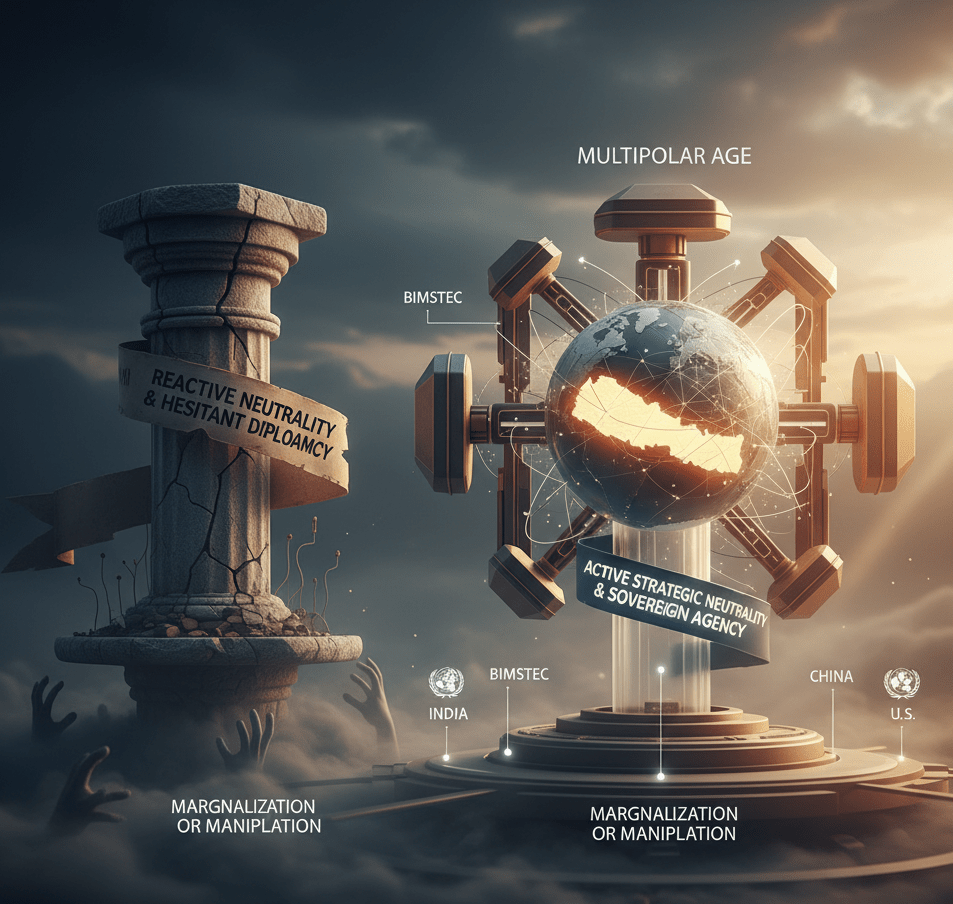
The contemporary political landscape of Nepal finds itself at a critical juncture, reminiscent of a master architect poised before a complex and unfinished edifice.
The foundational pillars of the 2015 Constitution, representing a hard-won consensus, have been erected, yet the superstructure of a stable, prosperous, and just Nepal remains incomplete.
The recent Gen-Z Movement has functioned as a powerful seismic event, not to topple the foundation, but to reveal with stark clarity the structural stresses and unresolved tensions within the political framework.
It has illuminated the pressing necessity for a comprehensive political accord—a grand blueprint that transcends partisan interests to secure the nation’s long-term socio-political and economic stability.
The dynamism and legitimate aspirations channeled through the youth-led demonstrations underscore a fundamental disconnect between the governing apparatus and the governed. This is not merely a crisis of administration but a deeper constitutional and social dissonance.
The existing political modalities, while procedurally democratic, have proven insufficient in addressing the granular grievances related to federal implementation, equitable resource distribution, and meaningful inclusion.
Consequently, the body politic exhibits symptoms of chronic instability, where short-term governmental survival consistently supersedes the long-term national interest, thereby perpetuating a cycle of underperformance and public disillusionment.
Economically, the repercussions of this political inertia are both profound and debilitating. Investor confidence, the lifeblood of any developing nation, remains contingent upon predictable and coherent policy environments.
The current climate of perpetual negotiation and latent crisis fosters capital flight, discourages foreign direct investment, and stifles the entrepreneurial spirit essential for growth. A nation cannot chart a course for economic prosperity when its political helm is subject to constant and erratic shifts.
A comprehensive accord would serve as a national anchor, providing the predictability required for strategic economic planning, infrastructure development, and the sustainable harnessing of human and natural capital.
Therefore, the pursuit of a comprehensive political accord is not a concession but a strategic imperative. It necessitates a return to the spirit of the peace process—a grand dialogue where all significant stakeholders, including the government, opposition parties, sub-national entities, and representatives of civil society, engage in good faith.
The objective must be to address the substantive lacunae in the federal compact, refine the mechanisms of governance to enhance accountability, and forge a consensus on a national vision that is both aspirational and actionable. This process demands diplomatic finesse, academic rigor in policy formulation, and a willingness to embrace pragmatic compromise.
One might consider the analogy of a symphony orchestra. A nation’s diverse political parties, ethnic groups, and socio-economic interests are its individual musicians, each possessing unique talent and a vital part to play.
Without a shared score—a comprehensive accord—the result is dissonance and cacophony, where individual brilliance is lost in a contest of volume. The conductor, representing the state’s institutions, requires a unified score to harmonize these efforts.
A new, detailed accord would be that score, enabling each section to contribute its distinct voice to a cohesive, powerful, and moving national symphony, rather than a collection of competing solos.
The implementation of such an accord would catalyze a virtuous cycle of stability and progress. Political predictability would bolster economic confidence, leading to job creation and improved public services. This, in turn, would reinforce social cohesion and strengthen the public’s faith in democratic institutions.
By proactively constructing this framework, Nepal’s leadership can demonstrate a masterful statesmanship that not only responds to the immediate calls for reform but also anticipates the challenges of the future. It is an opportunity to transform the energy of the Gen-Z Movement from a force of critique into a cornerstone of a renewed national compact.
In conclusion, the historical moment demands courage, vision, and an unwavering commitment to the collective good. The edifice of the new Nepal stands awaiting its final form. The blueprint of a comprehensive political accord is the indispensable tool required to complete this great work.
Let the political leadership of Nepal now take up this task with the gravity and foresight it deserves, ensuring that the nation’s journey is not one of navigating perpetual crises, but of marching confidently toward a destiny of enduring stability, equity, and prosperity.
The world watches, hopeful that Nepal will once again demonstrate its remarkable capacity for renewal and consensus.
I have been working on the trends of the Nepalese Foreign Policy as the existing global order gets gradually altered in 21st century world ..
I have been working on the trends of the Nepalese Foreign Policy as the existing global order gets gradually altered in 21st century world. I am an MA in English and MPhil in International Relations a...
@ Copyright matrikapoudyal.com All Rights Reserved
Designed by Fortune Info Tech
One comment
Very fantastic and highly motivational in effect