Mutation in Nepali Politics
The contemporary Nepali state occupies a state of profound liminality, characterized by a fundamental mutation of its political culture that transcends mere administrative transition.
This metamorphosis manifests as a convergence of structural economic precarity, the exhaustion of the post-uprising ideological settlement, and the emergence of a radicalized, digitally-mediated youth subjectivity.
The systemic instability observed in late 2024 and 2025, culminating in the resignation of Prime Minister KP Sharma Oli and the appointment of former Chief Justice Sushila Karki as interim leader, signifies more than a cyclical cabinet reshuffle. Rather, it reflects the collapse of a transnational social contract wherein the state leveraged labor migration as a safety valve for political acquiescence.
The economic foundation of the Nepali state relies precariously upon the systematic exportation of human capital, a phenomenon that engenders a unique form of remittance-rentierism. Remittances currently contribute approximately 30 percent of the national Gross Domestic Product (GDP), a figure that underscores a structural dependency unparalleled in the region.
This reliance functions as a double-edged sword, providing macro-economic stability through foreign currency inflows while simultaneously hollowing out the domestic productive sector.
The state fails to channel these resources into sustainable industrial or agricultural sectors; instead, remittances primarily fuel immediate household consumption, reinforcing a dependency syndrome that has seen a ten-fold increase in people leaving to work abroad since 2000.
The transnational social contract conceptualizes a governance model where the state facilitates labor emigration in exchange for domestic political acquiescence.
This model effectively de-territorializes welfare provision, shifting the burden of social security from the state to the individual migrant’s remittances.
In the early 21st century, the government responded to the Maoist insurgency by accelerating this export of youth, effectively removing potential revolutionaries from the domestic theater.
However, this system possesses an inherent fragility; any contraction in the global labor market or domestic political shock precipitates catastrophic economic fallout, as demonstrated by the $22.5 billion loss during the 2025 unrest.
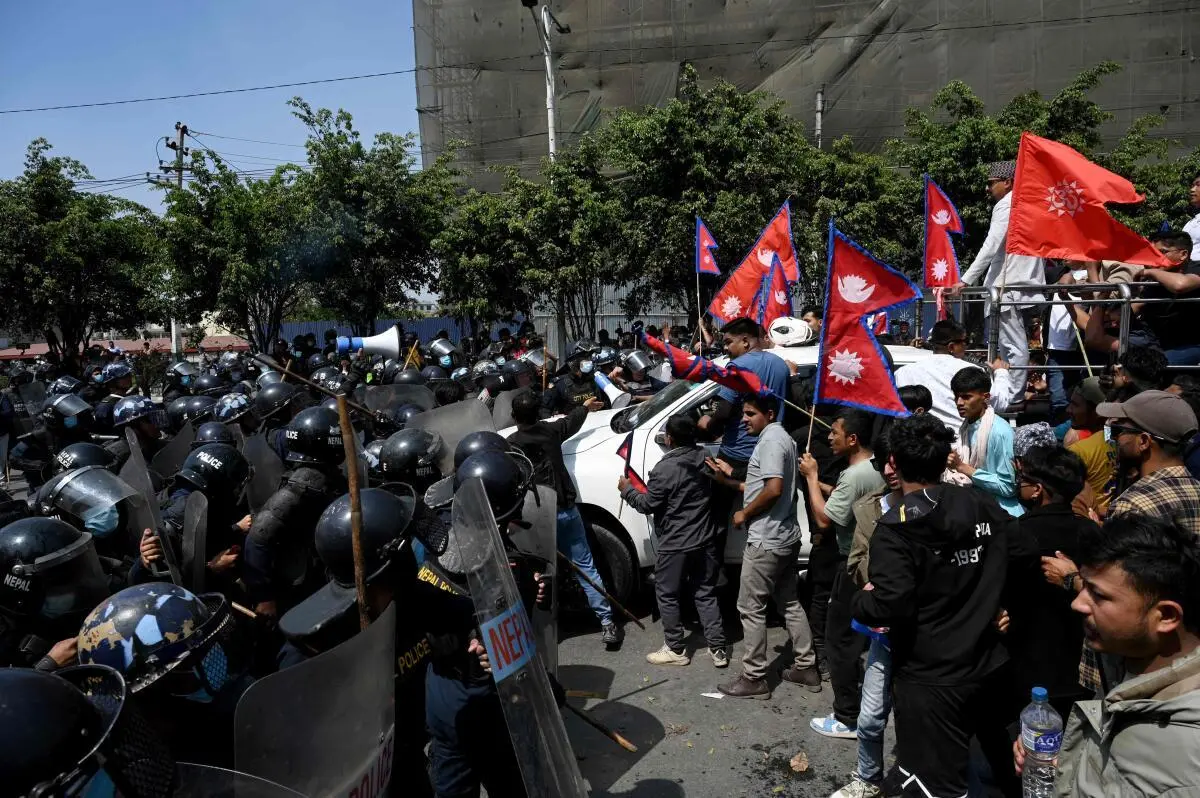
The September 2025 protests represent a critical rupture in the historical continuity of Nepali social movements, emerging from a decentralized, digital grassroots.
Unlike the 2006 Jana Andolan, this uprising was spearheaded by Generation Z, signaling a new political subjectivity that rejects both the traditional democratic camp and the communist legacy.
The tipping point involved the government’s decision to ban 26 social media platforms, an act of digital repression that backfired. Young activists utilized VPNs and platforms like TikTok to organize flash mobs, evolving the movement from a protest against internet restrictions into a broader indictment of systemic corruption and economic precarity.
The demographic core of this movement consists of the “educated unemployed”—a burgeoning group whose middle-class aspirations remain unfulfilled by an import-based economy.
This group identifies a sharp contrast between their own precarity and the lifestyles of the political elite’s “nepo babies,” who flaunt wealth in the same digital spaces frequented by the marginalized.
This frustration generates an angry, aspirational, yet fragile subjectivity that seeks a post-elite, egalitarian system. The use of digital savvy and decentralized organization made the 2025 protests harder for the regime to repress than traditional, hierarchy-driven movements, forcing entrenched elites to confront a gap between state performance and citizen expectations.
Nepal’s transition to a federal democratic republic in 2015 aimed to deconstruct the centralized structure that fueled a century of marginalization, yet the practical application has mutated into a transactional model.
The federal center in Kathmandu maintains an iron grip on resources through the continued use of the Civil Service Act of 1992, which denies provinces the authority to recruit their own staff.
Furthermore, the federal government maintains the position of the Chief District Officer (CDO), a representative of the central executive who frequently overrides elected local leaders. This “hourglass-shaped” model leaves the provincial tier starved of resources, with 91 percent of education budgets predetermined by the center.
The mutation of Nepali political culture also includes a pronounced democratic backsliding and the judicialization of politics. As the legislative and executive branches succumb to chronic instability—exemplified by 14 governments since 2008—the judiciary is frequently drawn into political crises to act as a referee.
The appointment of former Chief Justice Sushila Karki as interim Prime Minister in 2025 underscores this reliance. While intended to provide a break from corrupt partisan leadership, it risks blurring the lines between branches of government.
Analysts increasingly categorize Nepal as a hybrid regime where formal institutions coexist with authoritarian modes of governance and systematic discrimination against Dalit and indigenous populations.
Nepal’s domestic mutations remain inseparable from its status as a buffer state between India and China, and the increasing involvement of the United States. Foreign policy has transitioned from traditional equidistance to a dynamic geostrategic balancing strategy.
China’s Belt and Road Initiative (BRI), including projects like the Pokhara International Airport, focuses on deepening connectivity to Chinese markets, while the US-led Millennium Challenge Corporation (MCC) grant serves as a strategic counterweight.
This competition for influence makes Nepal a flashpoint for great power rivalry, where domestic instability is often exacerbated by external actors hedging their bets on different political elites.
The 2025 mutation indicates that the safety valve of out-migration has exhausted its utility, leaving the state to face a mobilized generation that rejects hybrid democracy. The path forward requires a transition from transactional governance to a performance-oriented system that can translate the promises of the 2015 Constitution into tangible economic security.
The transition between the 2006 Jana Andolan and the 2025 youth-led protests represents a shift from structured, party-led ideological warfare to decentralized, digitally-mediated demands for systemic accountability.
While the 2006 movement was defined by a formal alliance between the Seven Party Alliance and the Maoists to dismantle the monarchy and establish a republic, the 2025 uprising emerged as a post-ideological rupture led by Generation Z against the very elites who rose to power after 2006.
Failure to restructure the civil service, decentralize fiscal control, and channel remittances productively will likely result in a continued cycle of regime collapse. The digital sphere has shattered the information monopoly of the elites, and the demand for transparency and a genuine devolution of power can no longer be ignored by the traditional political syndicate.