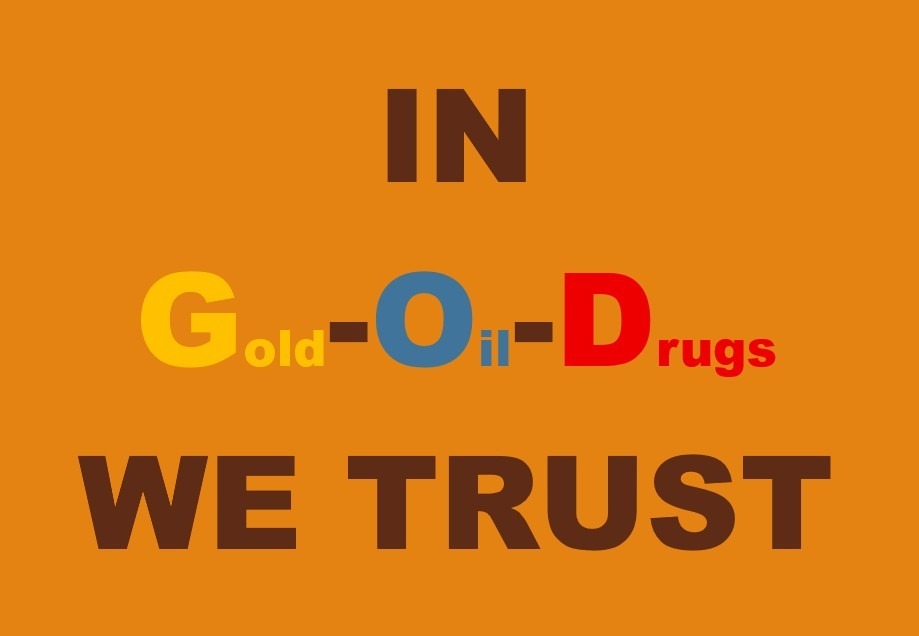
IN GOD WE TRUST
Gold, Oil, and Drugs function as three of the most powerful levers of wealth, power, and geopolitical leverage in the contemporary world economy because each of them concentrates value, can be mobilized across borders, and alters macroeconomic and political equilibria in ways few other commodities achieve.
Their centrality emerges not from metaphor but from measurable effects on growth, financial stability, state capacity, and conflict dynamics in economies such as the United States, China, Russia, and India.
Gold, oil, and drugs share structural properties that explain their persistent centrality despite technological change and financial innovation. These properties create powerful incentives for states to protect, accumulate, and weaponize them.
High value-to-weight ratios and ease of transport permit rapid mobilization of liquidity or political financing, especially for drugs and, to a lesser extent, gold.
Global demand remains relatively inelastic in the short run for oil and many narcotics, which stabilizes or amplifies revenue streams even when prices or enforcement regimes fluctuate.
Denomination and settlement in major reserve currencies plug these commodities directly into the international monetary system, magnifying their macroeconomic impact.
In addition, gold behaves as a safe‑haven asset, absorbing capital in periods of financial stress, while oil constitutes the backbone of modern energy systems and illegal drugs operate as a parallel, untaxed export sector in several fragile states.
Gold retains monetary and psychological salience because it stabilizes portfolios and central bank reserves in the face of financial crises and inflationary shocks. Its role relies on empirically documented hedging and safe‑haven properties.
Historical and contemporary analyses show that during crises—such as the global financial crisis and the COVID‑19 shock—investors reallocate from equities and often from oil to gold, which displays negative or low correlation with risky assets and buffers portfolio losses.
Time‑series models, including VAR and ARDL frameworks, indicate that gold prices respond asymmetrically to oil volatility and geopolitical risk, with gold frequently appreciating when oil markets experience destabilizing shocks.
Central banks in the United States, China, Russia, and India therefore use gold as a strategic reserve component, not to back currency mechanically but to diversify away from dollar and euro liabilities, hedge sanctions risk, and signal financial strength.
Empirical work on the direct economic impact of gold further documents its contributions to employment, value added, and export receipts in producing and refining economies.
Oil underpins industrial production, global trade, and military capability, which explains why every large state treats it as a strategic asset rather than a normal commodity. Even with gradual decarbonization, oil intensity still shapes the vulnerability of national income to supply disruptions.
Econometric studies consistently find that oil price shocks influence GDP growth, inflation, and stock market dynamics, with effects varying between net importers and exporters. For BRICS and G‑7 economies, co‑movement between oil prices and inflation persists in the presence of geopolitical risk.
Recent work on volatility spillovers shows that oil shocks transmit instability to equity and commodity markets, while gold often emerges as a net receiver or transmitter of shocks depending on the volatility regime, illustrating deep financial interconnectedness.
In the United States, domestic shale production has transformed the country from a highly vulnerable importer into a major producer, yet research still identifies one of the highest oil intensities of GDP among advanced economies, which maintains sensitivity to global price swings.
China, as the world’s largest oil importer, uses long‑term supply contracts, overseas investment, and diplomatic leverage to secure flows from the Middle East, Russia, and countries such as Venezuela, revealing oil’s role in its broader geopolitical strategy.
Russia and several OPEC states utilize oil exports, pricing, and output coordination as macro‑stabilization tools and as instruments of foreign policy, while India faces a permanent trade‑off between import dependence, subsidy costs, and growth.
Illegal drugs differ from gold and oil by their prohibition status, yet political‑economy research shows that narcotics behave like a high‑value natural resource whose rents reshape governance and conflict. This “narco‑resource” logic explains why some states tacitly tolerate or actively exploit drug economies.
Resource‑curse literature identifies narcotics alongside diamonds and gemstones as “lootable” resources: they have high value‑to‑weight ratios, can be extracted and trafficked by decentralized actors, and correlate with non‑separatist civil wars and criminal violence.
Empirical surveys demonstrate that in several countries, including Afghanistan, parts of Latin America, and some African states, drug revenues finance insurgent groups, corrupt security forces, and substitute for weak tax systems, thereby distorting state formation and public investment.
Recent analysis of Venezuela’s crisis illustrates how illicit activities—including drug trafficking—have supplied a large share of export earnings and government‑linked income, at times accounting for double‑digit percentages of GDP and a majority of foreign‑currency inflows.
In Mexico and other transit countries, U.S. enforcement against cocaine and synthetic opioids has pushed traffickers to diversify routes and products, generating complex feedback loops between North American demand, organized crime, and state legitimacy.
Country lenses: USA, China, Russia, India
United States
The United States integrates all three “G‑O‑D” pillars into its economic and security architecture, albeit with divergent legality and institutional control. As issuer of the dominant reserve currency, the U.S. holds significant official gold reserves and hosts deep gold futures markets, which influence global pricing and hedging behavior.
Energy research highlights robust linkages between oil prices, U.S. inflation, and stock markets; U.S. shale capacity and strategic petroleum reserve policy therefore serve as macroeconomic stabilization instruments. At the same time, the U.S. bears the world’s largest market for many narcotics, and federal agencies deploy sanctions, interdiction, and extraterritorial prosecutions that tie drug flows to broader geopolitical objectives, as illustrated by pressure on Venezuela, Mexico, and others.
China
China’s approach reflects a developmental state that treats gold and oil as hedges against external vulnerability, while aggressively repressing domestic narcotics markets. Studies of Chinese stock sectors reveal dynamic spillovers between oil, gold, and equities, particularly during crises, underscoring Beijing’s concern with commodity-financial linkages and the use of gold as a diversification asset in portfolios and reserves.
China’s heavy oil import dependence motivates extensive lending, infrastructure investment, and political ties with producers such as Venezuela and Middle Eastern states, using oil‑backed loans and long‑term contracts to secure supply.
China’s role as a source of precursors or synthetic drugs in some markets, particularly fentanyl compounds, has generated international disputes and shows how chemical and pharmaceutical capacities intersect with illicit economies even under strong domestic control.
Russia
Russia exemplifies the dual nature of oil and gold as both macroeconomic buffers and geopolitical weapons.
Hydrocarbon exports provide a substantial share of fiscal revenues and foreign exchange, making oil prices central to Russian growth, exchange‑rate dynamics, and military spending.
Sanctions following geopolitical conflicts have pushed Russia to accumulate gold reserves and explore alternative payment systems, leveraging gold’s safe‑haven status and its potential role in de‑dollarization strategies. Narcotics trafficking through or around Russian territory poses security issues, but Russia operates more as a transit and consumption zone than as a primary narco‑producer, which differentiates its “G‑O‑D” profile from some developing states.
India
India’s configuration stands out because of cultural and household preferences for gold, structural dependence on oil imports, and a complex but less globally central narcotics sector. Indian households and firms collectively hold vast quantities of gold, treating it as a store of value, inflation hedge, and informal collateral; this practice links micro‑level portfolio behavior with macro‑level current‑account pressures via gold imports.
As a fast‑growing, energy‑intensive economy, India experiences substantial GDP and inflation sensitivity to oil prices, which shapes subsidy policy, exchange‑rate management, and its diplomacy toward Middle Eastern and Russian suppliers.
India functions as a producer of some precursor chemicals and as a transit and consumption market in regional drug networks, producing localized governance and public‑health stresses rather than the macro‑level dependence seen in classic narco‑states.
Economic logic: From enrichment to entrapment
The apparent “trust” in gold, oil, and drugs reflects rational, if often myopic, responses to structural incentives embedded in the global system. Gold enriches by preserving wealth through crises, lowering portfolio variance, and enhancing reserve credibility; however, excessive hoarding can crowd out productive investment and lock capital into non‑productive storage.
Oil enriches through export revenues, industrialization, and cheap energy but exposes economies to price volatility, Dutch disease, and decarbonization risk, especially when institutions fail to convert windfalls into diversified capital.
Drugs enrich specific networks—cartels, corrupt officials, armed groups—rather than societies as a whole, often intensifying violence, undermining taxation, and creating a perverse resource curse in which illicit rents replace broad‑based development.
The empirical literature on the resource curse underscores that institutional quality, financial development, and governance determine whether such commodities generate sustainable growth or chronic fragility.
G‑7 and some BRICS economies avoid the worst outcomes not because gold, oil, and drugs lack power, but because regulatory regimes, taxation systems, and central banks partially domesticate that power.
Hence, across the United States, China, Russia, India, and many other states, gold, oil, and drugs occupy privileged positions because they condense wealth, risk, and coercive capacity into portable and globally tradable forms that can be measured in macroeconomic aggregates, portfolio statistics, and conflict indicators.
Empirical research on safe‑haven behavior, volatility spillovers, and resource curses converges on a single logical proposition: these commodities do not intrinsically enrich nations; rather, they amplify the consequences—positive or negative—of pre‑existing institutional and geopolitical structures.
A strictly scientific reading therefore rejects any mystical interpretation of “G‑O‑D” and instead treats gold, oil, and drugs as strategic assets embedded in an uneven global system, where trust arises from observed hedging performance, energy indispensability, and the brute profitability of illicit markets.
Nations that wish to transform such volatile sources of rent into durable prosperity must invest in robust institutions, transparent fiscal frameworks, and diversified productive bases; without these, reliance on gold, oil, or drugs tends not toward genuine enrichment but toward cyclical vulnerability, political capture, and, in extreme cases, state erosion.