




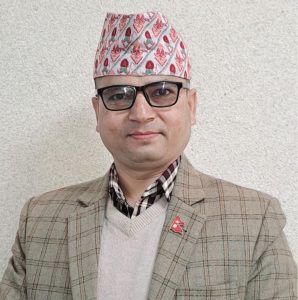
I have been working on the trends of the Nepalese Foreign Policy as the existing global order gets gradually altered in 21st century world ...

Matrika, an eleven-year-old Brahmin boy from Soltibazar in Sarlahi, still small enough to chase dragonflies, ride the patient water buffaloes, and swim laughing through sunlit forest streams—yet large enough to dream beyond the horizon, where wonder met the unknown and called him by name, thought to leave the comfort of home one day.
He was his mother’s most loved child, the first son but the sixth baby in a family of ten. In the early dawn, before the first light brushed the sky, his mother would bathe and begin her quiet rituals.
She cleaned the puja thali, the diyo, the pancha pala, the shankha and ghanta; she wiped the kalash, the karmapatra, and the dhoopauro until they gleamed softly in the flicker of lamp light. She washed the oven and the doorsteps, fetched sacred water from the well, and hummed the old verses under her breath. The scent of incense and the chill of the morning mixed gently as life stirred in every corner of the house.
His father, too, began his day before the sun. After his bath, he stood before the panchayan—Ganesh, Surya, Shiva, Devi, and Vishnu—and worshipped with patience and grace. The bell rang clear, the conch sounded deep; the house filled with the rhythm of prayer. He recited the Shreemadbhagwat Mahapuran, the Rudra Ashtadhyai, and the Durga Saptasati, each verse flowing like a river through the still air.
The world around Matrika was known—kind, repetitive, safe. The courtyard echoed with cows’ mooing, calves’ bells, and afternoon prayers; the farm breathed with green paddy; and the nearby woods smelled of damp leaves and monsoon secrets.
The world around him was known—kind, repetitive, safe. The home’s courtyard echoed with cows’ mooing, calves’ bells and afternoon prayers; the farm hummed with the green breath of paddy; the nearby woods smelled of damp leaves and monsoon secrets.
Each corner of his village had taught him something gentle: how smoke curls obediently to the gods during Panchayan worship; how the bazaar laughs on market days and sleeps on others; how temple bells swing slowly to call both faith and fatigue.
But that morning, one of the crispy chilling mornings, in February, 1987, something stirred within him—an invisible wind of bravery or restlessness that lifted his spirit from the ordinary. He no longer wanted to trace circles inside fences of familiarity.
His eyes, curious and clear as rainwater, searched toward the hills and beyond. He wanted to see where the road bent, how far the river ran, what lay beyond the whispered horizon that even grown men rarely questioned. That desire—naive, reckless, pure—became the first melody of his adventure.
He walked. Two hours under a sun too young to burn, too old to bless. The path wound through fields like a brown ribbon frayed at both ends. Dust rose around his heels, soft and faithful as old companions. His mind, however, sprinted far ahead.
Every shadow along the roadside carried a story; every birdcall sounded like guidance. The woods he passed still murmured his name, but he didn’t look back. Children who leave home for wonder rarely do.
By the time he reached the Mahendra Highway—the great East-West artery of Nepal—he felt both tiny and infinite. Trucks groaned past like metallic beasts, buses coughed smoke and promises, and he—one boy in a stringed kattu—stood between innocence and infinity.
A bus came, vibrant and loud, dust swirling like applause. His heart leapt ahead of reason. He boarded, whispering to himself that Kathmandu waited for him somewhere at the end of this moving dream.
The bus rattled, swayed, moaned—a theatre of motion and noise. Faces around him changed with every stop: merchants muttering in half-sung bargains, mothers chiding children, soldiers snoring against rattling windows.
To Matrika, they were not strangers but characters in an unfolding epic. The world he had imagined was alive, breathing beside him. Yet destiny, often cunning, had its own itinerary. The bus turned south instead of north.
The hills flattened; the air thickened with commerce and chaos. After half an hour from Pathlaiya the bus driver jammed on the brakes bringing the roaring giant to a halt. Matrika now could see the city of Birganj rose like an unforeseen destiny, humming and heaving with a life irrationally fast.
When he descended at Ghantaghar, the clock tower blinked over him like an iron eye. He was still smiling—at first—for he did not know he was lost. He reached into the narrow pocket of his kattu and counted his fortune: six quarters of Nepali currency-one and half rupees.
Enough to silence hunger for a moment, not enough to buy certainty. He bought a broiled corn from a roadside vendor; its smoke curled like memory. Each chew crackled warmth into the hollow of his stomach, and yet behind that small comfort hid a realization—he was utterly alone in a city that did not know his name.
Hours stretched and folded upon themselves like restless cloth. He waited by the roadside until the setting sun dipped like an ember behind roofs. Then came another bus, painted with the word “Gorkha.” Perhaps, he thought, if not the right road, it might still lead to something right. He climbed in without hesitation.
When the conductor came shouting for fare, he met the man’s anger with quiet eyes that neither begged nor resisted. His silence was wide, unscared, steady. It unsettled the conductor, who finally barked curses and walked away. Matrika’s face did not change; his hunger did.
Words of abuse were less painful than the twisting void in his belly. The bus carried him through twilight, hills gathering like beasts around the road, until it dropped him into Hetauda’s dust and noise. The night there smelled of industry and loneliness.
Shadows lengthened, streetlights flickered yellow and indifferent. He wandered through lanes with pockets empty but mind full—imagining, perhaps, that each turning could be a path back home, or forward toward something gentler.
In Hetauda he discovered the first true test of aloneness—not danger, but disregard. People passed, gazed, ignored. They spoke in voices half-curious, half-cruel, and none stopped to ask who this small boy was, barefoot and star-eyed.
Hunger had begun to speak louder now. It made his steps reel, his thoughts blur. Still, imagination burned stubbornly within him—bright, childlike, undimmed. He made stories from shadows: a stray dog became a guardian spirit; a broken bicycle wheel rolled like a sign from fate; even the chill wind carried messages only he could decode.
Hunger reduced his body, but it sharpened his seeing. When dawn crawled in, pale and reluctant, he found a bus to Narayanghat. He did not know where Narayanghat truly was—only that the name sounded kind, almost divine.
Perhaps the gods, he thought, had hidden his home under a different name and now called him toward it. Yet, before long, as fortune’s double-play would have it, a truck rumbled nearby, loaded with cement sacks and bound to Kathmandu. Its tailboard clanged like a challenge. He waited for no invitation. With a leap born of both courage and desperation, he climbed aboard.
The truck moved through serpentine roads where the Trishuli River coiled like a blue-green secret alongside. The river sparkled by day, glimmering like glass in the moonlight. Each turn of the road revealed the world both immense and indifferent.
Hills stood like ancient sentinels; wind screamed through gorges, a raw, rhythmic whistle. The cold deepened like unspoken truth, biting his skin, cracking his lips. Still, he watched—wide-eyed, half-frozen—as beauty and fear braided together before him.
The moon looked close enough to touch; he tried, once, stretching his small hand into the flapping air. In that gesture—brief, foolish, pure—was the whole theology of childhood: belief that the unreachable will bend if you are brave enough to reach.
The truck groaned upward through dark ridges, carrying within it a boy who was both pilgrim and dreamer. Beside him, the sacks of cement seemed like mountains asleep; beneath him, the earth reeled with distance.
He ate nothing, drank nothing, yet his imagination sustained him more than food could. He named the river “Companion,” the wind “Teacher,” the creaking truck “Friend.” The world, though vast and strange, now felt alive around him—hostile, but intimate.
When morning at last unclenched the sky, the truck neared the valley’s edge. The light turned silver, uncaring. The staff shouted for him to get off, voices rough as gravel. He obeyed softly, climbing down onto the cold earth of Kathmandu.
He had no welcome, no destination, no money. But he had arrived—whatever that meant to a heart that had once only dreamed of travel. His feet ached, his body shivered in thin clothes, and his stomach cried for something more than corn memory. Yet his eyes—those same clear eyes—still sparkled, not with triumph, but with understanding. For in one sleepless journey, he had seen the complexity of people—kindness mixed with cruelty, compassion mingled with contempt.
He had discovered that hunger was not only of the body but of the spirit—that some fires burn softly inside and refuse to die down, even when all else bends to the wind.
An eleven-year-old boy had wandered out of childhood and into wisdom. The world, with its indifferent vastness, had taught him more than school ever could. He had learned that courage is not loud; it often walks barefoot, in silence. That faith can exist without temples, that even hunger can hold beauty when one’s gaze is unbroken.
The Panchayan bells he once heard daily now rang differently inside him—not as ritual, but as memory of belonging. The truck’s screech, the river’s whisper, the moon’s pale pity—all had joined those bells in a new symphony of meaning.
When he looked back, years later, he would perhaps realize he was not lost that day—he was found. Found by the world, by truth, by the kind of grace that only suffering refines. The road, the bus, the truck, the hunger—all had been classrooms; each stranger, a rough teacher.
And though he returned someday to the same home and same hills, he was no longer the same boy. He had travelled beyond space into understanding—into the delicate knowledge that wonder always costs something, and that the price of knowing the world is losing the comfort of the known.
Matrika, the young son of a village priest, still felt the soft weight of his Yagyopabit grazing his chest—the sacred thread freshly blessed, a symbol of duty he scarcely understood but deeply cherished. Its white strands shone faintly in the dust of the road, reminding him of home, of purity, of prayers whispered at dawn.
Alone on his way to Kathmandu, without the shadow of kin beside him, hunger throbbed in his belly and sleeplessness carved silence into his bones. Yet, in that fragile ache, memory bloomed: his mother’s tender humming by the hearth, his father’s calm voice guiding chants, his sisters’ laughter chasing the newly born calves across their sunny yard.
Even the neighbors—each name, each face—rose in his heart like a procession of warmth. And there, amid fear and fatigue, the sacred thread became more than ritual—it became the invisible arm of home, pulling him gently through the vastness of the world.
I have been working on the trends of the Nepalese Foreign Policy as the existing global order gets gradually altered in 21st century world ..
I have been working on the trends of the Nepalese Foreign Policy as the existing global order gets gradually altered in 21st century world. I am an MA in English and MPhil in International Relations a...
@ Copyright matrikapoudyal.com All Rights Reserved
Designed by Fortune Info Tech