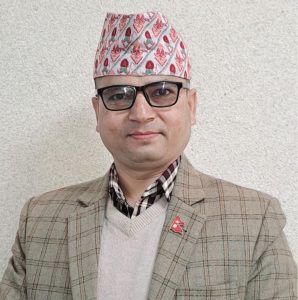
Gagan-Bishwa, the Icon for Democratic Nepal
Gagan Kumar Thapa and Bishwa Prakash Sharma today embody the most credible democratic alternative within Nepal’s contested political landscape, precisely because they seek to reform Nepali Congress from within while defending pluralism, constitutionalism, and accountable governance against both authoritarian drift and transactional coalitionism.
Their partnership offers a programmatic, institution-focused politics that stands in sharp contrast to the personality cults and ad hoc power bargains that characterize much of Nepal’s multiparty competition.
Gagan Kumar Thapa emerges not as a mere youth leader but as a system-builder forged through constituent assembly politics, parliamentary leadership, and executive responsibility.
From his early role in the First and Second Constituent Assemblies to his tenure as Health Minister, he consistently pressed for institutional solutions—stronger parliamentary committees, transparent regulatory frameworks, and credible crisis management—rather than episodic populist fixes.
The 14th General Convention of Nepali Congress, where he secured the highest number of votes among Central Working Committee members, formalized a generational mandate for internal reform and public-facing accountability, making him the pivotal figure in reorienting the party toward programmatic democratic renewal.
Bishwa Prakash Sharma complements Thapa’s institutional rigor with a disciplined political narrative that speaks to disillusioned youth, urban middle classes, and marginalized regions demanding a more responsive democratic order.
Both leaders rose from student politics and party organization, which grounds their rhetoric of reform in lived experience of party structures rather than abstract slogans. Their joint stewardship as General Secretaries, symbolized by the report they presented to the recent special convention and by high reformist vote tallies, signals a deliberate project: to transform Nepali Congress from an aging patronage network into a modern, rules-based, internally democratic party capable of defending the constitutional order.
The ongoing power struggle inside Nepali Congress does not simply reflect factional ambition; it represents a clash between a status quo leadership that treats the party as an electoral vehicle and a reformist bloc that insists on internal democracy as a precondition for national democratic consolidation.
Sher Bahadur Deuba’s reluctance to step aside even after Gen Z–driven protests and a clear reformist undercurrent reveals how deeply leadership inertia threatens to hollow out the party’s democratic credentials.
In response, Thapa and Sharma have chosen the most democratic instrument available—a special general convention, a reform report, and statute-based pressure—to enforce change through rules, not rupture, thereby demonstrating how internal party democratization can model constitutional behavior for the entire polity.
Within Nepal’s wider party system, Nepali Congress under a reformed, Thapa–Sharma-led direction would stand as the principal guardian of liberal democracy against two destabilizing tendencies: ideological rigidity and opportunistic fragmentation.
On one flank, left formations have oscillated between constitutional participation and centralizing impulses, repeatedly engaging in personality-driven splits and reunifications that prioritize tactical majorities over stable institutions.
On the other, emergent parties and identity-based platforms often channel legitimate grievances but rarely articulate coherent institutional blueprints, risking further volatility unless anchored by a mainstream, reformist democratic pole capable of absorbing demands through structured negotiation.
The Gen Z protests of September exposed a profound crisis of representation: young citizens no longer accept ritual elections without real accountability, transparent leadership turnover, and effective delivery. Thapa’s insistence that contesting elections under an unreformed leadership amounts to “political self-sabotage” captures the new democratic common sense: legitimacy now depends on both process and performance.
Sharma’s engagement with young professionals—from medicine to IT—through reform proposals underscores a deliberate attempt to link extra-party civic energy with intra-party transformation, thereby converting protest into structured democratic pressure rather than nihilistic rejection of politics itself.
For Nepal’s democratic future, the strategic importance of Gagan Kumar Thapa and Bishwa Prakash Sharma lies in their insistence that power must serve the constitution, not the other way around.
Their agenda—term limits in party statute, clearer internal rules, generational leadership renewal, and responsiveness to youth demands—directly reinforces habits that underpin independent institutions: regular leadership circulation, policy-based competition, and respect for internal procedural outcomes.
In a region where democratic institutions often erode through the slow normalization of impunity and personality rule, Nepal’s best guarantee against similar decay rests in leaders who voluntarily bind themselves to rules, tolerate intra-party contestation, and elevate the party from a patronage machine into a constitutional actor; in this respect, Thapa and Sharma stand not just as hopeful figures for Nepali Congress but as indispensable architects of Nepal’s democratic resilience.